
Apple has released Depth Pro 2, a new family of AI models that can look at an ordinary photo or video and tell you how far away everything in it is — in meters, not just “near” or “far.” Announced on November 20, 2026 by Apple Machine Learning Research, the release includes four open-weight models, a small tool that figures out a camera’s focal length on its own, and code on GitHub. The headline claim is that it solves a trade-off that has dogged depth estimation for years: keeping edges sharp while keeping video stable from frame to frame. Here is what Depth Pro 2 does, how the four models differ, and the one catch in the fine print.
What Is Metric Depth, and Why It Matters
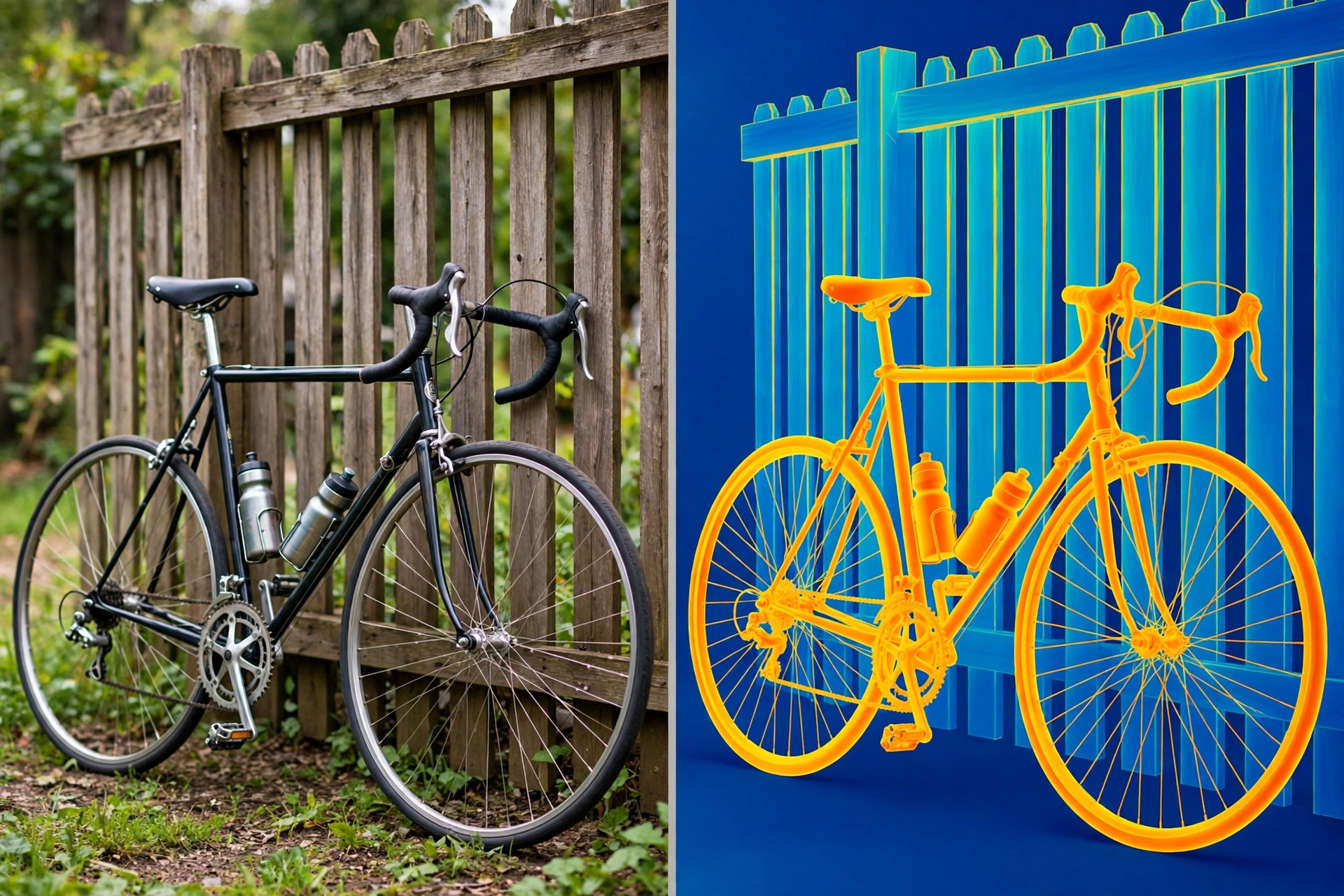
Most depth-estimation models output relative depth: they can say the bicycle is in front of the fence, but not that the bicycle is 2.4 meters away. Depth Pro 2 is a metric model, which means its depth maps carry real-world scale. That matters for anything that has to act on the world rather than just describe it — a robot reaching for an object, an augmented-reality app placing a virtual sofa in your living room, or a phone camera blurring a background convincingly. The original Depth Pro, released in 2024, already did this for single images, producing a 2.25-megapixel depth map in about 0.3 seconds on a standard GPU. Depth Pro 2 extends the idea to video and live camera feeds, at the input’s full resolution, using a single scalable network trained on clips of 1 to 32 frames.
Sharp Edges, Steady Video: What Depth Pro 2 Fixes
Earlier approaches forced a choice. Methods that processed several frames at once kept depth steady over time but smeared the edges of objects; methods that handled one frame at a time kept edges crisp but flickered as the video played. Apple’s paper, “Depth Pro 2: Sharp and Temporally Consistent Metric Monocular Depth,” says the new model gets both at once: depth maps that are metrically accurate, sharp, and temporally consistent, outperforming prior work on all three dimensions. The project page points to Boundary F1 — a measure of how well predicted depth edges line up with real object boundaries — as the metric where the improvement shows most clearly. In practical terms, that means fine structures like fence bars, bicycle spokes, and hair should hold their shape instead of melting into the background.
Four Model Sizes, From Laptop to Desktop GPU
Depth Pro 2 ships as four models, so users can trade quality against speed and memory. The smallest, S, has 24 million parameters and a 97 MB download, and the README suggests it for laptops and live use; the smallest model is reported to run at 53 frames per second on 1080p video. B steps up to 97 million parameters (386 MB), L to 334 million (1.3 GB), and the flagship H+ to 872 million parameters (3.5 GB), which is the default and the best quality, including native-resolution video. Alongside them sits a 23.5-million-parameter focal-length estimator that guesses a camera’s field of view when that information is missing — the trick that lets the models work on photos from any camera, not just ones with known settings. The code runs in bfloat16 on NVIDIA and Apple GPUs and in float32 on the CPU, Core ML exports are available, and the repo includes a Mac live-depth demo that needs Apple silicon, macOS 15 or later, and Xcode 16 or later.

Open Weights, But Not Open Source
This is the part to read carefully before building anything commercial on Depth Pro 2. The weights are public and the code is on GitHub, but the weights ship under the Apple Machine Learning Research Model license, which allows non-commercial research use only. That makes Depth Pro 2 “open-weight” rather than open source in the usual sense — a distinction that also applies to other open-weight models on the site, and one that matters the moment a project leaves the lab. The model card and README carry a 2026 copyright but no specific release date, and the paper is cited as a 2026 technical report; no benchmark numbers beyond the Boundary F1 claim have been published yet, so independent testing will have to confirm how the models perform outside Apple’s own evaluations.
What You Can Actually Do With It
For researchers and developers, the most immediate uses are straightforward: try the smallest model on a laptop with the command-line tool, feed it a photo or a clip, and see the depth map it produces. Beyond experimentation, the technology points at the places where Apple is already investing. Apple’s push to open Siri to developers and the arrival of iOS 26 show a company weaving AI deeper into its devices, and reliable on-device depth is a building block for AR, computational photography, and the kind of agentic assistant that needs to understand a room, not just a screen. It also fits a wider 2026 pattern: like the on-device AI chips and speed-focused AI models appearing across the industry, Depth Pro 2 is part of a shift toward AI that runs close to the user, fast, on ordinary hardware — no data center required for the smallest model.
How to Try Depth Pro 2
The code lives in the GitHub repository, with the weights on Hugging Face under the apple/DepthPro2 family — the full-size model is apple/DepthPro2-H. Clone the repo, pick a model size for your hardware, and the command-line tool will turn photos, video, or a live camera feed into depth maps. Start with the S model if you are on a laptop, and move up to H+ only if you have a desktop GPU and want the best quality. And check the license first: if your project is commercial, Depth Pro 2 as released is not cleared for that use, whatever the download page makes it look like.
Depth Pro 2 is a quiet release with a loud implication: a single camera, with no depth sensor and no special hardware, can now produce the kind of dense, stable, real-world depth map that used to need dedicated equipment. The models are free to try, the code is public, and the smallest one runs in real time on a laptop. The research-only license limits who can ship with it, but for anyone studying computer vision — or building the next generation of AR and robotics — Apple’s latest depth models are now one download away.
Sources: ExplainX’s breakdown of the Depth Pro 2 release and Daily AI Brief’s report on the new models.