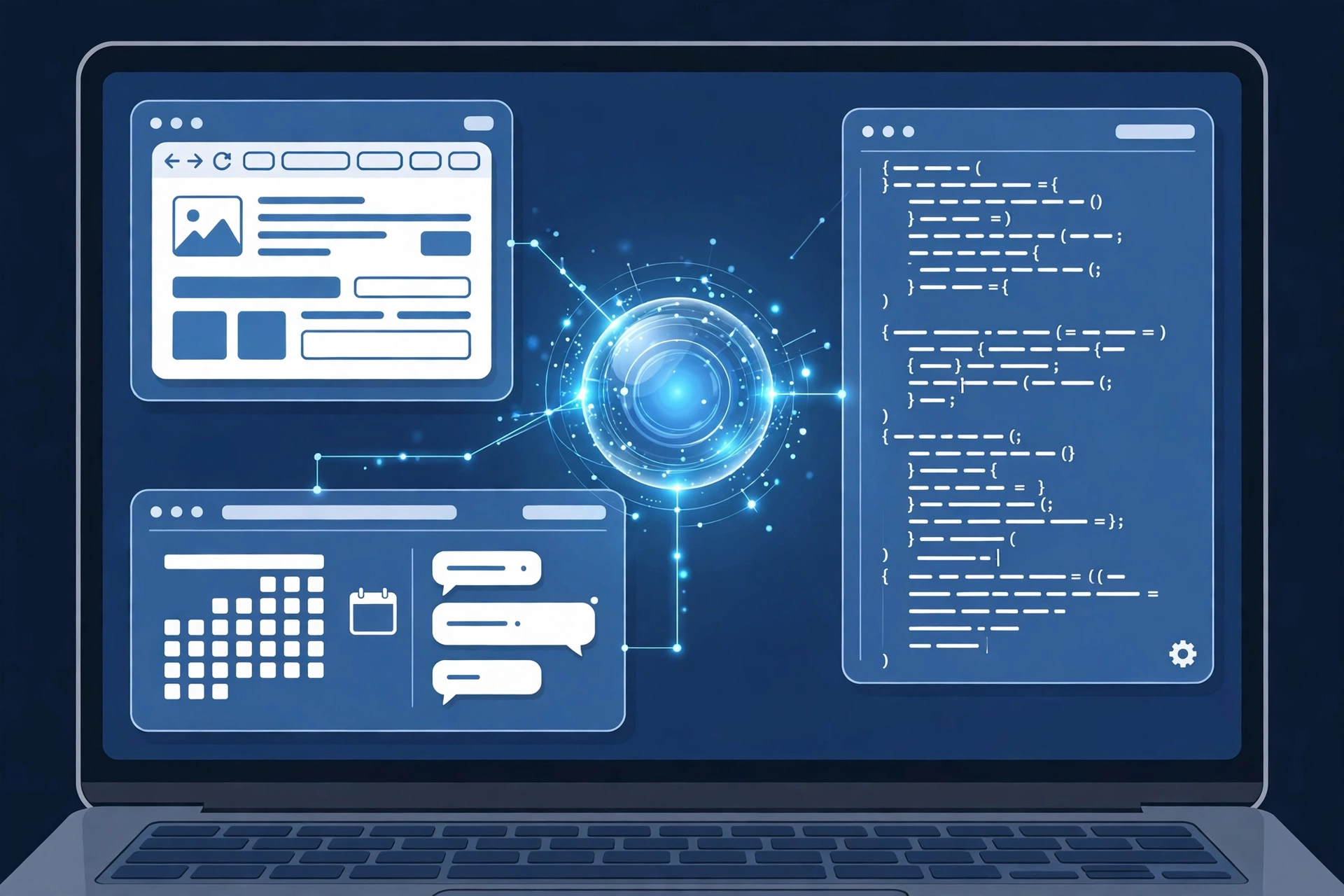
Apple is building an AI agent that can use a computer the way a capable person does. That is the pitch in a job listing Apple posted this week, spotted by Bloomberg’s Mark Gurman, and it may be the clearest sign yet of where Apple’s AI plans are heading: not another chatbot, but an assistant that actually operates your Mac.
The listing, for a senior engineering manager to lead a proactive, agentic AI assistant, describes “general-purpose computer-use agents” that plan and carry out multi-step tasks across apps, browsers, command lines, code and APIs — and coordinate specialized sub-agents along the way. Apple has eyed a launch as soon as the end of 2027, though Bloomberg stresses the work is still in the early stages and Apple has not confirmed the project. The listing itself was pulled from Apple’s careers site by Friday, November 20.
What Apple’s AI Agent Would Actually Do
The job posting asks readers to imagine an agent that “browses the web, works across apps, runs commands, writes and debugs code, and calls services, and it chooses the right tool for each step. It does all this privately and with the polish people expect from Apple.”
That is a much bigger job than today’s Siri. Instead of answering one question at a time, the agent would string together a whole workflow: look something up in a browser, pull the details into a document, run a command in the terminal, and hand the finished result back — deciding for itself which app or service fits each step. The new hire would work across Apple’s Siri, UI Frameworks and Apple Foundation Models teams, which suggests the agent is meant to sit deep inside the operating system rather than live in a single app.
The idea is not new in the industry. Google has just added computer use to the Gemini app for Mac, Microsoft’s Copilot Autopilot now keeps working after you log off, and Anthropic and OpenAI have their own computer-using agents. What would set Apple’s version apart, if it ships, is that Apple owns the whole stack: the Mac, the operating system, and the default apps the agent would drive.
The Job Listing That Gave It Away
Apple did not announce this agent. The news came from a job posting, not a keynote. The role — Senior Engineering Manager, Agentic AI, Proactive — was posted on November 17 and described agents that move “fluidly between tools” and carry out multi-step tasks. By November 20 the listing was gone from Apple’s site, though a screenshot shared online matches the role number, the posting date and the quoted text.
The listing also stresses safety, which matters more for an agent than for a chatbot. An assistant that can run code and act on your behalf needs “strong permission models, sandboxing, and transparency,” in the listing’s words. That framing fits Apple’s usual pitch: the agent would do its work privately, on the device and through Private Cloud Compute, rather than sending your screen to a distant server.
macOS 27.3 Is Raising the Drawbridge for Rivals
While Apple builds its own agent, it is making life harder for everyone else’s. In the macOS 27.3 beta, turning on ChatGPT’s ability to control a Mac now takes 14 distinct steps, up from four, with new warning screens asking users to reconsider before they grant a third-party agent permission. Beta 2, released on Monday, also splits the Device Control and Data Access setting in two — one for apps that control other apps, one for accessibility tools.
Apple told developers in October that it would add controls so users who want to grant “this extraordinary level of access” can only do so through “very explicit user action.” Apple presents the change as protecting customers. Some AI companies and users see it as an attempt to slow the competition — and Bloomberg notes Apple is already the subject of a Justice Department suit that includes its blocking of third-party access to features and hardware.

The timing is hard to miss: Apple is tightening the gate just as it starts building its own agent to walk through it.
Why Apple Is Moving Now
The push comes from the top. Bloomberg reports that John Ternus, Apple’s new CEO, has pushed software chief Craig Federighi to take a bolder approach to AI, with an agent central to it. Apple introduced Siri AI at WWDC on June 8, built on Apple Foundation Models and Google Gemini, and on November 3 it opened a developer preview that lets any app hand its own actions to Siri. The iOS 27.3 release due soon lets Siri AI work more deeply with third-party apps — booking a car or a restaurant, for example — but that still falls short of a full agent.
The rivals have not waited. Google added computer use to the Gemini app for Mac on Thursday and overhauled its agent, now called Tasks, earlier in the week. Anthropic has widened testing of its agent Duet, OpenAI has expanded Dots, and Meta’s Muse sat second among free apps in Apple’s App Store behind TikTok. OpenAI, meanwhile, is pushing into hardware as well as software — though its Jony Ive device has been delayed past 2026. After Bloomberg’s report, Anthropic’s shares fell more than 3% and Meta’s nearly 2% in late trading — though both moved on a day when the Nasdaq closed down 2.25%. Apple’s AI push is not limited to agents, either: the company also released Depth Pro 2, open-weight models that measure real-world depth from photos and video, earlier on Friday.
What It Means for Mac Users
For now, this is a hiring signal, not a product. A launch eyed for the end of 2027 could easily slip, and Apple has a long history of exploring ideas in job listings that never ship. But the direction is unmistakable: the next version of Siri is shaping up to be an agent that does things, not one that just answers.
If it arrives, Mac users should expect an assistant that works across their apps with Apple’s usual emphasis on permission prompts and on-device processing — and, judging by macOS 27.3, a platform where Apple’s own agent gets the smoothest path while rivals face more friction. The next real test comes at WWDC, where Apple will have to show whether its agent can match the computer-use tools its competitors already ship. TechCrunch’s report on the story is here for more detail.