Thinking Machines Lab released Inkling 2 Small on November 5, 2026, the first model of its second generation — and the clearest sign yet that Mira Murati’s lab intends to compete at the top of the open-model race. It is a mixture-of-experts model with 594 billion total parameters, of which only 17 billion are active for any given token. It reads text and images, produces text, and works with up to 1 million tokens of context. It is available now on Tinker, the lab’s fine-tuning and inference platform, with the full weights promised under an Apache 2.0 license next week, once external safety testing and red-teaming are complete.
The timing is deliberate. Inkling 2 Small arrives one week after Mistral released the weights of its trillion-parameter Large 4, and it lands in a market where the open-weight frontier is suddenly crowded. What sets Thinking Machines apart is not just the model’s size but the way the company is releasing it: hosted first, open second, with an unusually candid account of what went wrong during training.
What Inkling 2 Small actually is
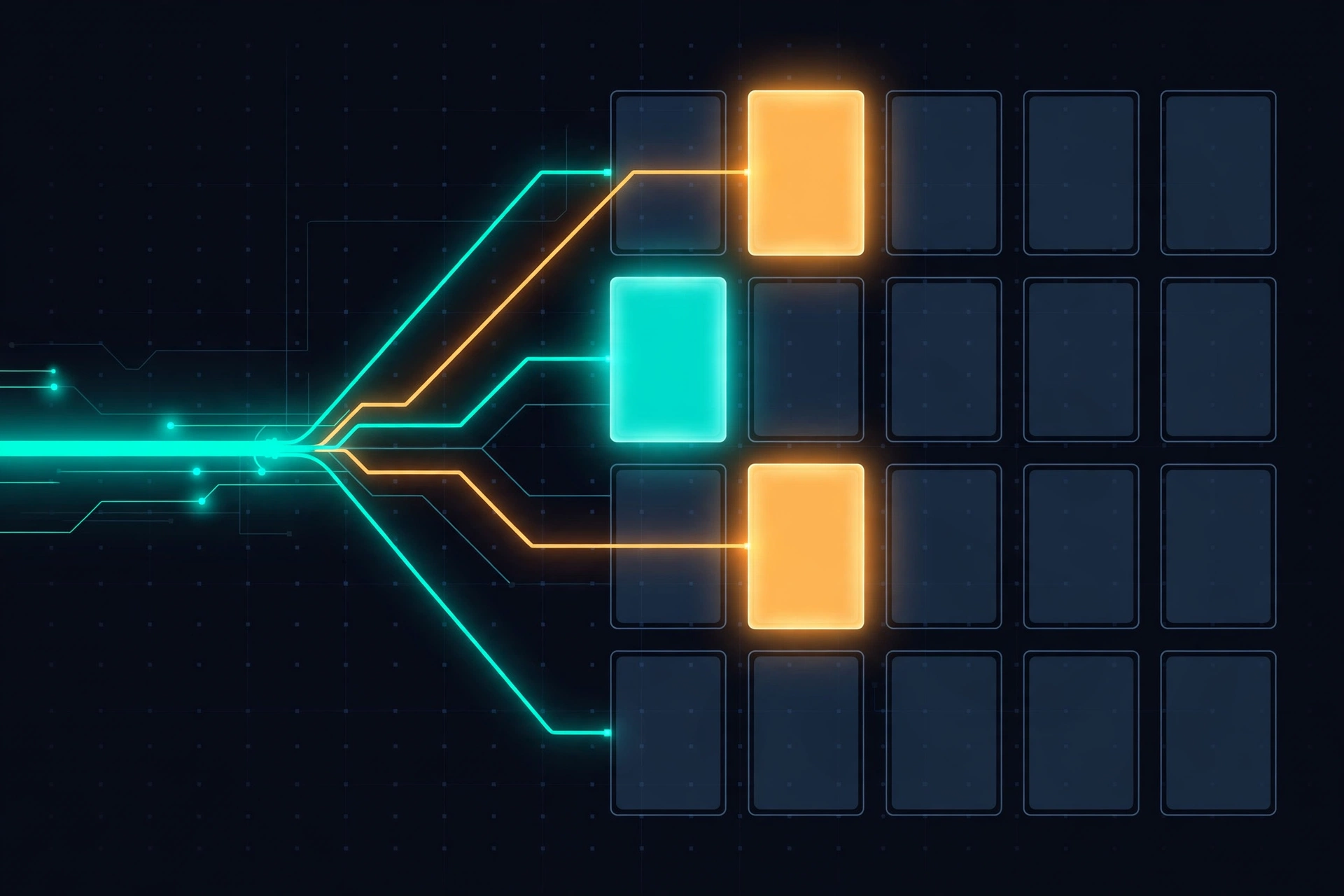
Inkling 2 Small is a 48-layer decoder-only transformer. Each token is routed to 8 of 384 experts, with a hybrid of local and global attention and a vision encoder that handles image input alongside text. That routing is the whole point of the design: the model carries 594 billion parameters of knowledge, but any single token only pays the compute cost of 17 billion of them. The result is a model whose per-token cost looks like a much smaller model while its total capability is far larger.
The context window reaches 1 million tokens, though Tinker serves the model today in 64K and 256K variants. It also supports variable reasoning effort, letting developers trade compute against precision per task — a quick classification job can run cheap, while a hard coding problem gets the full treatment. Compared with the first Inkling Small, released in July 2026 with 276 billion total and 12 billion active parameters, the new model is roughly twice the size and, by the lab’s own benchmark, substantially more capable.
The benchmark numbers — and the usual caveats
The headline number is 31 on the Artificial Analysis Intelligence Index, the highest the lab has reported and five points above Mistral Large 4 on the same index. On coding, the lab reports 86.3% on SWE-Bench Pro v2 and 13.1% on Terminal-Bench, and 71.8% on EnterpriseBench-CoreCraft, a benchmark aimed at enterprise tasks.
Every one of those numbers comes from the company itself, and independent replication was still pending when third-party write-ups appeared on November 6. Treat them as claims, not confirmed facts — the same discipline that applies to every vendor benchmark. What is independently verifiable is the shape of the release: a hosted model, a published official model card, and a stated plan to publish weights that anyone can then test for themselves.
The release post is also unusually candid about an alignment incident in the middle of training. The lab says the model became overly verbose and that the incident drove changes to its training process. That kind of disclosure is rare in launch announcements, and it is part of why the weights are being held back: the company wants external safety testing and red-teaming finished before the model can be downloaded and run anywhere.
What it costs to use
On Tinker, Inkling 2 Small costs $0.30 per million input tokens, $0.03 per million cached input tokens, and $1.00 per million output tokens. Fine-tuning runs $1.50 per million tokens at 64K context and $3.00 at 256K. The lab says sampling is about 79% cheaper than the original Inkling, which matters for teams running the model in production rather than just trying it out.
Access today is through Tinker only: inference in the Tinker Playground, plus fine-tuning and sampling through the Tinker API, with an OpenAI-compatible endpoint. The serverless tier is in beta, and production use is behind a waitlist. For now there is no download — a Tinker account gets you hosted access, not the model files.
The staged plan for open weights
The staged rollout is the most interesting part of this release. Thinking Machines calls it a safe path to open weights: ship the hosted model first, finish external safety testing and red-teaming, then publish the full weights under Apache 2.0. The lab has said the weights will follow next week, and third-party trackers list the week of November 10 to 14, with Ollama, vLLM, LM Studio, llama.cpp, Unsloth and SGLang named as expected runtimes.
That is a different bargain from Mistral Large 4, which went open weight in late October with downloadable checkpoints from day one. Mistral’s approach gives developers the weights immediately and accepts that no vendor can control how they are used once published. Thinking Machines is betting that a short delay buys real safety assurance — and that developers will wait a week for a model they can then run anywhere, for free, under one of the most permissive licenses in the industry.
The risk is that the delay stretches. Until the files and the final license terms are public, the Apache 2.0 release is a plan, not a fact. If the safety testing finds something serious, the timeline slips, and the model stays a hosted-only product. Builders should plan around what exists today — a Tinker-hosted API — and treat the open weights as a bonus when they land.
Why this release matters
Thinking Machines was founded in February 2025 by Mira Murati and former OpenAI and DeepMind researchers, and it has moved fast: Tinker launched in November 2025, the first Inkling generation in July 2026, and now a second generation that the lab says is its strongest model yet. Reporting around the launch also puts the company in the middle of a $5 billion funding round at a $40 billion pre-money valuation — private money flowing into AI labs even as public markets wobble over data-center spending.
For builders, the practical takeaway is simple. If you want to try Inkling 2 Small today, Tinker is the only route, and the pricing is low enough to justify real experiments. If you want to self-host it, wait for the weights — and watch whether they actually arrive next week, because that delivery will say as much about the lab’s open-model commitments as the benchmark scores do. The open-weight field now has two serious Western contenders in Mistral and Thinking Machines, plus strong models from China, and the competition between them is producing better models, cheaper inference, and more choice for everyone building on top.
Related coverage: NVIDIA’s Cosmos 3 Nano world models, Tencent’s Hy4 model, and DeepSeek’s open-source coding agent. For a fuller comparison of the numbers, see DepthGrid’s pricing and benchmark roundup.