
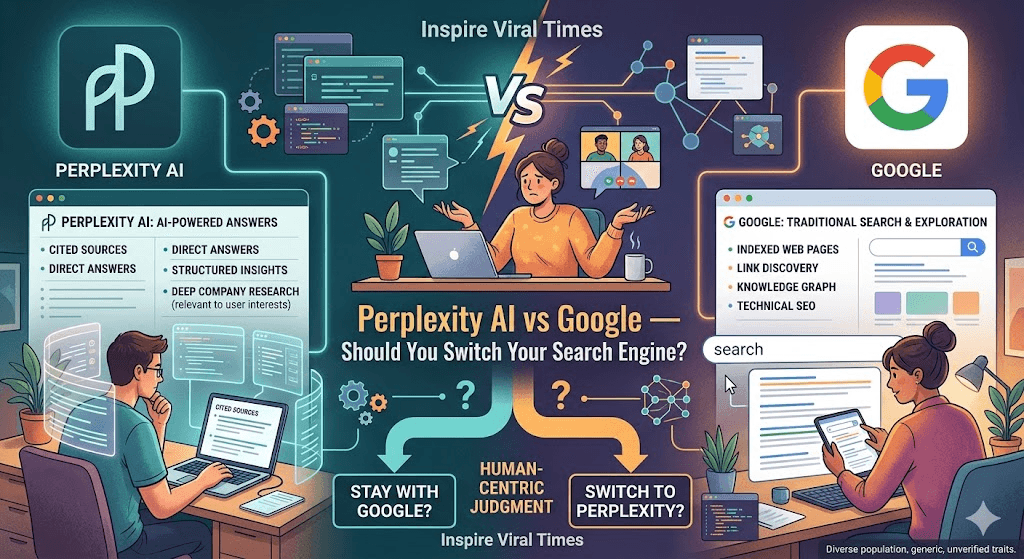
The way people search online is changing faster than ever. For more than two decades, Google has dominated how we find information on the internet. But now, AI-powered search tools like Perplexity AI are creating a serious shift in the search experience.
Instead of giving you a long list of blue links, Perplexity AI gives direct answers, summaries, sources, and conversational responses. That sounds impressive — but does it actually replace Google?
More importantly: should you switch your search engine in 2026?
The answer depends on what you value most: speed, accuracy, depth, privacy, productivity, or trust.
In this article, we’ll break down the real-world differences between Perplexity AI and Google, compare their strengths and weaknesses, and help you decide which one deserves your daily searches.
What Is Perplexity AI?
Perplexity AI is an AI-powered answer engine that combines traditional web search with large language models.
Instead of showing 10 links and ads first, it tries to answer your question directly in a conversational style while citing sources from across the web.
For example, if you ask:
“What are the best AI tools for freelancers in 2026?”
Perplexity will instantly generate:
- A summarized answer
- Tool recommendations
- Source citations
- Follow-up suggestions
- Related questions
It feels more like chatting with an AI assistant than using a traditional search engine.
What Makes Google Different?
Google still works primarily as a discovery engine.
When you search something on Google, you usually get:
- Website links
- Ads
- Videos
- Shopping results
- Featured snippets
- Maps
- News
- Forums
- AI Overviews
Google’s strength has always been its massive index of the web and its ability to help users navigate to the exact site they need.
In simple terms:
| Platform | Main Purpose |
|---|---|
| Perplexity AI | Gives direct AI-generated answers |
| Helps users discover websites and content |
That difference changes everything.
Perplexity AI vs Google: The Core Comparison
1. Speed of Finding Answers
Perplexity AI Wins for Instant Understanding
Perplexity is extremely fast for:
- Research summaries
- Quick explanations
- Comparing products
- Learning topics
- Brainstorming ideas
- Productivity questions
Instead of opening five different articles, you often get what you need immediately.
Example:
If you search:
“Explain quantum computing in simple words.”
Perplexity gives a clean explanation instantly.
With Google, you may need to open multiple pages before finding a clear answer.
Google Still Wins for Deep Browsing
Google performs better when:
- You want official websites
- You need local results
- You’re shopping
- You’re looking for videos
- You want recent breaking news
- You need forums or Reddit discussions
Google is still unmatched for web navigation.
2. Accuracy and Trustworthiness
This is where things become complicated.
Google’s Advantage: Original Sources
Google sends users directly to:
- Official websites
- Academic papers
- Government pages
- Trusted publishers
You can verify information yourself.
Perplexity’s Advantage: Source Citations
Perplexity usually cites sources beside its answers, which is better than many AI chatbots.
However, AI-generated summaries can still:
- Misinterpret information
- Oversimplify topics
- Occasionally hallucinate facts
That means you should still verify important information.
For High-Stakes Searches, Google Is Safer
If you’re searching for:
- Medical advice
- Financial decisions
- Legal information
- Government policies
Google’s direct-source approach remains more reliable.
3. User Experience
Perplexity Feels Cleaner
One reason many people love Perplexity AI is the minimal interface.
You don’t see:
- Endless ads
- SEO spam
- Clickbait headlines
- Cluttered search pages
The experience feels modern and distraction-free.
Google Feels More Powerful
Google’s ecosystem is incredibly advanced:
- Maps
- Flights
- Shopping
- YouTube integration
- Gmail integration
- Images
- News
- Scholar
- Drive
- Android ecosystem
Perplexity cannot replace all of that.
At least not yet.
4. Ads and SEO Spam
This is one of the biggest reasons users are exploring AI search engines.
Over the past few years, many Google users have complained that search results are becoming:
- Over-optimized
- Filled with affiliate content
- Dominated by ads
- Repetitive
Sometimes finding a genuine answer feels harder than before.
Perplexity reduces that friction by summarizing information directly.
For users tired of SEO-heavy content, this feels refreshing.
5. Research and Productivity
Perplexity Is Excellent for Students and Professionals
Perplexity works extremely well for:
- Writers
- Students
- Researchers
- Developers
- Analysts
- Marketers
You can ask:
- Follow-up questions
- Context-aware queries
- Comparative research
- Summaries of long topics
It behaves more like a research assistant.
Example Uses
- “Summarize today’s AI news.”
- “Compare AWS vs Azure pricing.”
- “Explain blockchain like I’m 12.”
- “Best remote jobs in cybersecurity.”
This conversational workflow saves enormous time.
6. Privacy Concerns
Privacy-focused users are paying closer attention to AI search tools.
Google Collects Massive User Data
Google uses search history, personalization, ads, and ecosystem tracking extensively.
That powers better personalization — but also raises privacy concerns.
Perplexity’s Position
Perplexity AI markets itself as a cleaner AI-first experience, though users should still review privacy policies carefully.
No major search engine today is completely privacy-perfect.
If privacy matters deeply, many users still prefer alternatives like:
- DuckDuckGo
- Brave Search
7. Which One Is Better for SEO and Content Creators?
This is becoming a huge debate in 2026.
AI answer engines may reduce clicks to websites because users get answers directly.
That creates challenges for:
- Bloggers
- Publishers
- Affiliate marketers
- News sites
Google still drives enormous traffic to websites.
Perplexity often summarizes content without requiring users to click through.
For content creators, this shift could reshape:
- SEO strategy
- Website traffic
- Ad revenue
- Content formats
The search industry is entering a completely new era.
Real-World Example: How People Are Actually Using Both
Most users are not completely replacing Google.
Instead, they’re using:
- Perplexity for understanding
- Google for navigation
Example workflow:
- Use Perplexity to learn a topic quickly
- Use Google to verify sources and explore deeper
That hybrid approach is becoming increasingly common among professionals.
Pros and Cons of Perplexity AI
Pros
- Fast AI-generated answers
- Clean interface
- Great for research
- Conversational search
- Source citations included
- Less SEO clutter
- Excellent productivity tool
Cons
- Can still hallucinate facts
- Not ideal for local search
- Limited ecosystem
- Weaker for shopping/maps
- Less reliable for breaking news
- Doesn’t replace traditional browsing completely
Pros and Cons of Google
Pros
- Massive web index
- Best for navigation
- Excellent local search
- Powerful ecosystem
- Better for live information
- Trusted source discovery
- Strong shopping and maps integration
Cons
- Heavy ad presence
- SEO spam issues
- Information overload
- Sometimes slower to get direct answers
- Increasingly cluttered interface
So… Should You Switch?
Here’s the honest answer:
You probably shouldn’t completely abandon Google.
But you should start using AI-powered search alongside it.
Use Perplexity AI if you:
- Research topics frequently
- Want faster answers
- Hate SEO-heavy articles
- Need productivity-focused search
- Prefer conversational interfaces
Keep using Google if you:
- Need maps, shopping, and local results
- Want official sources
- Verify important information
- Browse websites deeply
- Follow breaking news
The future of search likely won’t be “Google OR AI.”
It will be:
“Google AND AI.”
Final Thoughts
The rise of Perplexity AI shows that people are becoming frustrated with traditional search experiences.
Users want:
- Faster answers
- Less clutter
- Better summaries
- Smarter interactions
At the same time, Google still remains the backbone of the internet for discovery, navigation, and trusted source access.
The smartest move in 2026 is not choosing one over the other.
It’s learning when to use each tool effectively.
Because the future of search is no longer just about finding links.
It’s about finding understanding — instantly.