
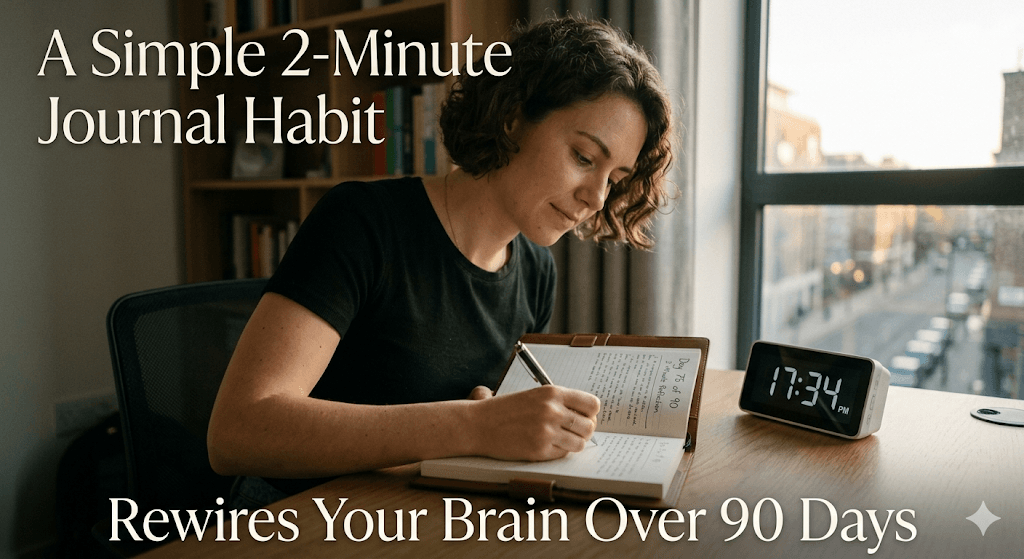
No expensive therapy. No meditation app. Just a pen, a notebook, and two minutes of your morning — backed by neuroscience you can actually feel working.
I want you to think about your morning for a second. Not the idealized version you pin on Pinterest — the real one. The one where your alarm goes off and your brain immediately launches into a highlight reel of every unfinished task, awkward conversation, and looming deadline from the past 72 hours.
Sound familiar? Yeah. Me too.
Here’s the thing nobody tells you about that mental chaos: it’s not a personality flaw. It’s a neural habit. Your brain has literally built highways of negative thought patterns — and every morning you wake up, it drives the same route on autopilot.
But what if you could reroute those highways? What if there was something so stupidly simple that it takes less time than brushing your teeth — and yet, over 90 days, it physically changes the architecture of your brain?
There is. And it’s been sitting on your nightstand this whole time.
The Habit: Write Three Things. Two Minutes. Every Morning.
That’s it. That’s the whole habit. Every morning, before you touch your phone, before coffee, before the world gets loud — you open a notebook and write down three specific things you’re grateful for.
Not “my family” every single day. Not vague, recycled answers. Three specific, vivid, real things from the past 24 hours.
Things like: “The way sunlight hit the kitchen counter at 7am and made me stop for a second.” Or: “My coworker Jess sent me a message just to check in — nobody asked her to.” Or even: “I made it through that hard conversation without shutting down.”
Simple? Absolutely. But simplicity is the point. Because the magic isn’t in the writing itself — it’s in what the writing forces your brain to do.
What’s Actually Happening Inside Your Skull
Here’s where it gets fascinating. When you sit down and search your memory for something to be grateful for, your brain doesn’t just passively recall information. It actively rewires itself.
UCLA researcher Matthew Lieberman found that labeling emotions in words reduces activity in the amygdala — your brain’s threat-response center — while increasing engagement in the prefrontal cortex, which governs reasoning and emotional regulation. In other words, the simple act of finding words for what you feel changes how your brain processes those feelings.
And that’s just the beginning. When you write about gratitude specifically, your brain releases dopamine and serotonin — the same neurotransmitters targeted by antidepressant medications. A researcher at UCLA noted that just the act of searching for something to be grateful for — even before you find it — stimulates serotonin production. The looking itself shifts your brain chemistry.
This is neuroplasticity in action. Your brain is constantly rebuilding itself based on what you repeatedly do and think. Neurons that fire together wire together — it’s one of the most well-established principles in neuroscience. And every time you write in that journal, you’re telling your brain: “Hey, pay attention to the good stuff.”
Why 90 Days? The Rewiring Timeline.
You’re probably wondering: why 90 days specifically? Why not 21 days, like every other habit article on the internet promises?
Because real neural change doesn’t happen overnight. Research shows a specific progression when you commit to consistent gratitude journaling — and understanding this timeline is what keeps most people from quitting too early.
The Awkward Phase
It feels forced. You might stare at the page for 30 seconds thinking, “I literally have nothing.” That discomfort is normal — it means your brain is being asked to run a program it hasn’t installed yet. Push through. The neural pathway is being laid down, one wobbly step at a time.
The Noticing Shift
Something subtle starts happening mid-day. You’ll catch yourself noticing a moment — a kind word, a beautiful cloud, a problem that didn’t happen — and thinking “that’s going in the journal tomorrow.” Your brain is starting to scan for positive data in real time, not just during the writing.
The Emotional Recalibration
Small frustrations start losing their grip. You still feel stress, but you bounce back faster. Research suggests most people notice meaningful changes in thought patterns and emotional responses within two to four weeks of consistent journaling. By day 30, you’re well into this territory.
The New Default
This is where it gets remarkable. A study published in NeuroImage found that participants who completed a gratitude writing intervention showed altered neural activity in the medial prefrontal cortex three months later — even when they weren’t actively practicing gratitude. The brain had learned a new default pattern. It wasn’t just a habit anymore. It was architecture.
The Exact Method (Steal This)
I’ve tested dozens of journaling formats over the years. Fancy prompts, color-coded systems, apps with streak counters. Most of them lasted about 11 days. Here’s the only format that stuck — because it’s so frictionless your sleepy, pre-coffee brain can’t talk you out of it.
Set the Stage (10 seconds)
Keep your journal and a pen on your nightstand. Not in a drawer. Not across the room. On the nightstand, open to the next blank page. Remove every barrier between waking up and writing.
Write Three Specific Gratitudes (90 seconds)
Write three things you’re grateful for from the past 24 hours. The key word is specific. Not “I’m grateful for my health.” Instead: “I’m grateful my knee didn’t hurt on that walk yesterday.” Specificity forces your brain to relive the moment, which deepens the neural encoding.
Add One Sentence of Why (20 seconds)
Under any one of the three, add a single sentence about why it matters to you. “This matters because it reminded me my body is healing.” This step activates your prefrontal cortex more deeply — connecting emotion to meaning — and it’s the difference between surface-level listing and actual brain change.
That’s it. Two minutes. Close the journal. Start your day.
What the Research Actually Shows
I’m not going to pretend this is some miracle cure that replaces professional mental health support. It’s not. But the body of evidence behind gratitude journaling is genuinely impressive — and growing.
In a landmark study, researchers Robert Emmons and Michael McCullough divided participants into three groups: one wrote about things they were grateful for, one wrote about daily hassles, and one recorded neutral events. After 10 weeks, the gratitude group was significantly happier, exercised more, and reported fewer physical complaints.
More recently, a researcher at Indiana University found that people who completed a gratitude writing exercise showed measurably different brain activity in the medial prefrontal cortex three months later. The brain had changed its baseline patterns — not temporarily, but structurally.
Gratitude journaling trains the brain to scan for positive experiences rather than defaulting to the threat-scanning mode that occupies most of our idle mental time. It doesn’t suppress negative experience — it rebalances what gets noticed. Over time, this rebalancing becomes automatic.
The physical health benefits are striking too. UCLA Health has documented connections between regular gratitude practice and lower blood pressure, improved immune function, better sleep quality, and reduced symptoms of anxiety and depression. Gratitude activates the parasympathetic nervous system — the “rest and digest” system — which counteracts the chronic stress response most of us live in.
The Mistakes That Kill This Habit
I want to be honest about what goes wrong, because knowing the pitfalls is half the battle.
Going too generic. “I’m grateful for my family” repeated every day teaches your brain absolutely nothing new. It’s the equivalent of walking the same 10 feet of a path and calling it a hike. Specificity is where the neural change lives.
Doing it at the wrong time. Nighttime journals tend to die within two weeks for most people. You’re tired, the day has drained your willpower, and “I’ll do it tomorrow” wins. Morning — before the phone, before email — works because your willpower tank is full and the habit piggybacks on the strongest routine anchor you have: waking up.
Overdoing it. Interestingly, researcher Sonja Lyubomirsky found that gratitude practices done once or twice per week were actually more effective than daily practice for some people, because daily repetition can start to feel like a chore and lose emotional impact. If daily feels like a grind after a few weeks, try every other day. Consistency over frequency.
Expecting a lightning bolt. The changes are subtle at first. You won’t wake up on Day 8 feeling transformed. You’ll notice it in retrospect — in how you handled a frustration differently, in how you slept a little better, in how your inner monologue shifted from critic to narrator. Trust the process. The neuroscience says the changes are real, even when you can’t feel them yet.
What 90 Days From Now Actually Looks Like
Let me paint you a picture. It’s three months from today. You wake up and — before you even realize you’re doing it — your mind drifts to something good. Not because you forced it, but because your brain has been retrained to notice it.
You’re not less stressed. Life didn’t suddenly get easier. But your relationship with stress changed. You have a wider emotional buffer. Things that used to knock you sideways for hours now register as a bump. You process and move on. Not because you’re suppressing anything, but because your prefrontal cortex is genuinely stronger — more connected, more active, more in control.
Your journal sits on the nightstand with 90 entries. Some of them are beautiful. Some are scraped together on hard mornings when “I’m grateful the coffee was hot” was the best you could do. Both kinds matter. Both kinds rewired something.
That’s the truth about this habit: it works not because it’s dramatic, but because it’s boring and consistent. And your brain — that extraordinary, plastic, endlessly adaptable brain — responds to boring consistency better than anything else in the world.
Start Tomorrow Morning
Put a notebook on your nightstand tonight. Set your alarm two minutes earlier. Write three things. That’s all. Your brain will take care of the rest.
Share This With Someone Who Needs It →This article draws on published research from UCLA, Indiana University, UC Davis, and the Greater Good Science Center at UC Berkeley. It is not a substitute for professional mental health care. If you’re struggling, please reach out to a qualified therapist or counselor.


Comments are closed.