
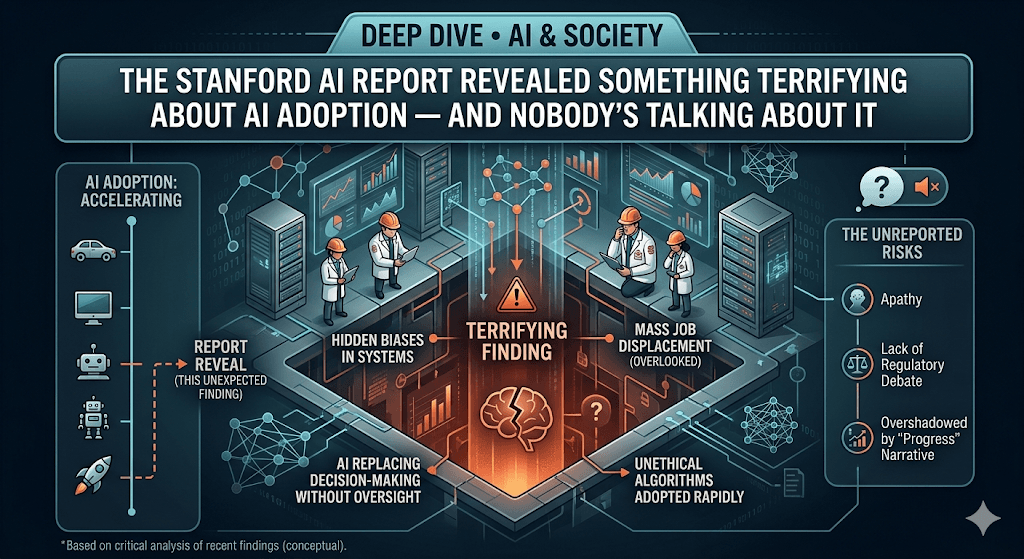
The countries pouring the most money into artificial intelligence are the same ones that trust it the least. Stanford’s data reveals a paradox that could define the next decade of technology.
Here’s the thing about ticking time bombs. They don’t make noise until it’s too late. And buried inside Stanford’s latest AI Index Report is a data point so unsettling that it should be on every front page in the country — but somehow, it barely registers.
Let me set the stage for you. In the span of a single year, AI adoption inside organizations jumped from 55% to 78%. Then, by 2025, that number climbed again to a staggering 88%. Generative AI reached over half the global population in just three years — faster than the personal computer, faster than the internet. The money is pouring in. Private AI investment in the U.S. alone hit $285.9 billion in 2025.
And yet.
Only 39% of Americans believe AI products and services are more beneficial than harmful. In Canada, that number sits at 40%. The United States — the very country spending more on artificial intelligence than any nation on Earth by an absurd margin — scored the lowest trust in its own government to regulate AI of any country surveyed. Just 31%.
Read that again. The people building the future don’t trust the future they’re building.
The Trust Paradox Nobody Wants to Acknowledge
Stanford’s researchers call it the “trust paradox,” and it might be the most important finding in the entire 400-plus-page report. The pattern is consistent and deeply counterintuitive: countries with the highest AI investment and most advanced AI ecosystems are also the ones expressing the deepest skepticism about it.
In China, 83% of people see AI as a net positive. In Indonesia, it’s 80%. In Thailand, 77%. These are countries where AI is often experienced as a tool that unlocks access — to healthcare, education, financial services. For many people in those markets, AI isn’t a threat. It’s a ladder.
But in the U.S., where AI companies are headquartered, where the billions flow, where the models are built — the public mood is something closer to dread.
And honestly? I think the public might be picking up on something the experts are too close to see.
The Experts and the Public Live in Different Universes
This is where the data gets genuinely alarming. Stanford’s latest report reveals one of the widest opinion gaps I’ve seen on any technological issue: when asked about AI’s impact on jobs, 73% of AI experts expect a positive outcome. Among the general public? Just 23%. That’s a 50-point gap. Fifty points.
On the economy? Similar divide. On healthcare? Same story. Nearly half of the experts surveyed said they feel more excited than concerned about AI in daily life. Among regular people, only 11% said the same. Meanwhile, 51% of adults said they are more concerned than excited.
The people building AI and the people living with AI have almost nothing in common when it comes to how they feel about it. That’s not a PR problem. That’s a legitimacy crisis.
Think about what this means practically. The engineers in San Francisco and Seattle are genuinely enthusiastic about what they’re creating. They see the benchmarks improving. They watch as AI models ace PhD-level science questions, solve complex coding challenges, and generate increasingly sophisticated reasoning. Performance on one key coding benchmark went from 60% to near 100% in a single year.
But the nurse in Ohio, the teacher in Texas, the truck driver in Pennsylvania — they’re reading a completely different story. They see 64% of their fellow Americans expecting AI to mean fewer jobs over the next 20 years. They see headlines about AI hallucinations, data breaches, and deepfakes. And they don’t trust the government — or the companies — to protect them from any of it.
The Incident Problem Is Getting Worse, Not Better
Here’s where “terrifying” stops being clickbait and starts being the accurate word. Documented AI incidents — real-world harms or near-harms caused by deployed AI systems — hit 362 in 2025. That’s up from 233 in 2024, which was already a record. We’re talking about a 55% year-over-year increase in things going wrong with AI in the wild.
And the response from the industry? Stanford’s researchers put it bluntly: responsible AI is not keeping pace with AI capability. Safety benchmarks are lagging. Reporting on responsible AI metrics remains “spotty” among major model developers. There is a real, documented gap between companies acknowledging that AI carries serious risks and those same companies actually doing something meaningful about it.
Trust in AI companies to protect personal data slipped from 50% to 47% between 2023 and 2024. That may sound like a small number, but it’s a continuation of a downward trend that should worry anyone building products in this space. When your users trust you less each year, you are not moving in the right direction.
AI capabilities are accelerating exponentially. Safety and governance are crawling.
We’re Watching a Consent Crisis in Real Time
Let me be direct about what I think is actually happening here, because I don’t think most coverage of the Stanford report gets at the real issue.
This isn’t a story about technology moving fast. We’ve seen that before. The internet moved fast. Social media moved fast. Smartphones moved fast. What’s different this time is the consent gap.
When personal computers came along, you chose to buy one. When social media emerged, you chose to sign up. Those choices had consequences we didn’t fully understand at the time, sure. But there was at least the illusion of agency.
With AI, that’s not how it works. AI is being embedded into the tools you already use, the systems that already govern your life, the processes that already determine whether you get a loan, a job interview, a medical diagnosis. It’s not that people are choosing AI and regretting it. It’s that AI is choosing them — and they know it.
When 88% of organizations say they’re using AI, but barely a third of Americans trust their government to regulate it responsibly, what you’re looking at is a technology being deployed without the meaningful consent of the people it affects most.
The gap between what AI can do and what society is prepared to accept remains the central challenge of the AI era.
— Stanford HAI, AI Index ReportThe Brain Drain Nobody’s Talking About
Buried deeper in the data is another alarming trend. The number of AI researchers and developers moving to the United States has dropped 89% since 2017. In the last year alone, that decline was 80%.
Let that settle in. The U.S. is spending more on AI than ever, but the talent pipeline that made American AI dominance possible is drying up. At the exact same time, Chinese AI models have closed the performance gap to near parity with American ones, trading top positions on key benchmarks multiple times throughout 2025.
You can pour $285 billion into an industry, but if the brightest minds don’t want to come build it in your country — and the public doesn’t trust what you’re building — you have a problem that money alone cannot solve.
So What Do We Actually Do About This?
I don’t think the answer is to slow down AI development. That ship has sailed. And frankly, the benefits are real. AI-powered tools are already helping doctors reduce clinical note-taking time by up to 83%. The cost of running AI has plummeted, making it accessible to organizations that couldn’t have dreamed of it two years ago. When used thoughtfully, AI narrows skill gaps and boosts productivity in measurable ways.
But here’s what has to change:
Transparency can’t be optional anymore. When Stanford says responsible AI reporting is “spotty” among major developers, that should be unacceptable. If you’re deploying models that touch millions of lives, you need to show your work. Every time. Not when it’s convenient. Not when it makes you look good. Every single time.
The expert-public gap must be treated as an emergency. A 50-point gap between how experts and ordinary people view AI’s impact on jobs isn’t a communication problem you can fix with better marketing. It requires genuine engagement — town halls, not whitepapers. Stories, not press releases. Listening, not lecturing.
Regulation needs to earn trust, not assume it. The U.S. scored dead last globally on trust in its government to regulate AI. That’s a five-alarm fire for anyone who believes democratic oversight matters. If the regulatory approach is perceived as captured by the very industry it’s supposed to oversee, the public will continue to check out — and the consequences of that disengagement will be felt for decades.
Consent needs to be redesigned. People need real choices about when and how AI touches their lives. Not buried-in-the-terms-of-service choices. Not opt-out-if-you-can-find-the-button choices. Real ones. Meaningful ones.
The Bottom Line
Stanford’s AI Index Report is 400+ pages of charts, benchmarks, and investment figures. But the story it tells, if you read between the lines, is fundamentally human. It’s about a species that has built something extraordinarily powerful and is now wrestling — unevenly, messily, sometimes badly — with what to do about it.
The terrifying part isn’t that AI is advancing fast. It’s that the people it affects most have the least say in how it’s shaped, the least trust in the institutions overseeing it, and the least confidence that anyone in power is looking out for them.
That’s not a technology problem. That’s a democracy problem. And until we treat it like one, all the benchmarks in the world won’t matter.
We’re not lacking intelligence — artificial or otherwise. We’re lacking trust. And trust, once lost, is the hardest thing in the world to rebuild.
Found this thought-provoking?
Share it with someone who needs to see these numbers.