
For someone who has lost the ability to speak, a few seconds of delay can turn a conversation into a monologue. On November 23, 2026, Austin-based neurotechnology company Paradromics announced a technical collaboration with NVIDIA aimed at closing that gap — moving the AI that decodes brain signals into speech onto fast edge hardware, with a target of under 10 milliseconds from thought to spoken word.
The partnership brings NVIDIA Holoscan and NVIDIA edge computing into Paradromics’ brain-computer interface (BCI) development stack, starting with speech restoration and extending into the company’s research program for new applications. It is the latest sign that BCIs are moving out of the lab: the computing bottleneck, not the implant, is now the thing to solve.
What Is the Connexus Brain-Computer Interface?
Paradromics’ Connexus system is an investigational brain-computer interface designed to restore communication for people with severe motor impairment. A microelectrode array implanted in the brain records the activity of individual neurons, and machine-learning models translate the signals tied to attempted speech into text, a digital voice, or commands for a device.
The system is being evaluated in the FDA-approved Connect-One Early Feasibility Study, a six-year trial enrolling adults aged 22 to 75 with conditions such as ALS or brainstem stroke who have lost intelligible speech and have experience with assistive communication devices such as eye-tracking systems.
Progress has been rapid. Paradromics completed its first long-term human implantation in June 2026, and in September reported that the first participant — a Michigan woman in her 60s living with motor neuron disease — used Connexus to answer open-ended questions and speak with her grandchildren by phone. That is the human stakes behind this week’s announcement: every millisecond of delay is a pause in a real conversation.
From Lab Cart to Wheelchair: Shrinking the Hardware
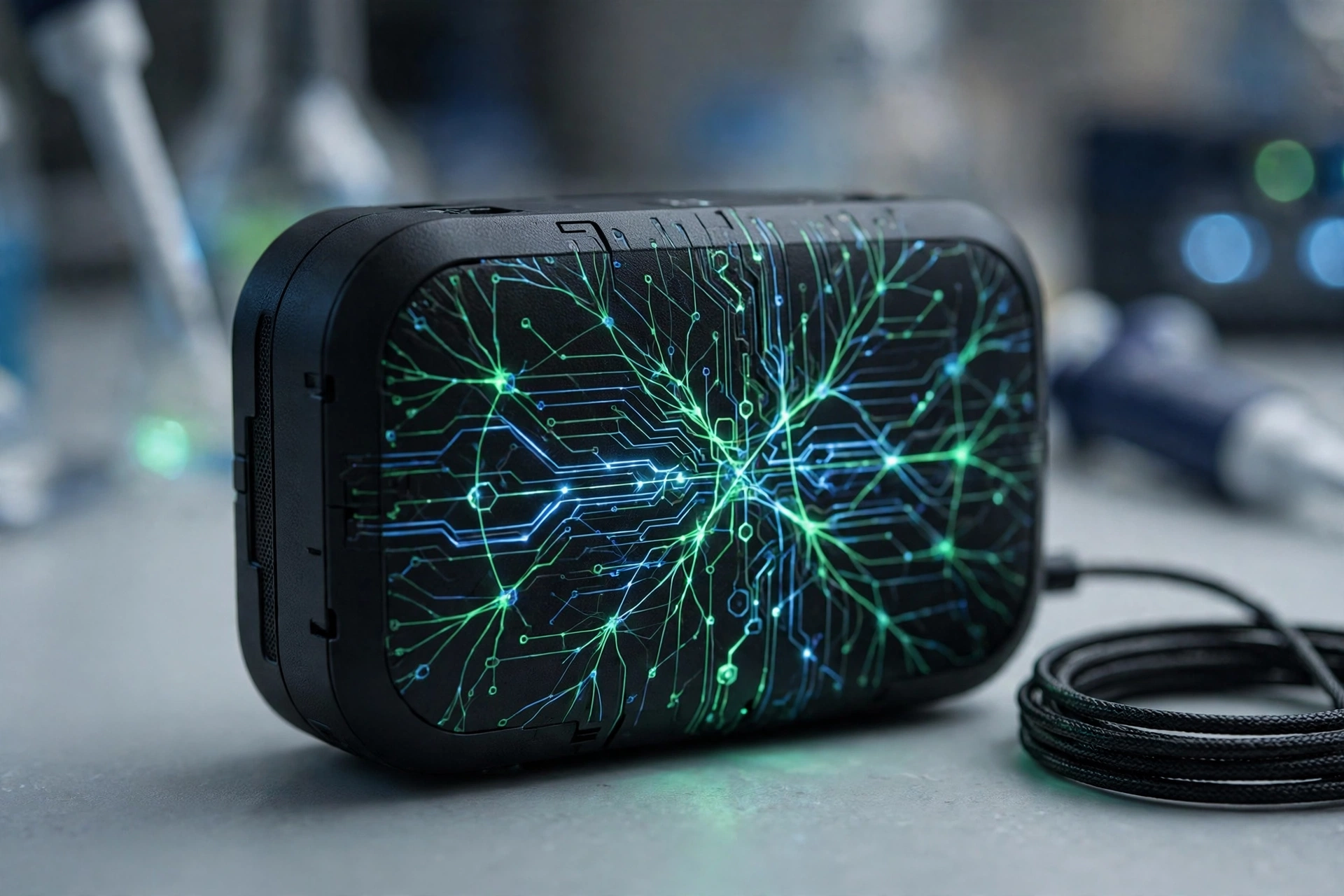
Today’s Connexus setup still depends on a laboratory. The external Connexus Control Unit houses an NVIDIA Jetson Orin Nano module, but it must stay tethered to an auxiliary workstation that runs the machine-learning decoding models. The collaboration moves that entire pipeline onto the NVIDIA Holoscan SDK running on dedicated embedded hardware — no external workstation, and a control unit compact enough to mount on a wheelchair and travel with the user all day.
That is the same edge-computing playbook NVIDIA is running elsewhere: NVIDIA’s RTX Spark desktops bring a petaflop of local AI into a box the size of a book, and NVIDIA’s Alpamayo 2 edge AI for self-driving cars puts a self-driving brain in the vehicle itself. The idea is identical here — do the heavy AI work where the data is created, instead of shipping it somewhere else.
The hardware roadmap points to NVIDIA’s Blackwell-based Jetson AGX Thor platform, which delivers up to 2,070 TFLOPS of AI computing performance in a compact, energy-efficient package — the muscle needed to run neural decoders, language models and speech synthesis together, on battery power, in real time.
The 10-Millisecond Target: Why Latency Is Everything

The collaboration’s roadmap sets two latency targets for compute and data transport. Direct brain-to-speech systems — which convert cortical activity straight into synthetic speech waveforms — target under 10 milliseconds end to end. Multi-stage brain-to-text-to-speech pipelines, which decode neural signals into text with a language model and then synthesise speech, target under 100 milliseconds.
Those numbers matter because natural conversation runs on tight timing. A delay of a few hundred milliseconds makes speech feel stilted and turns back-and-forth into turn-taking; under 10 milliseconds is effectively instantaneous to a listener. Hitting it means decoding, language modelling and synthesis all have to share one fast computing environment — which is exactly what Holoscan is built for, as a real-time framework for sensor processing that can bring neural decoding, adaptive learning, language models and speech synthesis together in one place.
The roadmap also calls for decoders that keep learning in the background. Neural signals drift over time, so the models must recalibrate themselves as a user’s brain patterns change — otherwise accuracy degrades and the system needs constant retuning by engineers.
What Comes Next: Motor Control, Vision and the APEX Program
Work starts this year with porting Paradromics’ speech decoders and speech synthesis pipelines onto Holoscan, followed by power profiling and deployment to speech-focused research partners. In 2027 the roadmap expands to high-degree-of-freedom motor control and vision-language-action models — the same brain signals, driving robotic arms and richer computer control.
A central piece is the Paradromics Application Expansion (APEX) Program, which works with academic researchers to find new uses for the platform. Paradromics plans to deploy NVIDIA IGX and Holoscan-ready systems to APEX partners, giving labs across institutions a common high-performance computing environment for BCI research instead of each group building its own stack.
Alongside Connexus, Paradromics is developing Tempo BCI, a pre-clinical device aimed at ambulatory users and mobile BCI applications — a hint that the company sees brain interfaces eventually leaving the wheelchair entirely. No financial terms for the NVIDIA collaboration were disclosed.
The deal also lands in a week when NVIDIA itself is back in the headlines — Jensen Huang’s return as NVIDIA CEO has reignited the AI trade — and it shows where the chipmaker’s ambitions now reach: not just data centres and cars, but direct interfaces with the human brain.
The Bottom Line
The Paradromics–NVIDIA collaboration is not about a new implant. It is about making the implant practical: fast enough to hold a conversation, small enough to leave the lab, and efficient enough to run all day. If the sub-10-millisecond target holds, speech BCIs stop being a laboratory demonstration and start being a communication device — one that lets people who cannot speak join a conversation in real time.
That is a bigger story than one company. How AI is transforming healthcare is usually told through diagnostics and drug discovery; here it is a person speaking to their grandchildren. And the same looped, efficient model thinking behind Z.ai’s looped-transformer model is showing up in hardware too: do more with less compute, closer to where it matters. For the details, read the official announcement from Paradromics, MobiHealthNews’ report on the partnership, Inside BCI’s breakdown of the collaboration and NVIDIA’s Holoscan SDK.