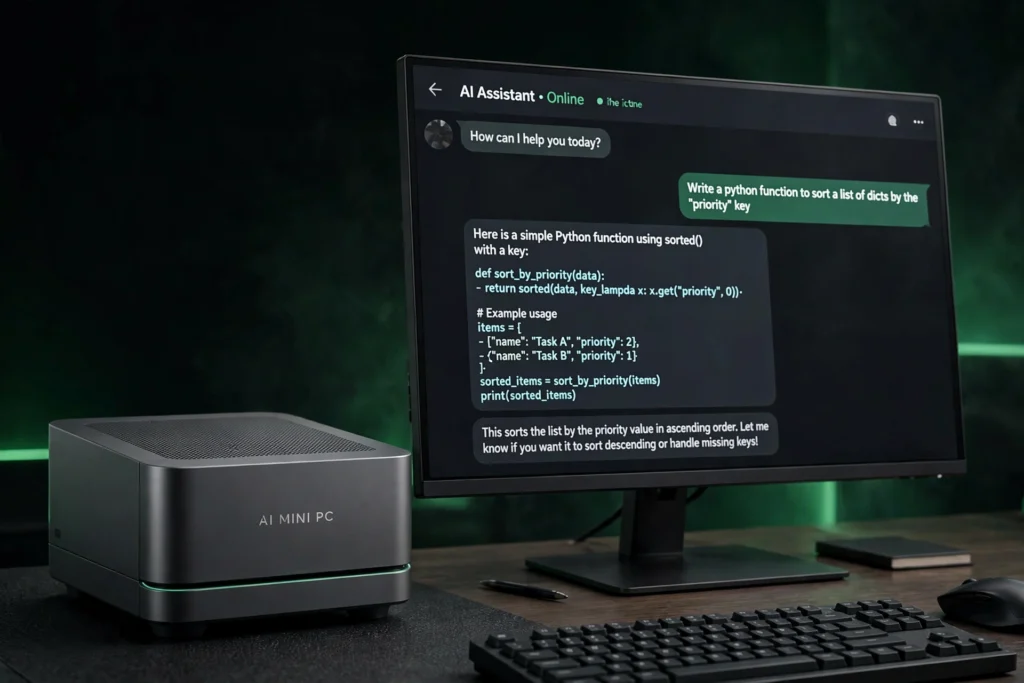
The AI PC just got a new job description. Nvidia’s RTX Spark compact desktops from ASUS, Dell and MSI are on sale now, and they are built for one specific purpose: running your AI agents locally, around the clock, on a Windows PC that sits on your desk. No cloud subscription, no per-token bill, no sending your files to a server farm — just a small box with a petaflop of AI performance inside.
What RTX Spark Actually Is
At the heart of every RTX Spark machine is a single superchip: a 20-core Nvidia Grace CPU and a Blackwell RTX GPU with 6,144 CUDA cores, connected by NVLink-C2C and sharing one pool of up to 128GB of unified memory. The headline figure is up to 1 petaflop of FP4 AI performance. Because the CPU and GPU share the same memory, a model never has to be copied back and forth between separate pools — the full 128GB is available to the model. In practice, Nvidia says these desktops can run 120-billion-parameter language models locally, render 90GB-plus 3D scenes in real time, and edit 4:2:2 video smoothly. Ten-gigabit Ethernet is built in, so large model files and datasets move fast between the desktop and networked storage. Full details are in Nvidia’s announcement.
The Desktops You Can Buy Today
The first wave is here. The ASUS ProArt GR1X mini PC measures just 150 x 150 x 51 mm and weighs 1.48 kg, yet it comes in 128GB and 64GB unified-memory configurations, with 10GbE LAN, Wi-Fi 7, Bluetooth 5.4, four USB-C ports and HDMI 2.1. ASUS has also partnered with Nous Research to bring Hermes Agent, an open-source autonomous agent, to its ProArt RTX Spark PCs. MSI’s EdgeMesa N AI+ Series is the other named desktop in the first wave, and Dell has its own compact desktop in the range. GIGABYTE’s AI TOP AERO, positioned as a “Personal AI Studio” with up to 4TB of PCIe Gen5 storage, launched on November 10 and starts at $3,999 in the United States. If you prefer a laptop, the ASUS ProArt P16 and P14 have been on sale since October 16, starting at $2,599.99. More choice is coming: mini PCs from Acer, GIGABYTE and HP, plus the Microsoft Surface RTX Spark Dev Box, are all on the way.
Why Run AI Locally at All?
Three reasons keep coming up. The first is privacy: code, documents and prompts processed on the machine stay on the machine, which matters for developers and creators working with client material. The second is cost: running supported models locally avoids per-token cloud API charges, and ASUS estimates that heavy daily agent workloads can rack up cloud token costs exceeding the price of a ProArt RTX Spark PC within five to ten months. The third is persistence: a dedicated desktop can keep agents and scheduled tasks running while a laptop travels or handles other work. It is the same direction the rest of the industry is moving — Google’s Agent Compute Engine gives every AI agent its own sandboxed computer in the cloud, and Anthropic’s Claude Ship lets agents review, fix and approve pull requests. RTX Spark is the hardware side of that same story: the agent gets a desk of its own. Nvidia is also building the software around it, with Hermes Agent and NemoClaw blueprints for setting up agents, Unsloth for fine-tuning, and a tool called Switchyard that routes simple tasks to the local model and harder reasoning to the cloud.

The Bigger Box: DGX Spark HPC Developer Kit
Nvidia is not stopping at the desk. At Supercomputing 26 in Chicago, the company introduced the DGX Spark HPC Developer Kit, a four-system cluster that links four RTX Spark machines in a ring with ConnectX-7 networking, aimed at researchers building scientific and AI workloads. The kit combines 512GB of memory across its four systems, turning the same local-AI hardware into a small cluster for labs that want serious compute without a data centre.
Who Should Buy One — and Who Should Wait
Buy one if you already run local models every day, fine-tune models, generate images and video on your own machine, or want an always-on agent that keeps working between sessions. Creators get a bonus too: Adobe’s apps now run natively on Windows on Arm for RTX Spark, and Blender 5.3 adds DLSS Ray Reconstruction to its viewport. Wait if your AI use is an occasional chatbot — a standard laptop or the cloud is far cheaper — or if you want the widest choice, since Acer, HP and the Surface Dev Box have not arrived yet. And keep an eye on the wider chip race: AI-designed processors like the Frostbite CPU show how fast this category is moving, so today’s petaflop desktop is the start of a product line, not the end of it.
RTX Spark desktops are the first Windows PCs designed from the ground up as homes for personal AI agents rather than as faster versions of the office PC. It caps a remarkable month for Nvidia — which recently reinstated Jensen Huang as CEO as its AI trade roared back. Whether RTX Spark machines become the default desk setup will depend on price, software and how quickly agents become part of everyday work — but the direction is clear. The AI PC is no longer a laptop with a chatbot button. It is a computer that keeps working for you after you walk away.