CodeBoxx Technology is now taking orders for something that sounds almost like a joke until you see the spec sheet: a whole AI software factory, squeezed into a one-cubic-meter box, that a company owns outright and runs in its own building. Called CrewKit Forge (also sold as Forge 20), it was unveiled on October 22 at the Titan 100 Tampa Bay gala and announced more widely on November 2, 2026. The pitch is blunt: stop renting your intelligence by the token, and own the machine that builds your software instead.
What CrewKit Forge actually is
CrewKit Forge is a self-contained appliance, about 3.3 feet on each side, made of black aluminum and smoked glass. It combines compute, storage and networking with its own control plane, and it runs the CrewKit Forge operating system. Its agents are designed to run the equivalent of up to 20 AI-equipped software professionals in parallel across product work, system architecture, design, testing, cybersecurity, monitoring, compliance and documentation. It can sit on a rolling Power Core Table with its own power conditioning, UPS and batteries, so CodeBoxx says it belongs in a boardroom or open-plan office, not a data center. Five touchscreens — three 32-inch panels plus a two-screen control console — show leaders in real time where work is happening and how it is performing. That presentation matters: this is sold as a program and a visible object, not a rack hidden in a server room.
The specs in the reference configuration
The reference configuration pairs a 96-core processor with NVIDIA-powered inference gateways, 1 TB of RAM and 12.8 TB of Gen5 NVMe storage. CodeBoxx’s own product page specifies an AMD Threadripper PRO 9995WX with 192 threads, an NVIDIA RTX PRO 6000 Blackwell card with 96 GB of VRAM, DDR5-6400 ECC memory and Gen5 storage for the repository vault and model cache, with 12 to 20 workstreams depending on configuration. CodeBoxx warns specifications may change before units ship, so treat these as the reference build, not a promise about every delivered unit. Still, the shape is clear: this is a serious workstation-class machine, tuned for running many AI models and many codebases at once, rather than one giant model in the cloud.
Local-first by design, cloud only when it wins
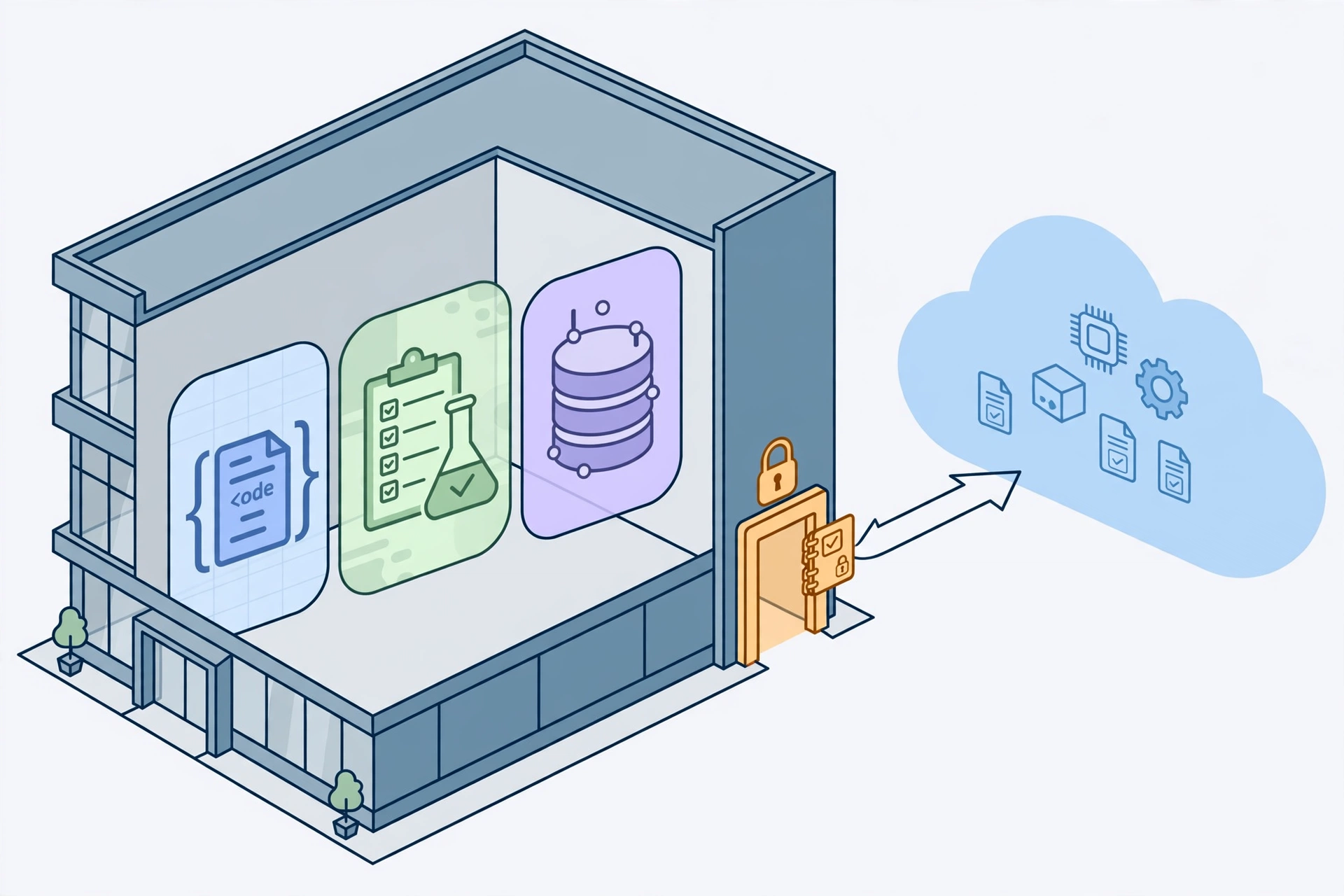
The most interesting idea in Forge is not the box, it is the rule for what leaves the box. Repository work, builds, code scaffolding, tests, code review and monitoring run locally by default. When a job needs frontier-scale reasoning or very long context, CrewKit escalates it to its private AI Cloud through a managed inference gateway — and logs the decision. CodeBoxx says no code or data leaves the building without a recorded decision, and people stay in charge of ideation, requirements, defining success and judgment at every iteration. For regulated companies, that audit trail is the point. It is also a direct answer to the way coding work is changing: as our coverage of how AI agents now start over 40 percent of GitHub pull requests shows, agents are doing more of the first draft, so governance and review matter more, not less. A local-first factory gives a team a place to enforce that governance. The same on-device logic is reshaping hardware too, as seen in the edge AI chip that runs powerful models on tiny power budgets.
A quantum gateway, for later
Forge also includes an optional quantum gateway that lets enterprise developers develop, simulate and rehearse quantum algorithms on the appliance before running them on actual qubits. Be realistic about this: it is preparation, not quantum computing. No company should buy Forge for quantum work today. But for teams that want to build quantum skills while the hardware matures, rehearsing on a local box is a lower-risk way to start than waiting for a breakthrough and then scrambling to catch up.
What CodeBoxx claims it already delivered
CodeBoxx says it built CrewKit Forge inside its own software delivery business, and it publishes striking self-reported results: about $14.9 million saved across seven client platforms compared with a traditional 2022 development team, and an average of 5.2 times faster delivery at 78 percent lower cost across four benchmark studies. Read those numbers carefully. The savings come from billed amounts and delivery records, but the traditional-team comparisons are CodeBoxx estimates, and the company publishes its methodology for readers to check. Independent verification has not been published. That does not make the claims false, but it does mean a buyer should ask for a pilot on their own codebase before believing a 5x speedup. The wider trend is real, though: team-scale coding agents are moving from demos to daily work, as shown by the open-source team coding agent from DeepSeek.
Who should actually buy one, and who should not

Forge makes most sense for companies with confidentiality or compliance requirements, predictable software workloads, and frustration with rising per-token cloud bills. For them, a fixed, owned asset plus a three-year White-Glove service plan and onboarding through CodeBoxx Academy could be simpler to budget than an open-ended AI bill. It makes less sense for a small team with one product, for a company whose workloads spike unpredictably, or for anyone who needs the very largest frontier models for every task — local hardware, however powerful, will not outrun the biggest cloud models. CodeBoxx delivers and installs Forge on site in the United States and Canada, and a fully refundable $2,500 deposit holds a configuration and a place in the deployment queue. Customers can pay on delivery or finance it monthly, but CodeBoxx has not published a full purchase price in the announcement, so the total cost of ownership is still an open question to confirm before ordering.
The honest caveats
First, this is a vendor announcement, not an independent review: no outside benchmark of Forge’s 20-workstream claim has been published yet. Second, owning hardware means owning its upkeep, upgrades and eventual replacement, even with a service plan. Third, the $14.9 million and 5.2x figures are CodeBoxx estimates against a 2022 baseline, and your results will depend on your codebase, your team and how disciplined your review process is. And fourth, a local-first box does not remove the need for human judgment — it just moves that judgment closer to home. If that trade sounds appealing, Forge is worth a serious look. If you want the simplest possible setup, a cloud tool you can cancel next month is still the easier choice.
Bottom line
CrewKit Forge is a bet that the next phase of AI software development is not bigger cloud bills, but smaller, owned, governed factories inside the companies that use them. The box is striking, the local-first rule is genuinely useful, and the quantum gateway is a sensible hedge. What it is not, yet, is proven at scale outside CodeBoxx’s own business. Treat it as a serious pilot candidate for regulated or cost-conscious teams — and demand real numbers on your own work before you buy the factory.