What if your AI coding assistant never sent a line of your code to the cloud? That is the pitch behind the AMD Instinct Coder 355, a turnkey on-premises AI coding appliance announced on Tuesday, November 10, 2026, at KubeCon North America in Salt Lake City. Built by Spectro Cloud with AMD, Dell and Supermicro, the appliance packs eight AMD Instinct MI355X GPUs into a Dell PowerEdge server and runs an open-weight coding model locally, so enterprise development teams can get AI help without their proprietary source code ever leaving the building.
The timing is no accident. AI-assisted coding has accelerated sharply through 2026, but so has executive concern about sending proprietary code to third-party APIs. The Instinct Coder 355 is aimed squarely at that tension: keep the everyday coding work inside the firewall, and send only the hardest tasks out to frontier cloud models when the local model reaches its limits.
What AMD and Spectro Cloud announced at KubeCon
The Instinct Coder 355 is a pre-validated, turnkey appliance — hardware, software and model routing bundled into a single SKU that IT teams can order and deploy rather than assemble themselves. It expands the AMD Instinct Coder portfolio with a higher-performance option for larger teams, following the Instinct Coder 325, which launched in August 2026 and, according to Spectro Cloud, showed strong demand for running AI coding inference on infrastructure organisations own and control.
The appliance is delivered by Spectro Cloud through Dell Technologies OEM Solutions, and it is available to order through Spectro Cloud and its reseller and distribution partners. Live demonstrations were held at Spectro Cloud’s KubeCon booth, number 125, throughout the three-day conference. No list price or lead times were disclosed in the public announcement.
Inside the box: eight MI355X GPUs and a Dell PowerEdge
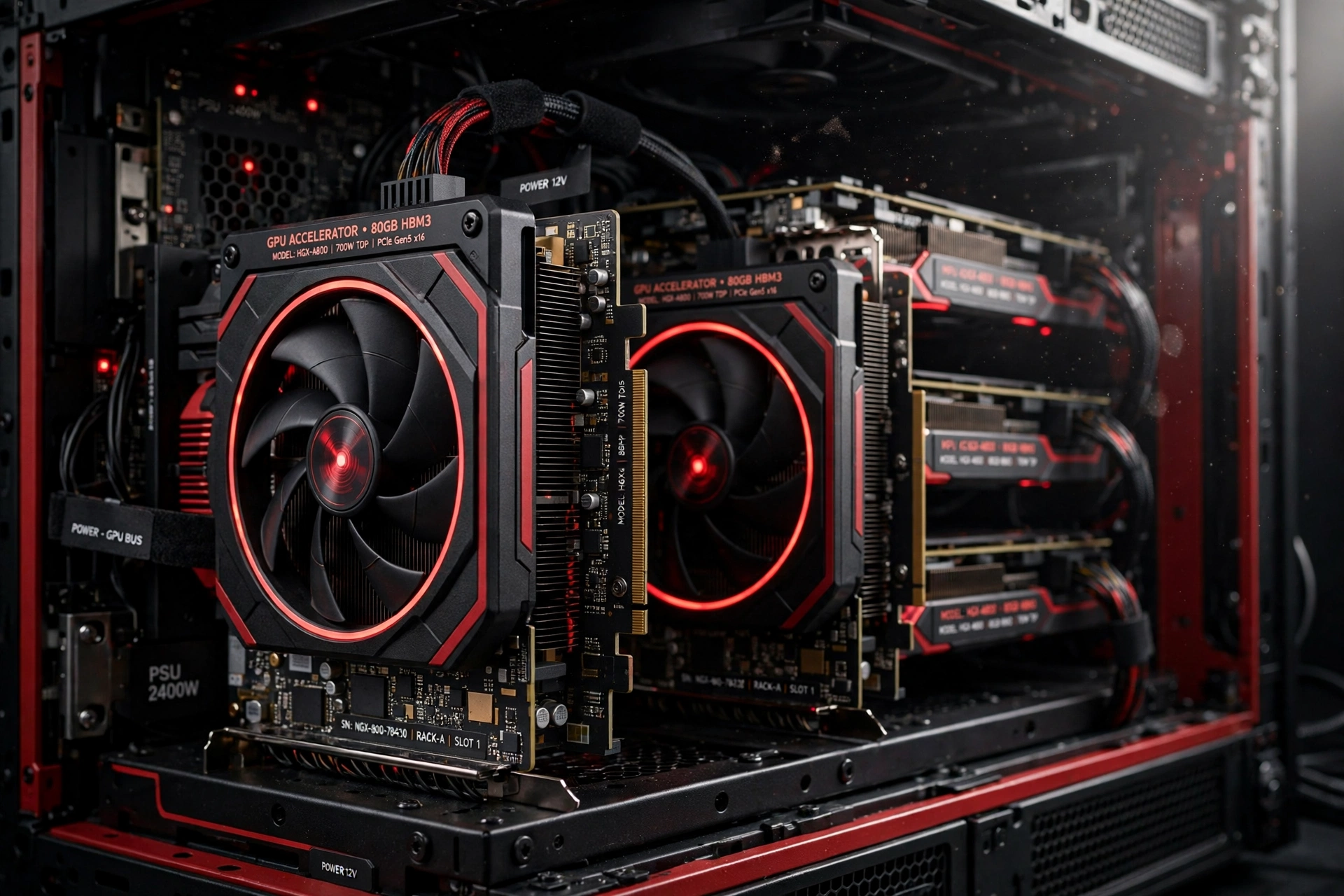
The hardware is the headline. Each Instinct Coder 355 node stacks eight AMD Instinct MI355X GPUs, each with 288 GB of HBM3E memory and up to 8 TB/s of memory bandwidth, inside a Dell PowerEdge XE9785 server. The chassis also carries a pair of AMD EPYC 9575F 64-core CPUs and 3 TB of DDR5 system RAM, according to Spectro Cloud’s launch materials.
That is serious compute for a single box, and it is deliberately over-provisioned for one purpose: serving large open-weight models with long context windows to many developers at once. The MI355X is the same GPU family powering some of the largest supercomputing systems of the year — IBM, Oak Ridge and AMD’s quantum error-correction platform, for example, runs its classical workloads on MI355X GPUs paired with 5th Gen AMD EPYC CPUs — so the appliance borrows hardware pedigree from the HPC world and points it at the everyday work of writing software.
Local-first by design: GLM-5.3 runs on-prem

The software layer is Spectro Cloud’s PaletteAI Inference Launchpad, which serves the open-weight GLM-5.3 coding model locally on the appliance. Developers connect through the tools they already use — Claude Code, Cursor, Codex and Visual Studio Code — through standard inference APIs, so the local model feels like any other coding assistant, except the requests never leave the building.
The “local-first” label comes with a safety valve. When a coding task exceeds what the local model can handle, or falls inside a sensitivity threshold the platform team defines, the router falls back to a frontier cloud model — Anthropic Claude, OpenAI GPT, Google Gemini or xAI — under the rules the platform team sets. Spectro Cloud describes this as intelligent model routing: routine autocomplete, code generation and conversational queries stay local, while only the hardest tasks go out. Token metering, per-team quotas, audit trails and side-by-side local-versus-frontier dashboards give platform teams visibility into what is being spent, on what, and by whom.
The cost pitch: up to 75 percent lower token costs
Spectro Cloud’s headline claim is economic: the appliance reduces AI coding token costs by up to 75 percent compared with cloud frontier models, and delivers up to 98 percent of frontier-model benchmark performance. Its product page also claims payback in about six months, modelled on an 85-developer scenario with mixed local and frontier usage.
Those numbers deserve a careful read. The 75 percent figure reflects the economics of amortising GPU capital expenditure across dozens of developers instead of paying per-token charges to an external provider — a trade that favours organisations with stable, predictable developer headcount. And the performance claims come from the vendor: no third-party workload mix or independent validation has been published for the 98 percent figure, and the product page itself cites a slightly different figure of up to 95 percent of frontier-model performance. Treat the headline numbers as the vendor’s case, not a benchmark.
Even with that caveat, the direction of the argument is sound. One appliance is projected to support roughly 50 concurrent developers, and Spectro Cloud’s product page describes up to 85 developers per node in its modelled scenario. For a team of that size paying frontier-model prices for every autocomplete and code review, the fixed-cost appliance can pay for itself quickly — if the local model is good enough for most of the work.
Who it is for — and who should wait
The Instinct Coder 355 makes the most sense for organisations where data residency is a requirement, not a preference: regulated industries, defence and government work, and companies whose code is their crown jewel. It also suits teams in locations where round-trip latency to cloud services is a real drag on the coding loop, and IT departments that lack in-house machine-learning infrastructure expertise but want a pre-validated box rather than a build-it-yourself GPU cluster.
It is less obviously right for small teams, where a single appliance is far more capacity than needed, or for teams whose work regularly pushes beyond what open-weight models can do — the overflow routing helps, but if most tasks end up in the cloud anyway, the cost case weakens. And with no list price disclosed, the payback math cannot be checked until buyers get a quote.
The broader point is that the appliance model shifts AI coding from variable operating expense to fixed capital expense. That is a trade-off, not a free lunch, and it favours organisations whose developer headcount and coding workloads are stable and predictable.
How it fits the on-prem AI coding race
The Instinct Coder 355 arrives in a crowded week for silicon and infrastructure. It joins a growing shelf of private coding-assistant appliances that aim to keep inference, training data and proprietary source code behind the corporate firewall, competing directly with cloud-based tools like GitHub Copilot and Cursor, as well as other on-premises offerings from silicon vendors and systems integrators.
The same week brought other big infrastructure bets. Rackspace and Together AI’s Blackwell Ultra infrastructure targets enterprise inference at a different scale, while Texas Instruments’ agentic AI tools for embedded development show the same local-first instinct reaching down to the chip level. Even the model labs are converging on the same question from the opposite direction: Anthropic’s Claude Fable 5.2, launched the day before, is aimed at coding, science and security workloads that enterprises increasingly want to run close to home.
What is striking is how quickly the market has split. One side is the cloud frontier — the biggest models, rented by the token. The other is the appliance shelf — open-weight models running on hardware you own, with the cloud as overflow. The Instinct Coder 355 is AMD and Spectro Cloud’s bet that a large slice of enterprise coding work belongs on the second side.
Availability and pricing: what you can order today
The AMD Instinct Coder 355 is available to order now through Spectro Cloud and its reseller and distribution partners, with live demonstrations at KubeCon North America. Spectro Cloud has not disclosed list pricing or lead times in the public announcement, so interested organisations are directed to contact the company for evaluation.
Bottom line
The Instinct Coder 355 is a straightforward idea executed at serious scale: put eight MI355X GPUs and an open-weight coding model in a box, sell it as a turnkey appliance, and let enterprises keep their code at home while routing only the hardest tasks to the cloud. The cost claims are vendor figures and the price is undisclosed, so the payback case cannot be verified from the announcement alone. But the product itself is real, orderable today, and aimed at a concern — proprietary code leaving the building — that every large engineering organisation now shares. If the local model is good enough for most of the day’s work, the box pays for itself; if it is not, the cloud is still one hop away.
Frequently asked questions
What is the AMD Instinct Coder 355?
The AMD Instinct Coder 355 is a turnkey on-premises AI coding appliance announced on November 10, 2026, by Spectro Cloud and AMD with Dell and Supermicro. It runs the open-weight GLM-5.3 coding model locally on eight AMD Instinct MI355X GPUs in a Dell PowerEdge XE9785 server.
How many developers can one Instinct Coder 355 support?
Spectro Cloud says one appliance supports approximately 50 concurrent developers, with up to 85 developers per node in its modelled total-cost scenario. Capacity depends on the mix of autocomplete, code generation and conversational queries in actual use.
How much does the Instinct Coder 355 cost?
No list price has been disclosed. Spectro Cloud claims up to 75 percent lower token costs versus cloud frontier models and payback in about six months, modelled on an 85-developer scenario. Orders go through Spectro Cloud and its reseller partners.
Does the Instinct Coder 355 work with Claude Code and Cursor?
Yes. The appliance serves GLM-5.3 and other open coding models to Claude Code, Cursor, Codex and Visual Studio Code through standard inference APIs, and it can route harder tasks to Anthropic Claude, OpenAI GPT, Google Gemini or xAI.
Source: BusinessWire press release
Source: Emergent’s report
Source: Spectro Cloud’s product page