
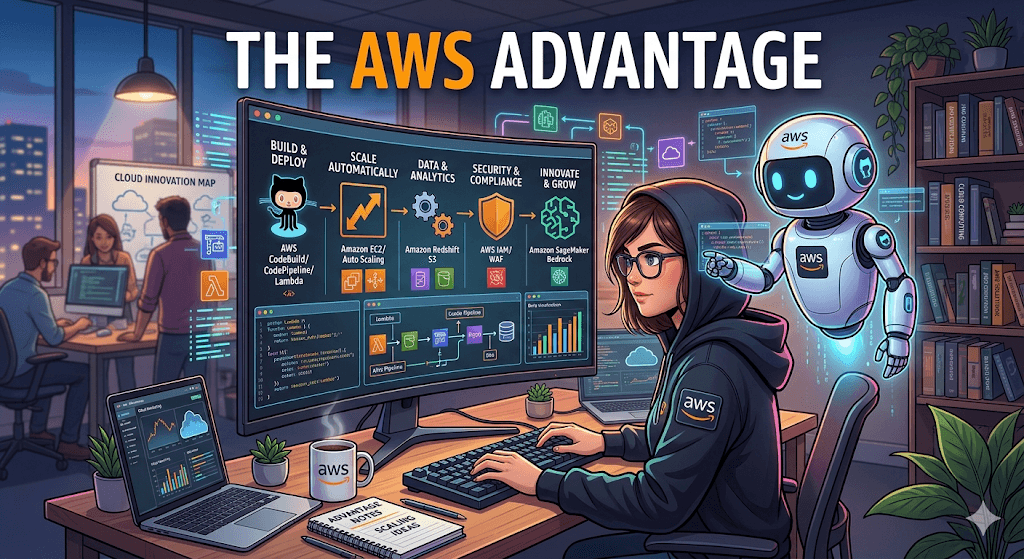
Six in-depth articles exploring why Amazon Web Services continues to be the backbone of modern cloud infrastructure for startups and enterprises alike.
Elastic Scalability: Growing Without Limits
One of the most compelling reasons businesses migrate to AWS is the ability to scale infrastructure up or down in real time — matching capacity precisely to demand without ever over-provisioning.
In the traditional on-premise world, planning for peak capacity meant purchasing hardware for the busiest day of the year and letting it sit idle the rest of the time. AWS flips this model entirely. Services like Amazon EC2 Auto Scaling, AWS Lambda, and Amazon ECS allow you to respond to traffic spikes in seconds, not weeks, ensuring your users always get a fast and reliable experience.
Why Elasticity Matters
Consider an e-commerce company during a holiday sale. Traffic might surge 10x in a matter of minutes. With AWS, auto-scaling groups detect the spike, spin up additional instances, and distribute load seamlessly through Elastic Load Balancing. When the rush subsides, those instances are terminated automatically — so you only pay for what you actually use.
AWS elasticity turns infrastructure from a fixed cost into a variable one, perfectly aligned with your actual business demand. You never pay for idle capacity again.
Serverless: The Ultimate Scale
AWS Lambda takes scalability a step further by removing servers from the equation entirely. Your code runs in response to events — an API call, a file upload, a database change — and AWS handles provisioning, scaling, and fault tolerance behind the scenes. This means you can go from zero to thousands of concurrent executions without configuring a single server.
For startups, this is transformative. You can build production-grade applications with virtually no upfront infrastructure investment and scale gracefully as your user base grows from hundreds to millions.
Cost Optimization: Pay Only for What You Use
AWS’s pay-as-you-go pricing model eliminates massive capital expenditure on hardware, transforming IT budgets from rigid cost centers into flexible, optimizable operating expenses.
The financial benefits of AWS go far beyond simply avoiding hardware purchases. AWS provides a rich ecosystem of pricing models — On-Demand, Reserved Instances, Savings Plans, and Spot Instances — that let you tailor your spending strategy to your workload patterns and risk tolerance.
Spot Instances: Up to 90% Savings
For fault-tolerant or flexible workloads — batch processing, data analysis, CI/CD pipelines — Spot Instances offer the same compute power at a fraction of the On-Demand price. Organizations running large-scale data pipelines routinely save 60-90% on compute costs by intelligently leveraging Spot capacity.
Right-Sizing and Visibility
AWS Cost Explorer and AWS Compute Optimizer analyze your usage patterns and recommend instance types that match your actual needs. It’s common for first-time audits to reveal 30-40% over-provisioning. By right-sizing instances and eliminating waste, organizations often see dramatic cost reductions within the first quarter of optimization.
Combine Reserved Instances for baseline capacity, On-Demand for predictable bursts, and Spot for background processing. This “tri-model” approach often yields the best overall cost efficiency.
AWS also offers the AWS Free Tier, giving startups and developers access to a generous set of services at no cost for the first 12 months. This allows teams to prototype, experiment, and validate ideas without financial risk — a powerful advantage in competitive markets.
Security and Compliance: Built from the Ground Up
Security is not a bolt-on feature in AWS — it’s woven into every layer of the platform. From physical data center protections to granular access controls, AWS provides one of the most comprehensive security frameworks in the industry.
AWS operates under a “shared responsibility model.” AWS secures the infrastructure — the hardware, networking, and facilities — while you manage security of your data, applications, and configurations within the cloud. This model provides a strong baseline that most organizations could never replicate on their own.
Identity and Access Management
AWS IAM lets you define precisely who can access what, down to individual API actions on specific resources. Combined with AWS Organizations and Service Control Policies, enterprises can enforce security guardrails across hundreds of accounts without manual intervention.
Encryption Everywhere
Nearly every AWS service supports encryption at rest and in transit. AWS Key Management Service (KMS) provides centralized key management, and services like Amazon S3 offer default encryption so that data is protected from the moment it’s stored. AWS CloudTrail logs every API call, giving you a complete audit trail for compliance.
AWS holds certifications for SOC 1/2/3, ISO 27001, HIPAA, FedRAMP, GDPR, PCI DSS, and over 90 other compliance standards — more than any other cloud provider. This means less work for your compliance team and faster time to audit readiness.
Advanced threat detection services like Amazon GuardDuty, AWS Security Hub, and Amazon Inspector continuously monitor your environment for suspicious activity, misconfigurations, and vulnerabilities — giving your security team actionable intelligence rather than noise.
Driving Innovation with Managed Services
AWS doesn’t just host your applications — it accelerates what you can build. With managed services spanning AI/ML, analytics, IoT, and beyond, teams spend less time on infrastructure plumbing and more time creating differentiated products.
The breadth of AWS’s service catalog is staggering. Need a machine learning model in production? Amazon SageMaker handles the entire lifecycle from training to deployment. Want real-time analytics on streaming data? Amazon Kinesis and Amazon Redshift make it straightforward. Building voice-enabled interfaces? Amazon Alexa and Amazon Lex provide the building blocks.
AI and Machine Learning
AWS offers AI services at every level of abstraction. Pre-trained APIs like Amazon Rekognition (image analysis), Amazon Comprehend (natural language processing), and Amazon Translate let you add intelligence to applications with a single API call — no ML expertise required. For teams with deeper needs, SageMaker provides a full-featured ML development environment.
Data Lakes and Analytics
Building a modern data platform on AWS is remarkably accessible. Amazon S3 serves as the foundation for data lakes, Amazon Athena lets you query data with SQL without provisioning any infrastructure, and Amazon Redshift delivers petabyte-scale analytics. The integration between these services means you can go from raw data to actionable insights faster than ever.
AWS releases thousands of new features annually. By building on AWS, your team automatically gains access to the latest capabilities in AI, analytics, compute, and networking — without managing upgrades or migrations.
Global Infrastructure: Reach Users Everywhere
With data centers spanning the globe, AWS lets you deploy applications close to your users — reducing latency, improving performance, and meeting data residency requirements without building a single physical facility.
AWS operates across dozens of geographic Regions, each containing multiple isolated Availability Zones. This architecture enables you to build applications that are resilient to facility-level failures while keeping data within specific jurisdictions for regulatory compliance.
Edge Computing with CloudFront
Amazon CloudFront, AWS’s content delivery network, caches your content at hundreds of edge locations worldwide. Static assets, API responses, and even dynamic content can be served from the location closest to each user. The result is dramatically lower latency — often under 10 milliseconds for cached content — and a significantly better user experience.
Multi-Region Architecture
For mission-critical applications, AWS makes it practical to deploy across multiple regions with services like Amazon Route 53 (DNS-based traffic routing), Amazon Aurora Global Database (cross-region replication with sub-second lag), and AWS Global Accelerator (optimized network paths). These tools let you architect for both performance and disaster recovery at a global scale.
Whether you’re a startup targeting a single market or a multinational serving users on every continent, AWS provides the infrastructure to meet your audience where they are — with the performance they expect.
DevOps Excellence: Ship Faster, Ship Safer
AWS provides a complete toolkit for modern software delivery — from code commit to production deployment — enabling teams to adopt CI/CD practices, infrastructure as code, and observability without stitching together disparate tools.
The AWS Developer Tools suite — CodeCommit, CodeBuild, CodeDeploy, and CodePipeline — forms an integrated delivery pipeline that automates building, testing, and deploying applications. Combined with AWS CloudFormation or the AWS Cloud Development Kit (CDK), teams can define their entire infrastructure in code, version it alongside application code, and deploy changes with confidence.
Infrastructure as Code
AWS CloudFormation lets you model your entire cloud environment in declarative templates. Every resource — from VPCs and databases to Lambda functions and IAM roles — is defined, version-controlled, and reproducible. The CDK goes further, letting you use familiar programming languages like TypeScript and Python to define infrastructure with the full power of loops, conditionals, and abstractions.
Observability and Monitoring
Amazon CloudWatch provides unified metrics, logs, and traces across your AWS resources. Combined with AWS X-Ray for distributed tracing and Amazon EventBridge for event-driven automation, you gain deep visibility into application behavior and can respond to issues before they impact users.
Organizations that fully embrace AWS DevOps tooling report deployment frequencies increasing from monthly to multiple times per day, with lower failure rates and faster recovery times. The investment in automation pays compound dividends over time.
Container orchestration through Amazon ECS and Amazon EKS, combined with AWS Fargate for serverless containers, means you can run microservices at any scale without managing the underlying cluster infrastructure. This lets engineering teams focus on writing code that delivers business value rather than managing servers.