
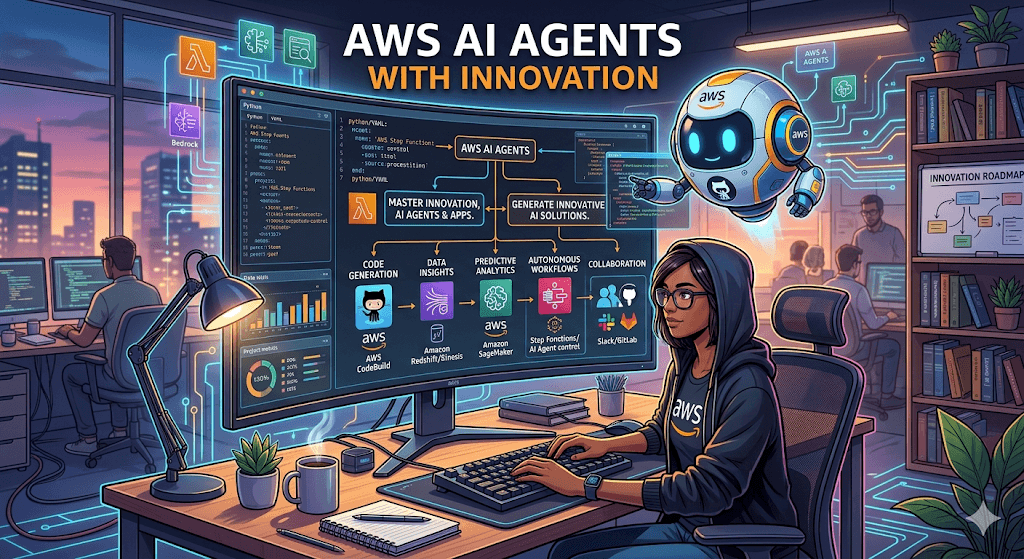
How Amazon Web Services is building the infrastructure, tools, and frontier agents that will define the next era of enterprise AI.
From Chatbots to Digital Teammates
Something fundamental has shifted in the AI landscape. The era of typing a prompt and receiving a paragraph back is giving way to something far more ambitious: AI systems that can plan, reason, and autonomously execute multi-step tasks with minimal human oversight. AWS calls this agentic AI, and they’re betting it will be as transformative as cloud computing itself.
Unlike the chatbot wave of 2023–2024, agentic AI isn’t about generating text — it’s about getting work done. These are AI systems that can research a problem, break it into sub-tasks, call the right APIs, evaluate their own results, and iterate until the job is finished. AWS envisions billions of such agents operating across consumer, enterprise, and industrial settings — from planning travel itineraries to optimizing global supply chains.
The Full Stack of Agentic AI
What sets the AWS approach apart is its ambition to own every layer of the agentic stack — from custom silicon to frontier agents. The company has organized its offerings into five tiers, each addressing a different need in the agentic AI journey.
Frontier Agents
Fully autonomous agents — like Kiro, Security Agent, and DevOps Agent — that work for hours without intervention.
Agent-Powered Apps
Ready-to-use solutions like AWS Transform for legacy modernization and Amazon Quick for research and insights.
Builder Tools
Amazon Bedrock AgentCore, Strands Agents SDK, and Nova Act for custom agent development at scale.
Foundation Models
Access to Anthropic’s Claude, OpenAI models, Amazon Nova, and Qwen — all optimized for reasoning and tool use.
Sitting beneath all of this is what AWS calls its agentic infrastructure — purpose-built silicon like Trainium and Inferentia chips, Amazon SageMaker AI, and the vertically integrated data center stack that provides the compute backbone agents need at scale.
Frontier Agents: The Headline Act
The most attention-grabbing announcement in the AWS agentic portfolio is the concept of frontier agents: a new class of AI systems designed to deliver complete outcomes autonomously. These aren’t assistants that help you write code — they are the developer, the security consultant, and the on-call operations team.
The Big Three
A virtual developer that takes on tasks asynchronously, maintains persistent context across sessions and repositories, and learns from feedback — dramatically multiplying team capacity.
Embeds deep security expertise from design to deployment — performing automated code analysis, architecture reviews, and contextual penetration testing tailored to each organization’s stack.
Goes beyond incident response to proactive prevention — resolving issues and continuously improving system reliability and performance before problems reach production.
The key difference between frontier agents and earlier automation tools is scope. These agents can work for hours or even days on complex, multi-step tasks without needing a human to steer every decision. Early adopters like Commonwealth Bank of Australia, SmugMug, and Western Governors University have already reported meaningful improvements in their software development lifecycle.
Amazon Bedrock AgentCore: The Builder’s Platform
For organizations that want to build their own agents rather than use off-the-shelf solutions, Amazon Bedrock AgentCore is the centerpiece. It’s a platform for building, deploying, and operating agents securely at enterprise scale — and it’s been designed to be framework-agnostic and model-agnostic from the start.
AgentCore is comprised of fully managed services that can be combined or used independently. Key capabilities that have rolled out include Policy, which lets developers set natural-language boundaries for what agents can and cannot do; AgentCore Memory, which gives agents persistent context across interactions; and AgentCore Evaluations, a suite of 13 pre-built evaluation systems that monitor for correctness, safety, and tool-selection accuracy.
The Policy feature is particularly noteworthy. Developers can write rules like “issue refunds up to $100 automatically, but escalate anything larger to a human” — and the system enforces those boundaries in real time across all agent actions. This kind of governance is exactly what risk-averse enterprises need before deploying agents in production.
Real-World Results — Not Just Promises
The case for agentic AI is strongest when measured in outcomes, not demos. Several organizations are already showing measurable returns with AWS-powered agents.
Thomson Reuters used AWS Transform to modernize their .NET applications and cut costs by 30% while quadrupling transformation speed. Syngenta is using multi-agent collaboration on Amazon Bedrock to help farmers boost crop yields with data-driven insights. And internally, AWS built RuleForge — an agentic AI system that generates security detection rules from vulnerability code — achieving a 336% productivity advantage over manual methods while maintaining production-grade accuracy.
In healthcare, Amazon Connect Health is tackling administrative burden for providers, with one health system saving 630 hours of labor per week by shifting from patient verification to direct assistance across its 3.2 million annual interactions.
The Open-Source Play: Strands Agents
In a move that signals AWS’s commitment to developer flexibility, the company open-sourced Strands Agents — an SDK that lets developers build sophisticated agents in just a few lines of code, with no complex orchestration required. The SDK dramatically reduces what previously took months of technical work into a process that can take hours.
Strands Agents is designed for multi-agent collaboration — enabling coordinated teams of AI systems to handle customer service, data analysis, and other complex tasks. Paired with Model Context Protocol (MCP) support for agent-to-agent communication, this positions AWS to be a hub not just for building individual agents, but for orchestrating fleets of them.
The Infrastructure Advantage
Perhaps the most underappreciated aspect of the AWS agentic strategy is the infrastructure investment beneath it all. Amazon has announced plans to spend a record $200 billion in capital expenditure in 2026, a significant portion directed at data centers, custom chips, and AI infrastructure.
The latest Trainium3 chip — AWS’s first 3nm AI silicon — delivers up to 4.4× more compute performance and 4× greater energy efficiency than its predecessor. When packaged in EC2 Trn3 UltraServers with up to 144 chips per system, these machines are designed to train and run the kinds of massive, reasoning-intensive models that agentic workloads demand.
AWS is also introducing stateful runtime environments within Bedrock that allow agents to maintain memory, context, and tool access across multi-step workflows — a foundational shift from the stateless prompt-response paradigm that defined the first generation of LLM applications.
What This Means for 2026 and Beyond
Industry analysts are forecasting rapid adoption. Gartner predicts that 40% of enterprise applications will integrate task-specific AI agents by the end of 2026 — up from less than 5% when the prediction was first published. The shift in customer mindset is moving from “what is possible” to “what can we operationalize.”
AWS is positioning itself at the center of this wave by offering everything from quick-start applications for teams who want results today, to deeply customizable platforms for builders who need to control every detail. The breadth of this approach — from custom silicon to frontier agents — is difficult for competitors to replicate in the near term.
The open question isn’t whether agentic AI will transform enterprise workflows — the early results make that case persuasively. The real question is which organizations will move early enough to capture the advantage, and which will be playing catch-up in a landscape that has fundamentally changed beneath their feet.
Ready to Start Building?
New AWS customers receive up to $200 in credits to explore agentic AI tools — from Bedrock AgentCore to Strands Agents.
Explore AWS Agentic AI →