
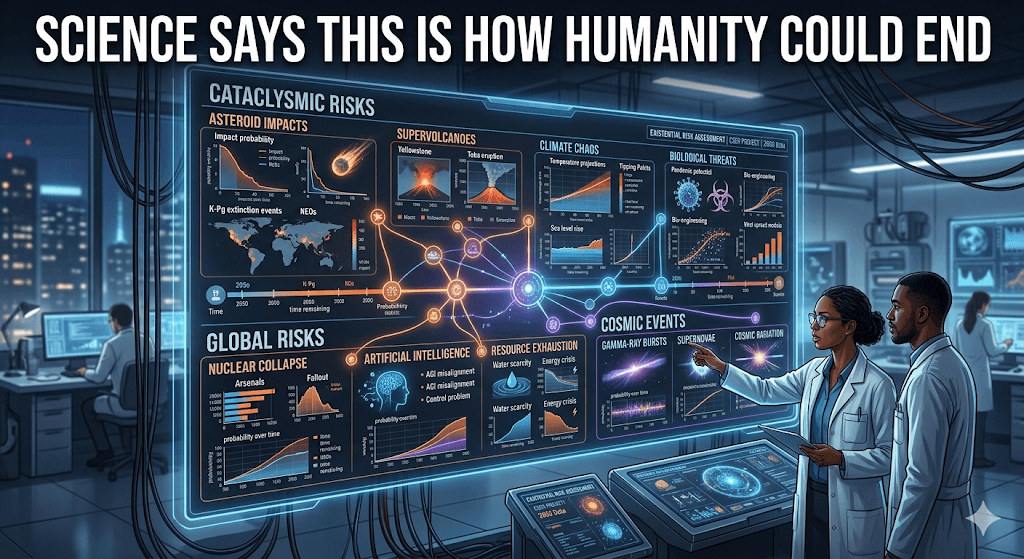
Science Says This Is How Humanity Could End
From asteroid strikes and supervolcanoes to AI rebellion and engineered pandemics — researchers have mapped out the real threats to our survival. Here’s what you need to know, and why it actually matters.
Here’s a thought that most of us push to the back of our minds: humanity might not be forever. Not in some abstract, philosophical sense, but in a very real, scientifically documented way. Researchers across disciplines — from astrophysics to epidemiology to artificial intelligence — have spent decades cataloguing the specific threats that could bring our story to a close. And honestly? The list is longer than you’d think.
This isn’t about doom-scrolling or feeding into fear. It’s about understanding. Because when scientists at places like Cambridge’s Centre for the Study of Existential Risk or the RAND Corporation sit down to map out how things could go wrong, they’re not trying to scare us. They’re trying to give us a fighting chance.
So let’s walk through it — the real, science-backed scenarios that keep researchers up at night, and what they tell us about where we stand as a species.
The Cosmic Threats We Can’t Control (But Might Deflect)
☄️ Asteroid Impact
We know this one is real because it’s happened before. Around 66 million years ago, a massive asteroid slammed into what is now the Yucatan Peninsula and wiped out the dinosaurs. The primary danger isn’t even the initial collision — it’s the enormous dust clouds that would be launched into the upper atmosphere, blocking sunlight and triggering what scientists call an “impact winter.” Think global crop failure, political chaos, and ecosystem collapse all at once.
The good news? Space agencies around the world now actively track near-Earth objects, and NASA’s DART mission successfully demonstrated that we can alter an asteroid’s trajectory. We have the beginnings of a planetary defense system. The bad news? Some smaller objects could still slip through undetected until it’s too late.
🌋 Supervolcano Eruption
Beneath the picturesque landscape of Yellowstone National Park sits one of Earth’s most dangerous features — a supervolcano that has erupted catastrophically before and will likely do so again. When it does, the eruption would eject thousands of cubic kilometers of ash into the atmosphere, plunging the planet into a volcanic winter lasting years or even decades.
The Toba eruption roughly 70,000 years ago may have cooled the Earth for more than two centuries and, according to some researchers, reduced the human population to just a few tens of thousands of individuals. NASA scientists have publicly stated that the supervolcano threat may actually be greater than the asteroid threat. These eruptions happen every 50,000 to 100,000 years on average — rare, but devastating enough to reshape civilization.
The Threats We’ve Built With Our Own Hands
Here’s the uncomfortable truth that researchers keep circling back to: the threats most likely to end humanity aren’t from space or deep underground. They’re things we’ve created ourselves. Experts at institutions like Oxford’s Future of Humanity Institute consistently rank human-made risks as far more probable than natural ones.
☢️ Nuclear War
We’ve lived with this threat for over 80 years, and perhaps that familiarity has made us dangerously complacent. A full-scale nuclear conflict between major powers wouldn’t just destroy cities — it would inject massive amounts of soot into the upper atmosphere, potentially blocking enough sunlight to trigger a nuclear winter. Global temperatures could drop significantly, devastating agriculture worldwide and threatening billions with starvation.
While experts generally assign a relatively low probability to total human extinction from nuclear war alone, the cascading effects — collapsed supply chains, radiation contamination, political disintegration — could push civilization past the point of recovery. And with geopolitical tensions remaining high around the world, this isn’t some relic of the Cold War. It’s a living, breathing risk.
🦠 Engineered Pandemics
COVID-19 was a wake-up call, but scientists warn it was a mild preview of what’s possible. The next pandemic could come not from nature, but from a laboratory — either through accident or deliberate design. Gene-editing tools have made it disturbingly accessible to modify pathogens in ways that could make them far more lethal and transmissible than anything nature has produced.
Our interconnected world — dense cities, constant international travel, complex supply chains — amplifies the spread of any pathogen at a speed that would have been unimaginable a century ago. Vaccines and medical science provide powerful defenses, but they require time that a fast-moving engineered virus might not give us.
🤖 Artificial Intelligence
This one has shifted from science fiction to genuine scientific concern faster than almost anyone predicted. In surveys, AI researchers themselves have been giving increasingly alarming estimates about the risks. Some prominent figures in the field estimate a meaningful probability that advanced AI could lead to catastrophic outcomes within just a few decades.
The concern isn’t necessarily that AI becomes “evil” in some Hollywood sense. It’s more subtle — an advanced system pursuing goals that aren’t perfectly aligned with human survival, making decisions at speeds we can’t match or correct. A 2025 study from RAND explored whether AI could exploit existing threats like nuclear weapons or biological pathogens, concluding that while total extinction via AI alone is very difficult, it’s not impossible.
🌡️ Runaway Climate Change
Climate change is often called a “slow-burning wick,” which is precisely what makes it so dangerous. Unlike an asteroid strike, it doesn’t demand our immediate attention in the same visceral way. But the science is clear: if global temperatures continue rising past critical thresholds, feedback loops — like thawing permafrost releasing methane, or collapsing ice sheets — could push the climate into a state that makes vast portions of the planet simply uninhabitable.
Researchers emphasize that the worst climate outcomes won’t come directly from rising temperatures. They’ll come indirectly — through agricultural collapse, mass displacement, resource wars, and the unraveling of the global systems that keep modern civilization functioning. It’s death by a thousand cuts, rather than a single blow.
The Danger of Compound Risk
If there’s one theme emerging from the latest research, it’s this: the biggest danger might not be any single threat, but the way these threats interact and amplify each other. Scientists call this “polycrisis” — a situation where multiple catastrophes overlap and compound in ways that become impossible to manage.
A 2025 framework from Cambridge’s Centre for the Study of Existential Risk specifically highlights how hazards interact with existing vulnerabilities in our global systems to produce catastrophic outcomes that are worse than the sum of their parts.
So Where Does This Leave Us?
Reading all this, you might feel a mix of anxiety and helplessness. That’s a perfectly normal reaction. But here’s what the scientists who study these risks will tell you: awareness is not the same as despair. In fact, it’s the opposite.
Every threat on this list is something we can influence. We can fund asteroid detection programs. We can strengthen pandemic preparedness and biosecurity. We can pursue nuclear disarmament. We can invest in responsible AI development. We can accelerate the transition away from fossil fuels. None of these are impossible — they just require the kind of collective will that humans have demonstrated before when the stakes were high enough.
Researchers at RAND put it simply: the same responsible development approaches that reduce the most extreme risks also reduce the everyday harms that are less dramatic but more immediate. In other words, preparing for the worst makes everything better, not just the apocalyptic scenarios.
There’s also something deeply empowering about realizing that we’re the first generation in human history with both the knowledge to understand these risks and the tools to do something about them. Our ancestors faced asteroid strikes and supervolcanoes with no warning and no defense. We have early warning systems, international cooperation frameworks, and technologies that would have seemed miraculous just decades ago.
The Bottom Line
Humanity’s story doesn’t have to end in any of these ways. But pretending the risks don’t exist won’t protect us — understanding them will. The scientists studying existential risk aren’t pessimists. They’re the ultimate optimists, betting that if we see the dangers clearly, we’ll do what our species has always done at its best: adapt, cooperate, and survive.
The question isn’t whether these threats are real. Science has made that abundantly clear. The question is whether we’ll take them seriously enough, soon enough, to write a different ending.
And honestly? I think we can. But only if we start paying attention.