
Zoho has spent ten years turning Zoho Desk into one of the world’s most widely used help desks — more than 125,000 businesses across 155 countries. On November 16, 2026, the company marked that anniversary with its biggest change to the product yet: Blended Agents, AI agents that don’t just answer customers, but actually do the work behind the answer.
Powered by Zoho’s Zia Agents platform, Blended Agents can pull up an order, check whether an item is in stock, update a customer account, and then hand the conversation to a human when judgment is needed. The twist that will get the most attention is the price: businesses can build and deploy the agents on any paid Zoho Desk plan at no extra cost, paying only for the AI model usage behind them.
That makes customer-service AI a free add-on rather than a premium product — and it puts Zoho squarely in the middle of the biggest shift in support software this year.
What Zoho Desk Blended Agents Actually Do
Most support chatbots stop at the reply. They can tell a customer where their order is, but they can’t change anything. Blended Agents are built the other way around: they act inside the business systems a support team already uses.
According to Zoho’s announcement, the agents can retrieve order details, check stock levels, and update customer accounts across connected applications. A customer asking “where is my order?” gets an answer drawn from the real order record. A customer asking to change a delivery address gets the change made, not a link to a form.
The agents are powered by Zia Agents, Zoho’s agentic AI platform, which connects the agent to the apps and data a business already runs on. That connection is the difference between a chatbot that talks about work and an agent that does it.
Crucially, the “blended” in the name is a design choice, not a slogan. The agents work alongside human representatives, bringing people in for the nuanced cases — an angry customer, an unusual refund, a situation where empathy matters more than speed. Human oversight is built into the flow rather than bolted on afterward.
How Blended Agents Actually Work
A Blended Agent starts where every support interaction starts: with a customer message. From there, the flow looks like this.
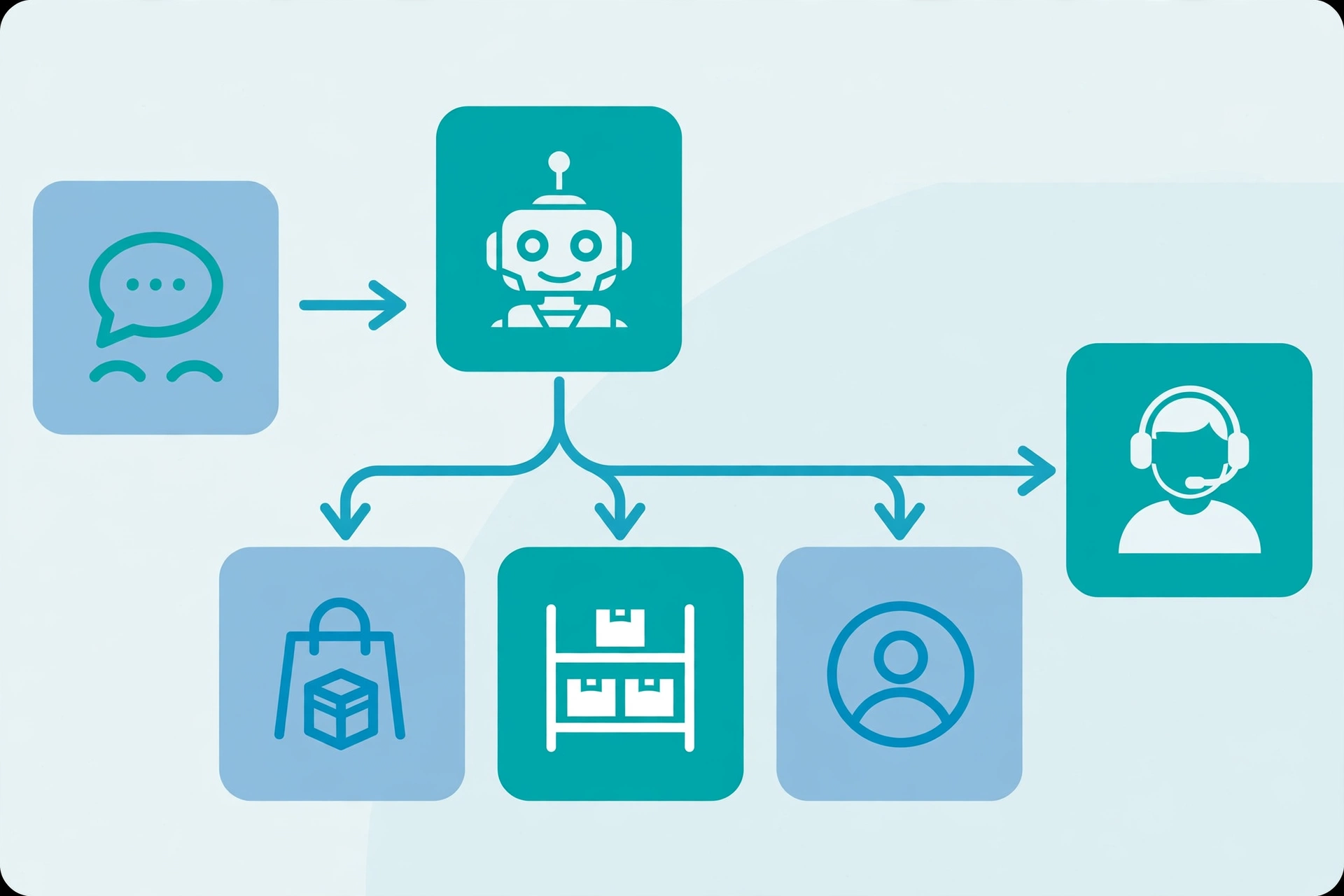
First, the agent reads the request and decides what it needs to know. If the customer is asking about an order, it retrieves the order record from the connected system. If the question is about availability, it checks stock. If the customer needs an account change, it pulls up the account.
Second, it acts. The agent executes the task in the connected application — updating the record, checking the inventory, or applying the change — rather than drafting a reply that tells the customer to do it themselves.
Third, it knows when to stop. Cases that need judgment, negotiation, or a human touch are handed to a support representative, with the full context of what the agent already did. The customer doesn’t repeat themselves, and the human picks up mid-conversation instead of from scratch.
The agents also work across the broader service operation, not just the front line. Zoho says Blended Agents bring AI into both frontline support and back-office service work, which means the same agent layer can help with the routine tasks that usually pile up behind the inbox.
What It Costs
This is where the launch gets interesting for small and mid-sized businesses.

Blended Agents are free to create and deploy on all paid Zoho Desk plans. There is no per-agent license, no seat fee for the AI, and no premium tier to unlock the feature. Businesses pay only for the large language model usage behind the agents.
For customers using Zoho-hosted AI models, Zoho is offering a monthly allowance of up to 30 million free tokens, depending on the plan. That is a generous runway: routine support work — order lookups, stock checks, status updates — consumes relatively few tokens per conversation, so many smaller teams may run entirely inside the free allowance.
The model matters because it removes the usual buying decision. Support teams don’t need to justify a new AI budget line or predict how many conversations the agent will handle. They can turn the agents on, see what they resolve, and only start paying when usage grows past the free tokens.
Compare that with the enterprise agent platforms that charge per agent or per resolution, and the contrast is sharp. Zoho is betting that making the agent layer free will pull more of its 125,000 customers into AI-assisted support — and that the usage fees will follow.
Where Blended Agents Are Available
Blended Agents are available now in India, the United States, the European Union, Japan, China, and Australia, with Canada launching soon. The feature is available in the Express edition, with Automation Studio from the Professional plan and Workstation in the Enterprise plan, according to the announcement.
That rollout covers the markets where most Zoho Desk customers operate, and the tiering means even the entry-level paid plan gets access. The more advanced automation tooling sits in the higher plans, which is consistent with how Zoho has always packaged Desk.
The timing is also deliberate. The launch coincides with Zoho Desk’s tenth anniversary — the product launched in 2016 and has grown at roughly 35.3% a year between 2017 and 2025, according to Zoho. Blended Agents are, in effect, the anniversary release: the feature that defines the product’s next decade.
Why This Launch Matters for Customer Support
Customer support is in the middle of a shift from chatbots that answer to agents that act. The distinction sounds small, but it changes what support software is for. A chatbot that can only reply is a faster FAQ page. An agent that can retrieve an order, check stock, and update an account is a new member of the support team.
Zoho is not the only company making this move. Salesforce has been pushing voice AI agents for customer service, and ServiceNow just launched an autonomous engine that redesigns CRM deployments. The enterprise AI spending boom — $177 billion on agents in 2026, according to Menlo Ventures — is funding exactly this kind of tooling.
What sets Zoho’s launch apart is who it is for. Salesforce and ServiceNow are selling to large enterprises with large budgets. Zoho Desk’s customers are the small and mid-sized businesses that make up most of the economy, and Blended Agents arrive with no extra license cost. If the agent layer becomes a free add-on for 125,000 businesses, the shift from answering to acting could reach far more support teams, far faster, than the enterprise launches will.
There is also a trust question that every support team will ask. An agent that can change account records needs guardrails: approval steps, audit trails, and clear handoff rules. Zoho’s answer is the blended model itself — humans stay in the loop for anything that needs judgment, and the agent handles the routine work where the risk is low and the volume is high. Whether that balance holds up in practice will depend on how well teams configure approvals and how transparent the agent’s actions are.
The Bigger Picture: AI Agents Go Mainstream in Support
The launch fits a pattern visible across the software industry in 2026. AI agents are moving out of demos and into the daily tools businesses already use. IBM and Microsoft just launched an enterprise platform with 6,000 prebuilt agents for regulated industries. Salesforce’s Koa model is built to make decisions, not just generate text. And Zoho’s own Zia Agents platform is the engine underneath Blended Agents.
The difference is distribution. Zoho Desk is already installed in 125,000 businesses. Blended Agents don’t require a migration, a new platform, or a new budget — they switch on inside the help desk teams already use. That is how a technology goes from early adopters to the mainstream: not through a flagship launch, but through a free upgrade to a tool people already open every morning.
For support leaders, the practical question is not whether AI agents are coming to customer service — they are already here. The question is whether the agent can do real work, whether the pricing is honest, and whether humans stay in control. On the first two, Zoho’s launch looks strong. On the third, the next few months of real-world use will tell.
Frequently Asked Questions
What are Zoho Desk Blended Agents?
Blended Agents are AI agents built into Zoho Desk and powered by Zoho’s Zia Agents platform. They retrieve information and carry out tasks across connected business applications — such as checking order details, verifying stock, and updating customer accounts — while handing complex cases to human agents.
How much do Blended Agents cost?
They are free to build and deploy on all paid Zoho Desk plans. Businesses pay only for the large language model usage behind the agents. Customers using Zoho-hosted AI models get a monthly allowance of up to 30 million free tokens, depending on their plan.
Which Zoho Desk plans include Blended Agents?
Blended Agents are available across all paid Zoho Desk plans. The feature is available in the Express edition, with Automation Studio from the Professional plan and Workstation in the Enterprise plan.
Where are Blended Agents available?
The feature is available now in India, the US, the EU, Japan, China, and Australia, with Canada launching soon.
Do Blended Agents replace human support agents?
No. Zoho designed them to work alongside human representatives. The agents handle routine tasks and bring humans in for cases that need judgment, empathy, or negotiation, with full context carried over so customers don’t have to repeat themselves.
The Bottom Line
Zoho Desk’s Blended Agents turn the help desk from a place where customers ask questions into a place where work gets done. The agents act on orders, check stock, and update accounts — and they do it at no extra license cost on any paid plan.
For the 125,000 businesses already running Zoho Desk, that is a free upgrade to a fundamentally more capable support tool. For the rest of the industry, it is a signal: the agent layer of customer service is becoming a standard feature, not a premium product. The teams that figure out the right balance between AI action and human judgment will have the advantage — and Zoho just made it much cheaper to start figuring that out.

