
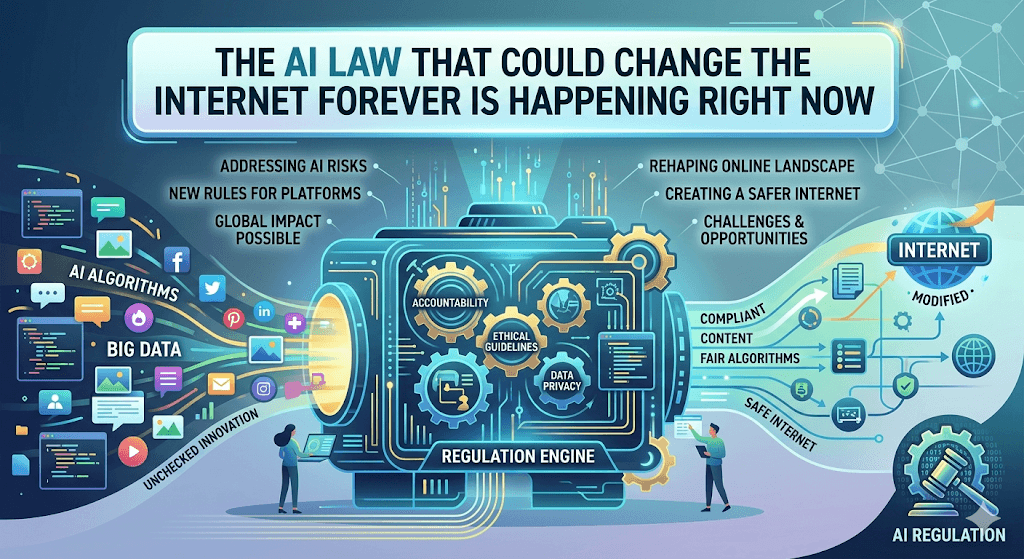
The AI Law That Could Change the Internet Forever Is Happening Right Now
We’ve spent years talking about regulating AI “someday.” Well, someday just arrived — and the internet you know is about to look very different.
Something massive is unfolding in the world of technology right now, and most people scrolling through their feeds have no idea it’s happening. Governments on both sides of the Atlantic are racing to pass, enforce, and fight over artificial intelligence laws that will fundamentally reshape how we use the internet, how companies build products, and what kind of digital future we’re all walking into.
This isn’t a drill. It’s not another “AI might be regulated someday” story. The laws are here. Some have already taken effect. Others hit their enforcement deadlines in months. And the fights over them — between states and the federal government, between the U.S. and Europe, between tech giants and lawmakers — are getting louder by the day.
Let me walk you through what’s actually going on, why it matters to you personally, and what the internet could look like on the other side of all this.
Europe Went First — And It’s About to Get Real
The European Union passed the AI Act back in 2024, making it the world’s first comprehensive legal framework for artificial intelligence. But passing a law and enforcing a law are two very different things. The real teeth come out on August 2, 2026 — just a few months from now — when the rules for high-risk AI systems kick in with full enforcement power.
What does “high-risk” actually mean in practice? Think about AI systems that make decisions about whether you get a loan, whether your job application makes it past the first round, or whether your insurance claim gets approved. Under the EU’s framework, those systems now have to meet strict requirements around transparency, human oversight, data quality, and documentation.
If your company builds an AI-powered hiring tool and serves European customers, you’re now subject to conformity assessments, incident reporting, and post-market monitoring. The era of “move fast and break things” just hit a regulatory wall.
And it’s not just high-risk systems. The EU is also rolling out transparency obligations that require companies to clearly label AI-generated content, disclose when users are interacting with a chatbot, and flag deepfakes. The European Commission published its draft Code of Practice on marking and labeling AI-generated content late last year, with the final version expected by mid-2026.
Here’s where it gets complicated, though. The EU itself is debating whether to push back some of these deadlines. The “Digital Omnibus” proposal could delay high-risk obligations to as late as December 2027 or even August 2028 for certain product categories. Critics are worried this creates a loophole — companies could rush products to market before the rules apply, and existing systems might never have to comply.
The stakes are enormous. Fines for serious violations can reach up to 35 million euros or 7% of global annual turnover. For mishandling personal data through AI systems, GDPR-style penalties could add up to 20 million euros or 4% of global revenue on top of that.
America’s AI Law Problem: Fifty States, Zero Consensus
While Europe moves toward a single, unified rulebook, the United States is heading in the opposite direction — and it’s creating a regulatory mess that’s unlike anything the tech industry has faced before.
There is no comprehensive federal AI law in America. Not one. What exists instead is a sprawling, sometimes contradictory patchwork of state laws, federal agency guidance, executive orders, and voluntary standards that are nearly impossible to navigate.
Colorado became the first state to pass a comprehensive AI law requiring companies that deploy high-risk AI to use reasonable care against algorithmic discrimination. That law took effect in February 2026. California has multiple AI transparency laws now active, covering everything from training data disclosure to watermarking requirements. Texas enacted its own governance framework. Illinois has hiring-specific rules. New York City regulates automated employment decision tools.
And in just the first quarter of 2026, state lawmakers across the country introduced over 600 AI-related bills. Six hundred. In three months.
The themes come up again and again across these state laws: transparency about when AI is being used, protections against biased decision-making, safeguards for personal data, and accountability when AI systems cause harm. But the details differ wildly from state to state, and that’s where the headache begins for any company operating nationally.
The White House vs. the States: A Showdown Is Brewing
In December 2025, President Trump signed an executive order that threw a grenade into this already chaotic landscape. The order declared that the growing patchwork of state AI regulations is creating barriers to innovation and called for a unified federal framework that would preempt state laws the administration considers “unduly burdensome.”
In January 2026, the Department of Justice established an AI Litigation Task Force with the specific mission of challenging state AI laws on constitutional grounds. And in March 2026, the White House released its National Policy Framework for Artificial Intelligence, laying out legislative recommendations for Congress to establish that unified approach.
But Congress hasn’t exactly jumped on board. Lawmakers on both sides of the aisle have pushed back. The Senate pulled an AI regulatory moratorium provision from a major bill after states complained. Democrats introduced the GUARDRAILS Act in March 2026, which would repeal the executive order and block efforts to impose a moratorium on state-level AI regulation.
We’re watching a constitutional tug-of-war play out in real time. One side says innovation requires national uniformity. The other says states have every right to protect their residents from AI harms. The outcome will determine who actually gets to write the rules for artificial intelligence in America.
The legal arguments are genuinely interesting. Can the federal government preempt state AI laws under the Commerce Clause? Courts have previously ruled that state laws regulating internet content within their borders don’t necessarily constitute overreach, even if the effects extend beyond state lines. AI regulation may follow the same logic — or it may not. We’re in uncharted territory.
Deepfakes, Chatbots, and the Content You See Online
Beyond the big-picture regulatory battles, there’s a whole category of AI laws that are going to change what you encounter online every single day.
Deepfakes are the obvious flashpoint. Every state in the country has introduced some form of legislation targeting sexually explicit deepfakes. The federal Take It Down Act now requires platforms to remove non-consensual AI-generated intimate imagery. And lawmakers are increasingly going after not just the people who create deepfakes, but also the platforms, AI tools, hosting services, and even payment processors that enable them.
Chatbot safety has exploded as a legislative priority, especially when it comes to kids. Washington, Oregon, and Idaho all enacted new laws in early 2026 governing AI companion chatbots, with requirements around disclosure, safety protocols, and protections for minors. California’s Companion Chatbots Act mandates safety features against suicidal and self-harm content, with special restrictions for young users.
Meanwhile, several states including Indiana, Utah, and Washington have passed laws prohibiting health insurers from using AI as the sole basis for denying or modifying claims. Tennessee and Delaware are working on legislation that would prevent AI systems from being marketed as qualified mental health professionals.
The pattern is clear: lawmakers are no longer content to let the tech industry self-regulate. They’re targeting specific, tangible harms — and they’re doing it fast.
What This Actually Means for You
Okay, let’s get practical. If you’re a regular person who uses the internet — which is basically everyone — here’s what’s going to change:
You’re going to start seeing a lot more labels and disclaimers. That AI-generated image in your social feed? It’s going to come with a tag. That chatbot you’re talking to for customer support? It’s going to have to tell you it’s not human. That content recommendation algorithm deciding what you see? Companies may have to explain how it works.
If you’re applying for jobs, applying for credit, or interacting with your insurance company, there’s a growing chance that the AI systems making decisions about you will be subject to bias audits, documentation requirements, and human oversight mandates. You may gain the right to know that an AI was involved in a decision that affected you — and to challenge that decision.
If you’re a creator, your work is about to get new protections. Training data transparency laws are requiring AI companies to disclose what content was used to train their models. Copyright questions around AI-generated content are heading to court at an accelerating pace. The relationship between human creativity and machine learning is getting legally defined in real time.
And if you’re building a business that uses AI — whether you’re a startup founder, a product manager, or a developer — you need to pay attention right now. The compliance obligations are real, they’re multiplying, and they carry serious consequences.
The Bigger Picture: Who Decides What AI Becomes?
Step back from the individual laws and deadlines for a moment, and you’ll see a much larger question taking shape: Who gets to decide what role artificial intelligence plays in our society?
Europe has placed its bet on comprehensive regulation, prioritizing safety and fundamental rights while trying not to stifle innovation. The U.S. is caught in an ideological and jurisdictional fight, with some voices pushing for light-touch federal standards and others demanding robust state-level protections. China is pursuing its own model entirely.
There’s a real possibility that the EU’s approach becomes the global standard, just as GDPR did for data privacy. Companies serving international markets tend to build for the strictest rules, because it’s easier to comply everywhere than to maintain different versions for different jurisdictions. If that happens, European regulators will have effectively set the ground rules for AI development worldwide — whether other governments like it or not.
But there’s also a risk of regulatory fragmentation so severe that innovation stalls, small companies can’t compete, and the benefits of AI end up concentrated among the handful of tech giants with enough lawyers to navigate the maze.
The honest truth? Nobody knows exactly how this is going to shake out. The laws are being written, challenged, delayed, and rewritten in real time. What we do know is that the decisions being made in the next 12 to 18 months will echo for decades.
So pay attention. Read the fine print. Ask questions when an AI system makes a decision about your life. Support the regulations that protect your rights, push back against the ones that don’t make sense, and don’t let anyone tell you this stuff is too complicated for ordinary people to care about.
Because the AI law that could change the internet forever? It’s not a hypothetical. It’s happening right now. And whether you’re watching or not, the future is being written.