A century after Srinivasa Ramanujan’s remarkable mathematical discoveries, his ideas are still inspiring researchers to explore some of the deepest mysteries of mathematics.
What makes a mathematical discovery truly extraordinary? Sometimes, it is not the complexity of the equation itself, but the hidden connections it reveals.
That is precisely what makes the latest research connected to Srinivasa Ramanujan so fascinating.
A new mathematical development reported in October 2026 has brought renewed attention to the legendary Indian mathematician. Researchers have reportedly demonstrated that the famous Rogers–Ramanujan identities are part of a much broader mathematical structure, opening the door to infinitely many related identities.
The discovery is a reminder that Ramanujan’s mathematical legacy is far from finished.
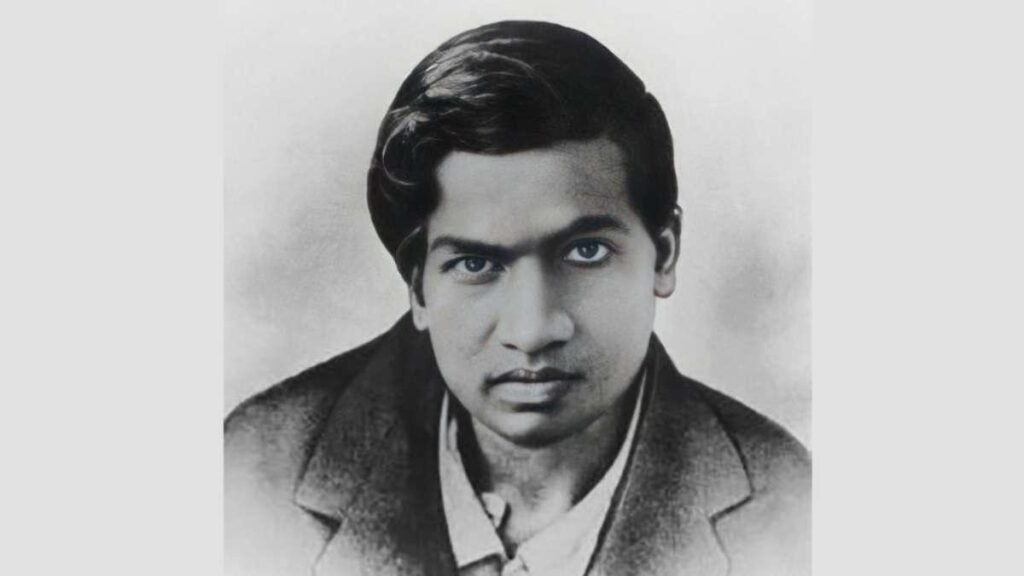
Who Was Srinivasa Ramanujan?
Srinivasa Ramanujan was born on December 22, 1887, in Erode, India.
Despite having limited access to formal mathematical resources during his early years, he developed an extraordinary ability to recognize mathematical patterns.
His work covered several important areas, including:
- Number theory
- Infinite series
- Continued fractions
- Partition functions
- Modular forms
- Mathematical identities
Ramanujan’s journey became internationally recognized after he began corresponding with British mathematician G. H. Hardy.
Hardy recognized the originality of Ramanujan’s work and invited him to Cambridge University, where their collaboration produced important mathematical advances.
Ramanujan died in 1920 at the age of 32, but his notebooks and mathematical ideas continue to influence researchers today.
What Are the Rogers–Ramanujan Identities?
The Rogers–Ramanujan identities are two remarkable mathematical formulas involving infinite series and infinite products.
They describe a surprising relationship between different ways of representing mathematical quantities.
One of the identities can be written as:
\prod_{n=0}^{\infty}
\frac{1}{(1-q^{5n+1})(1-q^{5n+4})}
]
Here, the notation ((q;q)_n) represents a product:
[
(q;q)n=\prod{k=1}^{n}(1-q^k)
]
For readers unfamiliar with advanced mathematics, the important idea is that two seemingly different mathematical expressions can produce exactly the same result.
One side uses an infinite sum. The other uses an infinite product.
The identities are also connected to partition theory, which studies the different ways an integer can be expressed as a sum of positive integers.
These connections make the formulas much more than mathematical curiosities.
Why Are Ramanujan’s Equations Trending in October 2026?
The current attention is connected to research reportedly published in September 2026.
According to reports, mathematicians Yifeng Huang and collaborators developed a proof connecting the classical Rogers–Ramanujan identities to a broader mathematical theory.
The research reportedly connects the identities to geometric structures involving mathematical knots.
In particular, the classic Rogers–Ramanujan case is associated with the trefoil knot, one of the simplest examples of a mathematical knot.
The reported work suggests that related mathematical structures can generate infinitely many additional identities.
This is significant because it places a famous result from Ramanujan’s mathematical legacy within a much larger framework.
The research does not mean that Ramanujan personally discovered every newly identified equation. Rather, his original mathematical ideas helped inspire a new generation of discoveries.
What Is a Mathematical Knot?
Imagine taking a piece of string, tying it into a knot, and connecting its two ends.
Mathematicians study such structures through a field called knot theory.
Knot theory investigates which knots are mathematically equivalent and how their properties can be described using equations and other mathematical tools.
Although knot theory may sound unrelated to number theory, modern mathematics frequently reveals unexpected connections between different fields.
The reported Ramanujan-related research is an example of how ideas involving infinite series can connect to geometry and knot theory.
These connections may help mathematicians understand mathematical structures that previously appeared unrelated.
Ramanujan’s Famous Number: 1729
One of the most popular stories associated with Ramanujan involves the number 1729.
British mathematician G. H. Hardy once visited Ramanujan while he was ill.
Hardy mentioned that the taxi he had taken carried the number 1729, which seemed rather uninteresting.
Ramanujan immediately recognized its remarkable mathematical property.
The number 1729 can be expressed as the sum of two positive cubes in two different ways:
[
1729=1^3+12^3
]
And:
[
1729=9^3+10^3
]
It is the smallest positive integer that can be expressed as the sum of two positive cubes in two different ways.
The story illustrates Ramanujan’s remarkable ability to recognize mathematical patterns that other people might overlook.
Another Extraordinary Discovery: Ramanujan’s Formula for Pi
Ramanujan also developed extraordinary formulas involving the mathematical constant (\pi).
One of his famous infinite-series formulas is:
\frac{2\sqrt{2}}{9801}
\sum_{k=0}^{\infty}
\frac{(4k)!(1103+26390k)}
{(k!)^4 396^{4k}}
]
The formula is remarkable because it converges extremely quickly.
In practical terms, a small number of terms can provide a large number of correct decimal digits of (\pi).
This is one reason Ramanujan’s work continues to attract interest from mathematicians and researchers.
His discoveries demonstrate how mathematical elegance can also have practical computational value.
Why Ramanujan’s Mathematical Legacy Still Matters
Ramanujan’s work demonstrates that mathematical discoveries can remain relevant long after their original publication.
His ideas have influenced research in:
- Number theory
- Combinatorics
- Mathematical physics
- Modular forms
- Computer-assisted mathematics
The latest research connected to the Rogers–Ramanujan identities offers another example of how mathematical ideas can evolve over generations.
A formula discovered in one era may become the starting point for a much larger theory in another.
Can Artificial Intelligence Help Discover New Mathematical Equations?
Modern mathematical research increasingly uses computational tools and AI-assisted reasoning.
These technologies can help researchers identify patterns, test conjectures, and explore complicated mathematical relationships.
However, identifying a pattern is not the same as proving a mathematical theorem.
A rigorous proof must establish why a statement is true under the required assumptions.
The reported Ramanujan-related development also highlights the importance of collaboration between human mathematicians and computational tools.
The most meaningful advances often come from combining mathematical intuition, computational exploration, and rigorous proof.
Final Thoughts: A Genius Whose Ideas Continue to Inspire
Srinivasa Ramanujan’s story is about much more than equations.
It is a story of curiosity, determination, and the extraordinary possibilities of mathematical thinking.
His discoveries continue to inspire researchers because they reveal connections that were not immediately obvious, even to experienced mathematicians.
The latest developments connected to the Rogers–Ramanujan identities demonstrate that his legacy is still evolving.
More than a century after his death, Ramanujan’s ideas continue to open new doors in mathematics.
And perhaps that is the most remarkable part of his story: some of the greatest discoveries are not the end of a journey, but the beginning of another.
References:
mathematicians-find-an-infinite-number-of-ramanujan-equations
Srinivasa Ramanujan Was a Genius. Math Is Still Catching Up. | Quanta Magazine