
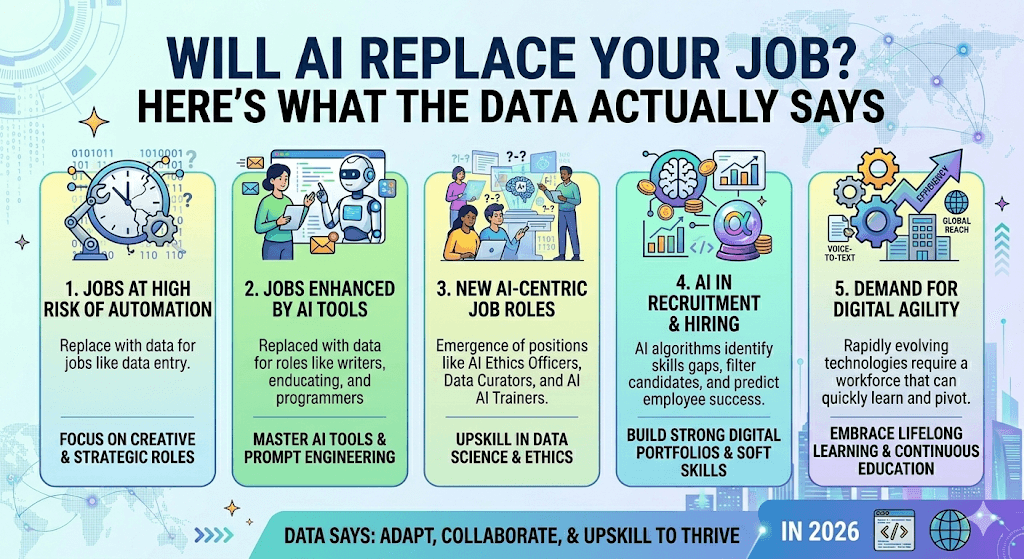
Will AI Replace Your Job? Here’s What the Data Actually Says — a blog article with statistics and analysis
The headlines swing between panic and hype. The reality — backed by the latest research from Goldman Sachs, the WEF, and McKinsey — is far more nuanced than either camp admits.
Let’s be honest. You’ve heard both versions of the story. Version one: AI is an unstoppable tide that will wash away millions of jobs and leave workers stranded. Version two: every new technology creates more jobs than it destroys, so relax. Neither of those is the full picture. What the data actually shows is something messier, more interesting, and more urgent — a real transformation that rewards those who understand it and penalizes those who ignore it.
So let’s set the breathless speculation aside and look at what the numbers really say.
The numbers are big — and frequently misread
The most commonly cited figures come from the World Economic Forum’s Future of Jobs Report 2025 and Goldman Sachs research updated through 2025. They’re striking. But they require careful reading.
Notice something? The WEF projects more jobs created than lost — a net gain of around 12 million roles. Goldman Sachs talks about jobs “at risk,” not jobs that will vanish overnight. The IMF’s 60% figure measures exposure, not elimination. These are different things, and conflating them is where most of the fear — and false comfort — comes from.
The net picture: destruction and creation at the same time
Here’s the job math that matters — but also why the math alone can mislead you.
by 2030
created by 2030
The net number looks reassuring. But here’s the catch that researchers keep flagging: displaced workers often lack the skills for the newly created roles — without significant retraining. A customer service representative whose job was automated in 2025 is not automatically qualified to become an AI Solutions Architect in 2027. The gap between displacement and accessibility is the defining policy challenge of this transition.
Which jobs are actually at risk — and by how much?
Automation risk is not evenly distributed. The jobs facing the sharpest disruption share a common trait: they involve routine, predictable, rules-based tasks where the output can be measured and replicated.
| Role / Sector | Automation risk | Timeline |
|---|---|---|
| Data entry clerks | Now–2027 | |
| Paralegals / legal researchers | By 2026–27 | |
| Customer service (tier-1) | Already underway | |
| Retail cashiers / checkout | By 2025–2026 | |
| Healthcare (creative, diagnostic) | Low near-term risk | |
| Education | Low near-term risk | |
| Creative services (senior) | Low near-term risk |
Sources: Goldman Sachs 2025, DemandSage, AllAboutAI industry analysis, McKinsey Global Institute
The entry-level shock nobody’s talking about enough
One of the most striking — and underreported — findings of 2025 comes from Stanford’s Digital Economy Lab. Researchers Erik Brynjolfsson, Bharat Chandar, and Ruyu Chen found a 13% relative employment decline for workers aged 22–25 in the most AI-exposed occupations between late 2022 and July 2025. For software developers in that age bracket, the drop was nearly 20%.
Meanwhile, workers over 30 in the same occupations saw 6–12% employment growth during the same period. AI isn’t replacing experienced workers — it’s replacing the entry-level pipeline that feeds into experienced workers. That has profound implications for the next generation entering the workforce.
Anthropic’s own CEO, Dario Amodei, predicted in 2025 that AI could eliminate roughly 50% of white-collar entry-level positions within five years. Cornell University research backs the trend: U.S. companies adopting AI have reduced hiring of junior employees by about 13%.
Geography matters more than you think
AI disruption is not happening uniformly around the world. The IMF’s analysis draws a sharp geographic line. Advanced economies — where knowledge work, white-collar roles, and analytical tasks dominate — face far higher exposure than developing economies still anchored in physical labor and agriculture.
In the U.S., the disruption is already measurable. AI was directly linked to 4.5% of all reported job losses in 2025, with over 77,000 tech job cuts in just the first six months of that year attributed to AI-driven decisions. Wall Street banks have signaled plans to cut approximately 200,000 positions over the next three to five years as back-office and entry-level roles get automated.
The jobs AI is creating — faster than you’d expect
Here’s the side of the story that gets far less airtime: AI is also creating roles at a remarkable pace. The Information Technology & Innovation Foundation found that approximately 119,900 AI-related roles were added in 2024 alone — far exceeding confirmed AI-driven job losses for the same period.
The fastest-growing roles tell you where the real opportunity lies:
- 1 AI Engineer — demand up over 140% year-over-year; one of the fastest-growing careers globally
- 2 Big Data Specialist — projected to see the largest net job growth of any role between 2025 and 2030
- 3 AI Content Creator — positions have grown by more than 130%, as generative AI creates new editorial roles
- 4 Prompt Engineer / AI Solutions Architect / AI Product Manager — growing at 35%–110%, commanding salaries up to 56% higher than peers without AI skills
- 5 Software Developer (senior) — despite the entry-level squeeze, senior developer roles are projected to grow 17.9% through 2033
What does “your risk” actually depend on?
Here’s the most important insight buried inside all this research: your risk is not determined by your job title. It’s determined by the nature of the tasks you actually perform.
Two people with the title “marketing manager” can have wildly different automation exposure depending on whether they spend their days writing templated copy and pulling reports — or building strategy, managing client relationships, and making creative judgment calls. The first set of tasks is highly automatable. The second is not, at least not yet.
Oxford University’s foundational research found the highest-risk occupations are telemarketers (99% automation probability), data entry keyers (99%), and insurance underwriters (98%). The lowest-risk are recreational therapists (0.3%), emergency management directors (0.3%), and roles requiring deep physical dexterity in unpredictable environments. Workers in lower-wage jobs face four times the automation risk of those in high-wage roles.
So — what should you actually do?
The data paints a clear picture of where the risks cluster and where the opportunities are emerging. The workers who will navigate this best are not the ones who simply ignore AI or the ones paralyzed by it — they’re the ones who treat it as a tool to extend their own judgment, creativity, and human relationships.
- → Move upstream. The clearest signal in every major study: decision-making, problem framing, and relationship management remain human territory. Orient your role toward those activities.
- → Build AI fluency now, not later. The 56% salary premium for AI-skilled workers exists today. The gap between AI-fluent and AI-unfamiliar workers is already widening.
- → Audit your task mix. Which tasks in your current role are routine, predictable, and rule-based? Those are the ones to hand off to AI tools — and reposition your time toward the work only you can do.
- → Don’t wait for your industry to catch up. Reskilling efforts need to move faster than most companies and curricula currently allow. Individual initiative matters more now than institutional programs.
The WEF projects a net positive for employment. Goldman Sachs projects GDP growth alongside disruption. McKinsey emphasizes task automation over full job elimination. The thread running through all of it is the same: the disruption is real, the transformation window is 2025–2030, and the difference between falling behind and moving ahead comes down to timing, skills, and honesty about what the data actually says.
Which means there’s no better time than right now to read it clearly.