
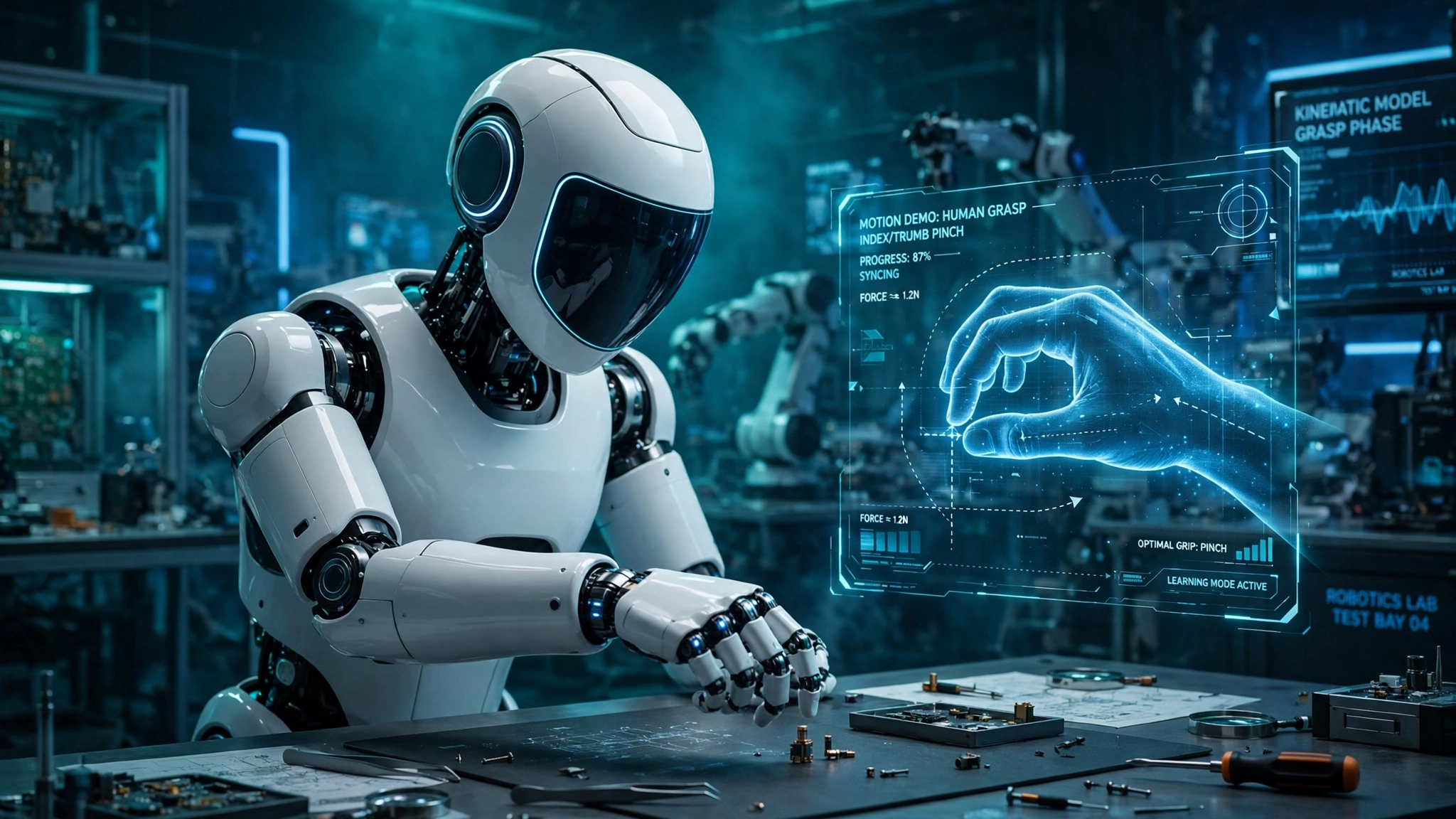
The hardest problem in robotics has never been building a robot that can move. It is teaching one a new job without weeks of painstaking programming. On November 9, 2026, NVIDIA unveiled GR00T 2 at the Conference on Robot Learning (CoRL) in Austin, Texas — a robot foundation model that learns dexterous manipulation skills by watching people work, then transfers those skills to robot bodies that never practised the task.
GR00T 2 is what NVIDIA calls an open frontier “world action model,” built on its Cosmos platform of world models. Instead of being trained only on robot demonstrations, it learned from more than 400,000 hours of first-person human video — and, according to NVIDIA’s own evaluations, it can complete 40 of 50 unseen tasks at least once with no demonstrations at all, rising to 95% average success after just five demonstrations per task.
What GR00T 2 Actually Is
GR00T 2 is a single diffusion transformer with 2 billion parameters. It takes in recent camera views, the robot’s current state and a written instruction, then jointly predicts what the scene will look like next and which actions the robot should take. Predicting the future video and the next action together is the core idea: if the model can imagine how a task should unfold, it can work out the movements needed to get there.
It is the successor to the GR00T N1 line, which NVIDIA released in 2025 as its first open foundation model for humanoid robots. Where N1 was a starting point, GR00T 2 is positioned as a general-purpose brain for manipulation — one pretrained checkpoint that covers parallel-gripper arms, dexterous hands and a full humanoid robot, rather than a separate model for each body.
The training data is the story. GR00T 2 was pretrained on 402,730 hours of egocentric video of people at work, 10,184 hours of demonstrations with a handheld UMI gripper across 2,897 tasks, and 23,500 hours of robot teleoperation spanning YAM and Franka arms, Sharpa and Wuji dexterous hands, and the Unitree G1 humanoid. NVIDIA has also released 100,000 hours of that human footage openly as the Human-1M-100K dataset on Hugging Face, under a CC BY 4.0 licence.
Learning From Watching People Work
The traditional way to teach a robot a task is teleoperation: a human drives the robot through the job, over and over, until there is enough demonstration data to train on. It works, but it is slow, expensive, and it ties every new skill to a specific robot body. GR00T 2 flips the ratio. Human video is vastly easier to collect than robot demonstrations — people already do the work, all day, in factories, kitchens and workshops — so the model learns the shape of a task from watching humans, then adapts it to whatever body it is running on.
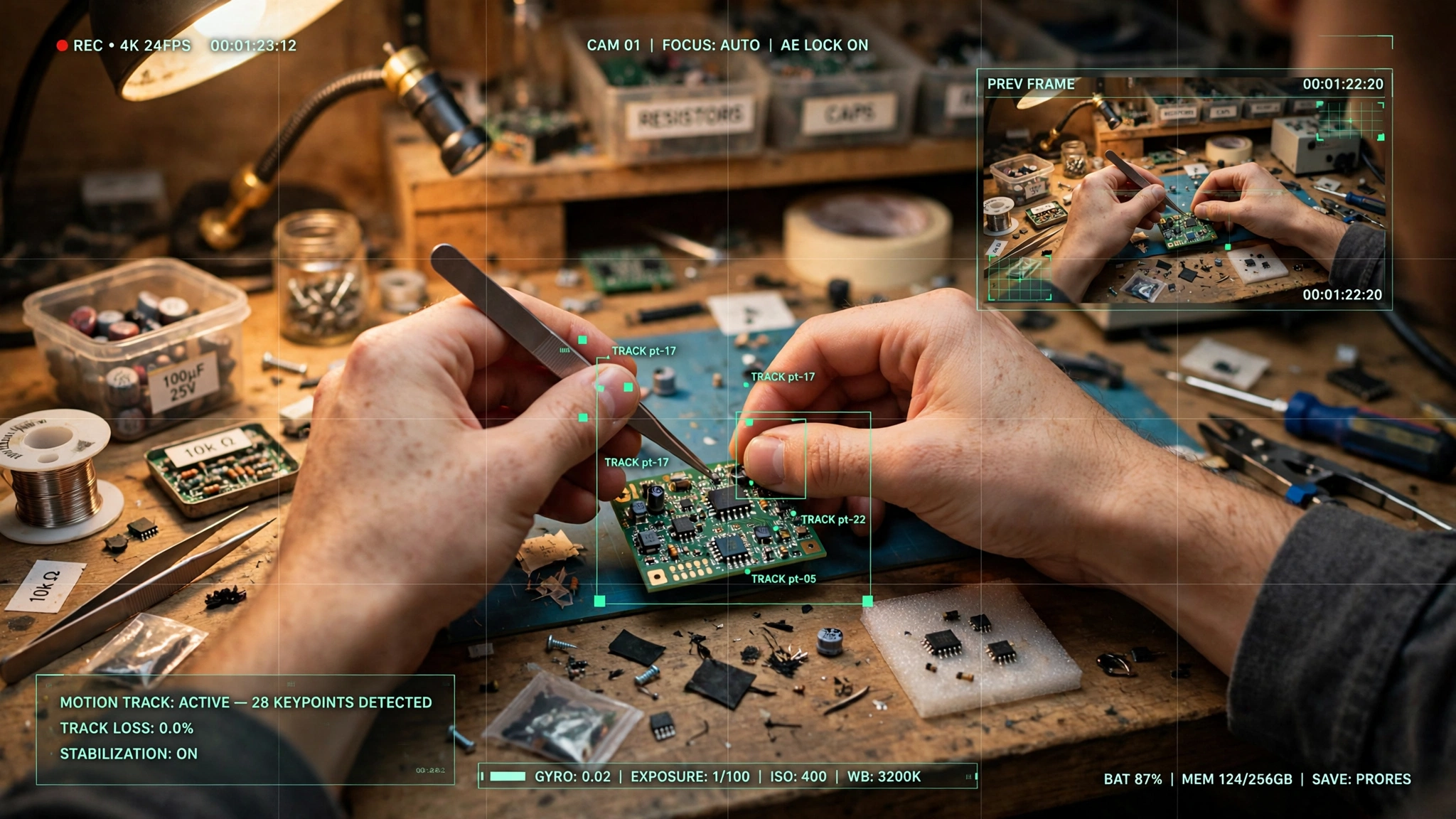
NVIDIA’s headline numbers, from its own 50-task evaluation set, are striking: 40% average success with zero demonstrations, 71% with a single demonstration, and 95% with five. That last figure is the one that matters for real deployments. Five demonstrations is an afternoon’s work, not a data-collection project — and it is the difference between a robot that can only repeat what it was exhaustively trained on and one that can be shown a new job and get on with it.
There is a caveat worth stating plainly. The 50 tasks in the evaluation, known as Dexter-50, were selected for reaching at least 80% success with five demonstrations, according to the model’s own whitepaper — so the 95% is a result on a selected set, not a random sample of every manipulation task. And all of these figures come from NVIDIA’s own evaluations; no independent benchmarks have been published yet. The model also ranks among the top three across the RoboCasa365, RoboLab, RoboDojo and MolmoSpaces benchmarks, in both the vision-language-action and world-action model categories.
GR00T 2 Turbo Brings It Onto the Robot
A 2-billion-parameter model that only runs in a data centre is of limited use to a robot on a factory floor. That is why NVIDIA also announced GR00T 2 Turbo, a distilled version built for speed. It uses a smaller transformer and a more compact video representation, and it runs on board a Unitree G1 humanoid at 124 milliseconds per prediction on the robot’s Jetson Thor computer.
That matters because manipulation is a real-time problem. A robot reaching for a cable connector cannot wait a second between decisions; by the time the answer arrives, the scene has changed. Running the model on the robot itself, with no round trip to the cloud, is what turns a research demonstration into something that can work on a production line.
Simulation Is Where the Practice Happens
GR00T 2 did not arrive alone. NVIDIA introduced it alongside Isaac Lab 3.0, the latest version of its open-source robot-learning framework, which lets researchers use AI agents to set up training environments with simulation-ready assets, switch between the PhysX and Newton physics solvers, and apply a new reinforcement post-training library to foundation models like GR00T. In a vision-based dexterous manipulation benchmark, Isaac Lab 3.0 with Newton reached up to 2.5 times the training throughput of Isaac Lab 2.3 with PhysX.
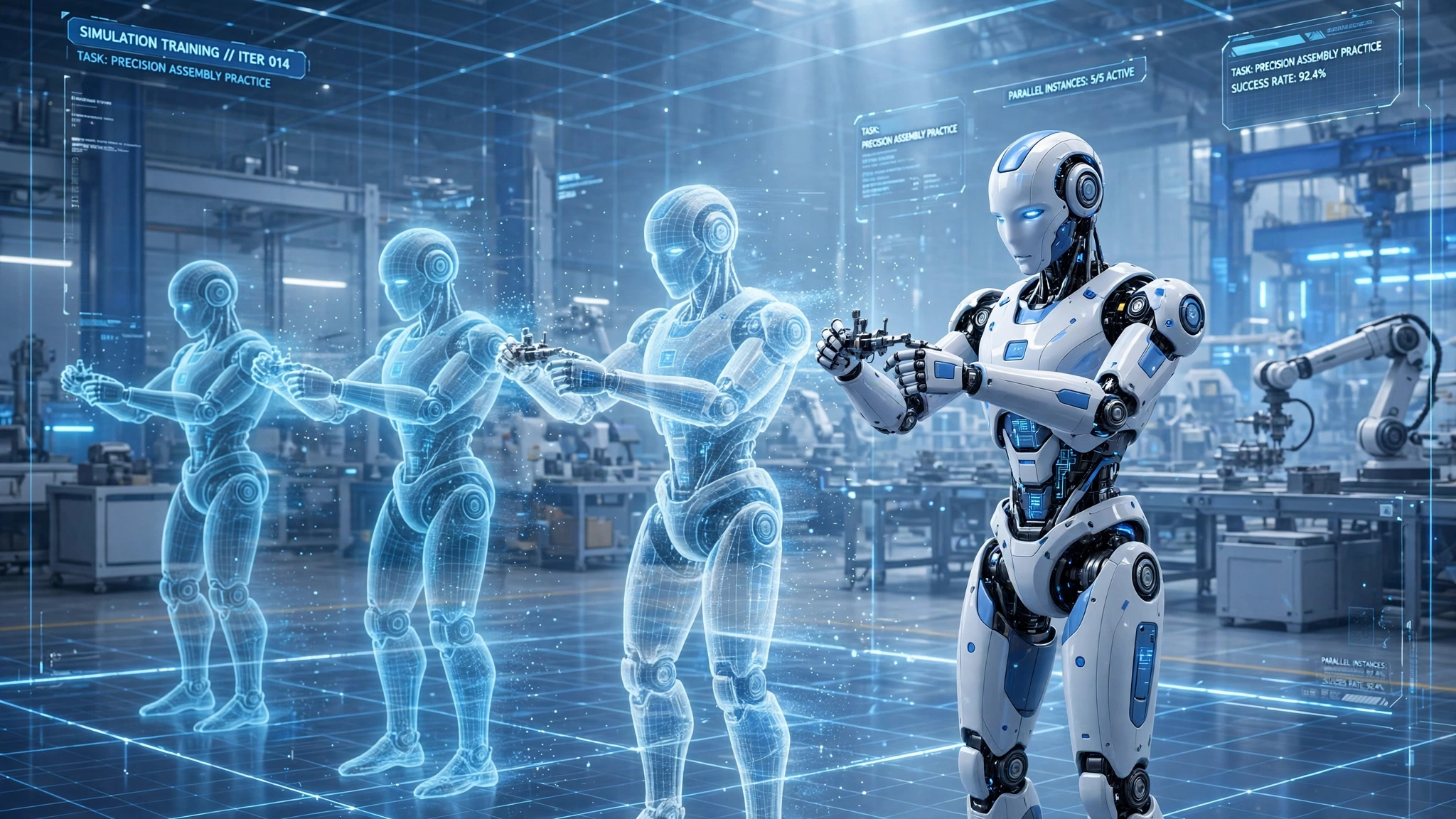
Simulation is where robots can afford to fail. A robot learning to swap an Ethernet cable can drop it a thousand times in simulation without breaking anything — and that is exactly what MicroAGI did, post-training GR00T 2 with reinforcement learning to perform cable swapping on a YAM robotic arm, using agents to build and calibrate the simulation environments in Isaac Lab 3.0 and Newton before transferring the policy to the real arm. The same pattern is playing out at Foxconn, which is testing GR00T 2 on server manufacturing lines, Siemens, which is evaluating industrial use cases, and Nexuni, which is trialling it for robotic laundry handling.
The Catch: “Open” Comes With an Asterisk
NVIDIA calls GR00T 2 an open frontier model, and parts of the release genuinely are open: Isaac Lab 3.0 is open source, and the 100,000-hour Human-1M-100K dataset is already available. But for GR00T 2 itself, the November 9 announcement gave no download date for the weights, no licence terms, and no hardware requirements. The model code is promised for December 2026 — announced by Jim Fan, NVIDIA’s director of robotics, in his CoRL keynote — but until that code and the weights actually ship, outside labs cannot reproduce NVIDIA’s results on their own robots, and the teams able to use GR00T 2 today are limited to official partners accessing it through NVIDIA.
That timing lands in an unusual week for the company. Just three days after the GR00T 2 announcement, Jensen Huang resigned as NVIDIA’s CEO, ending a 33-year run, with CFO Colette Kress named interim CEO. The robotics roadmap NVIDIA laid out at CoRL will now be executed under new leadership — and the December code release will be an early test of whether that roadmap survives the transition intact.
The hardware side is moving just as fast. AMD’s Instinct MI450X and MI455X accelerators are aimed squarely at the same AI inference workloads, and open robot brains are proliferating — Runway’s Praxis-1 is another open-weight model built to give robots general-purpose physical skills. GR00T 2’s advantage is not that it is the only open robot model, but that it arrives with the simulation stack, the data and the industrial partners attached.
What to Watch Next
The honest answer is December. If the code, weights and licence arrive on schedule, researchers will quickly find out whether the 95% holds up outside NVIDIA’s own evaluation — and whether a model trained largely on human video really does transfer to robots it has never seen. If they slip, GR00T 2 joins a long list of impressive announcements that stayed impressive only on paper.
For everyone else, the simplest way to feel the shift is to watch what the partners do. Foxconn putting a GR00T 2-trained arm on a server line, or Siemens running one in a real factory, would say more than any benchmark. And the same local-AI logic that makes llama.cpp 1.0’s stable API matter for on-device chatbots applies here too: the robots that win will be the ones that can think where they stand, without phoning home.
Frequently Asked Questions
What is NVIDIA GR00T 2?
GR00T 2 is an open frontier “world action model” for robots, introduced by NVIDIA on November 9, 2026, at the Conference on Robot Learning in Austin. Built on NVIDIA Cosmos, it learns dexterous manipulation skills from human video and robot demonstrations, then transfers them to different robot bodies.
How well does GR00T 2 actually perform?
According to NVIDIA’s own evaluations on 50 tasks, GR00T 2 averages 40% success with no demonstrations, 71% with one demonstration per task, and 95% with five. These are NVIDIA’s figures on a selected task set, and no independent benchmarks have been published yet.
Can I download GR00T 2 today?
Not yet. NVIDIA calls GR00T 2 open, but the model code is promised for December 2026, and no release date or licence terms for the weights had been announced at launch. The 100,000-hour Human-1M-100K training dataset is already available on Hugging Face.
What is GR00T 2 Turbo?
GR00T 2 Turbo is a smaller, faster distilled version of the model designed to run on the robot itself. NVIDIA reports it runs on a Unitree G1 humanoid at 124 milliseconds per prediction, using the robot’s Jetson Thor computer.
What is Isaac Lab 3.0?
Isaac Lab 3.0 is NVIDIA’s open-source robot-learning framework, released alongside GR00T 2. It provides the simulation environments where robot skills are trained and refined before they are deployed on physical hardware, and it integrates the Newton physics engine.

