
Can artificial intelligence actually help someone land a job faster? I decided to find out the hard way.
The job market in 2026 is brutal.
Hundreds of applicants compete for the same remote positions. Recruiters use AI filters. Applicants use AI tools. Everyone is optimizing resumes, automating applications, and trying to stand out in an overcrowded digital hiring system.
So I ran an experiment.
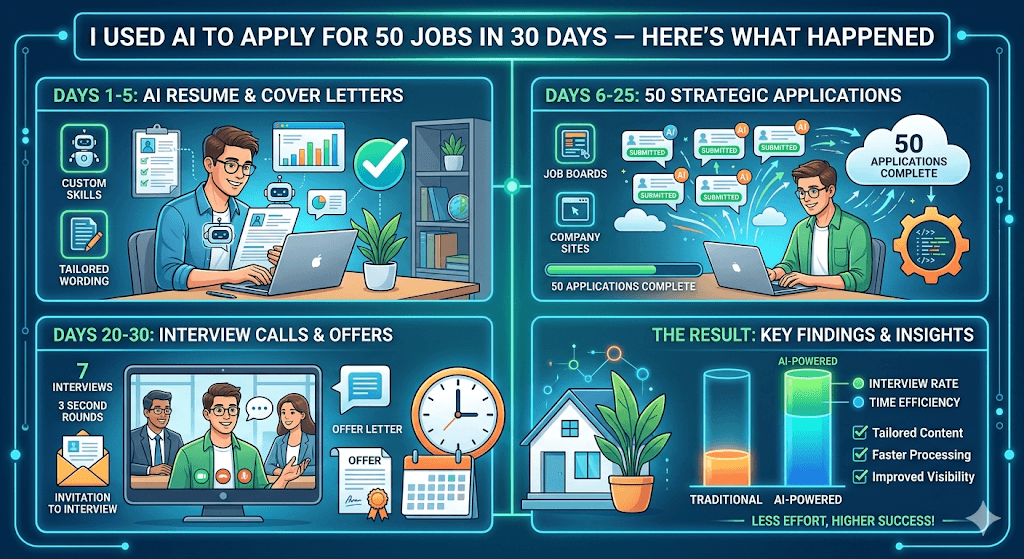
For 30 days, I used AI tools to help me apply for 50 jobs across remote tech, content writing, marketing, and entry-level digital roles.
I tracked:
- How much time AI actually saved
- Whether recruiters noticed AI-generated applications
- Interview response rates
- Mistakes AI made
- Which tools genuinely worked
- And whether AI made the process better… or worse
Here’s the complete breakdown of what happened.
Why I Tried This Experiment
Like many people in 2026, I was tired of:
- Writing the same cover letter repeatedly
- Editing resumes for every job posting
- Filling out endless applications
- Getting ghosted after spending hours applying manually
At the same time, AI job tools were everywhere.
Every platform claimed:
- “Apply to 100 jobs instantly”
- “Generate perfect resumes”
- “Beat ATS systems”
- “Land interviews faster”
Some people called AI the future of job hunting.
Others said recruiters could instantly detect AI-generated applications.
I wanted real answers instead of marketing hype.
So I committed to applying for 50 jobs in 30 days using AI wherever possible.
The AI Tools I Used
Here are the main AI tools that powered the experiment:
1. ChatGPT
I used OpenAI’s ChatGPT for:
- Resume optimization
- Cover letters
- Interview preparation
- LinkedIn summaries
- Rewriting applications
It became the “main assistant” during the experiment.
2. Canva AI Resume Builder
Canva helped create visually clean resumes quickly.
Good for:
- Modern resume templates
- Fast edits
- ATS-friendly formatting
Not great for:
- Highly technical resumes
- Complex job histories
3. Grammarly
Grammarly caught awkward phrasing and made applications sound more natural.
This mattered more than expected because AI-generated text often sounded robotic.
4. LinkedIn AI Features
LinkedIn now offers AI-assisted profile suggestions and message drafting.
I used it for:
- Recruiter outreach
- Headline optimization
- Job recommendations
5. Teal
Teal helped track applications and tailor resumes for specific roles.
This tool became surprisingly useful because keeping track of 50 applications manually gets messy fast.
The Rules of the Experiment
To keep things realistic:
- I only applied to jobs I was genuinely qualified for
- Every application was reviewed manually before submission
- AI assisted the process, but didn’t completely automate it
- I customized resumes for most positions
- I avoided “one-click spam applications”
The goal wasn’t quantity alone.
The goal was to test whether AI could improve application quality and speed.
Week 1 — Excitement and Speed
The first week felt incredible.
Using AI reduced application time dramatically.
Before AI:
- One application took around 45–60 minutes
With AI:
- Many applications took 10–15 minutes
That difference adds up fast.
AI helped:
- Rewrite resumes based on keywords
- Generate personalized cover letters
- Summarize experience professionally
- Match skills to job descriptions
For the first time, applying for jobs felt less mentally exhausting.
But then the problems started.
The Biggest Problem: AI Sounded Too Generic
After about 15 applications, I noticed something.
Everything sounded… polished but empty.
AI-generated cover letters used phrases like:
- “I am passionate about innovation”
- “I thrive in collaborative environments”
- “I am excited for this opportunity”
The applications sounded professional but forgettable.
And that’s dangerous in a competitive market.
Recruiters read hundreds of applications every week. Generic language disappears instantly.
So I changed strategy.
Instead of letting AI fully write applications, I used it as:
- A drafting assistant
- An editor
- A brainstorming partner
That worked much better.
What Actually Improved My Results
After experimenting for several weeks, I found a better workflow.
The Winning Formula
Step 1: Use AI for Structure
AI handled:
- Formatting
- Grammar
- Keyword optimization
- Resume tailoring
Step 2: Add Human Stories
I personally added:
- Real experiences
- Specific achievements
- Personal tone
- Unique examples
That combination created stronger applications.
Not robotic.
Not sloppy.
Not overly polished.
Just human enough to feel authentic.
The Numbers After 30 Days
Here are the final results from the 50 applications.
| Result | Number |
|---|---|
| Total Applications | 50 |
| Recruiter Responses | 11 |
| First Interviews | 6 |
| Second Interviews | 2 |
| Rejections | 28 |
| No Response | 11 |
| Final Offers | 1 |
Was the Response Rate Better?
Honestly, yes.
My previous manual applications had a much lower response rate.
AI helped because:
- Applications were more consistent
- Resumes matched keywords better
- Formatting looked cleaner
- Applications were completed faster
But AI alone did not magically create interviews.
The applications that performed best always included:
- Personalization
- Specific accomplishments
- Human tone
- Clear storytelling
Recruiters Could Definitely Spot Bad AI Usage
One recruiter indirectly called it out during an interview.
They said:
“We’re seeing a lot of applications that sound identical lately.”
That sentence stuck with me.
Recruiters may not always detect AI technically, but they absolutely notice:
- Generic phrasing
- Repetitive language
- Emotionless writing
- Overly perfect wording
In other words:
Bad AI use is obvious.
Smart AI assistance is harder to detect because it still sounds human.
The Most Surprising Discovery
The biggest surprise wasn’t about AI.
It was about confidence.
When AI handled repetitive tasks, I had more energy for:
- Networking
- Interview prep
- Learning skills
- Following up professionally
Instead of burning out writing repetitive applications, I could focus on strategy.
That changed everything.
The Biggest Mistakes AI Made
AI is powerful, but it still makes serious mistakes.
Here are some problems I encountered.
1. Fake Experience Generation
Sometimes AI exaggerated skills or experience accidentally.
That’s risky.
Always verify everything before submitting.
2. Wrong Company Names
A few generated cover letters mentioned the wrong company.
This happens more often than people realize.
One mistake like that can instantly ruin credibility.
3. Robotic Tone
Applications occasionally sounded like corporate templates written by machines.
Recruiters hate that.
4. Keyword Stuffing
Some AI-generated resumes overloaded job keywords unnaturally.
ATS systems may like keywords, but humans still read resumes eventually.
What I Learned About ATS Systems
A lot of people believe AI can “hack” ATS filters.
That idea is exaggerated.
ATS systems mainly check:
- Keyword relevance
- Formatting
- Basic compatibility
AI helps optimize for these factors, but it doesn’t guarantee success.
A weak candidate with an AI-generated resume is still a weak candidate.
The Emotional Side Nobody Talks About
Job searching affects mental health.
And AI changed that more than expected.
The process became:
- Less draining
- Less repetitive
- More manageable
But there’s another side.
When AI writes everything for you, applications can start feeling emotionally disconnected.
You stop feeling ownership over your own story.
That balance matters.
Would I Use AI Again for Job Applications?
Absolutely.
But differently.
I would never fully automate the process.
Instead, I’d use AI for:
- Resume optimization
- Drafting
- Research
- Editing
- Organization
- Interview preparation
And I’d personally handle:
- Final personalization
- Storytelling
- Networking
- Relationship building
That hybrid approach feels far more effective.
Best AI Job Application Tips for 2026
If you’re planning to use AI during your job search, here’s what actually works.
Do:
- Use AI to save time
- Tailor resumes to each role
- Add personal examples
- Edit every AI-generated response
- Keep your tone natural
- Use AI for interview prep
Don’t:
- Spam hundreds of applications blindly
- Submit fully AI-written cover letters
- Fake experience
- Overuse buzzwords
- Depend entirely on automation
Final Verdict: Is AI Worth Using for Job Hunting?
Yes — but only if you use it intelligently.
AI is not a magical “get hired instantly” machine.
It’s a productivity tool.
The people getting the best results are not replacing themselves with AI.
They’re combining:
- Human creativity
- Real experience
- Strategic thinking
- And AI efficiency
That combination is extremely powerful in today’s hiring market.
The future of job hunting probably isn’t fully human or fully AI.
It’s both working together.
Conclusion
Applying for 50 jobs in 30 days taught me something important:
AI can dramatically improve the process of job searching, but it cannot replace authenticity.
Recruiters still hire people — not perfectly optimized machine-generated paragraphs.
The best applications are still the ones that feel real, specific, and human.
AI simply helps you get there faster.
Key Takeaways & My Best Tips for You
- AI is a co-pilot, not the pilot. Use it to accelerate, then make it yours. Always add specific examples, metrics, and personality.
- Tailor aggressively. Generic applications (even AI-powered) still fail. Matching the job description closely boosted my success significantly.
- Track everything. I noted which tools and prompts worked best. Simple system = better results over time.
- Prep for interviews like your career depends on it (because it does). AI got me in the door; my real experience closed the deal.
- Tools worth trying (2026 edition):
- Rezi or Teal for resume/cover combos.
- ChatGPT with strong prompts (share your full background + JD).
- LinkedIn Premium for insights.
- Huntr or similar trackers.
- Be human. Share stories AI can’t invent. Authenticity still wins once you’re talking to people.