
Artificial Intelligence is no longer “coming soon.”
It’s already rewriting the rules of work.
From tech companies replacing repetitive tasks with AI tools to CEOs openly warning employees about automation, the conversation has shifted from “Will AI affect jobs?” to “Which jobs will survive?”
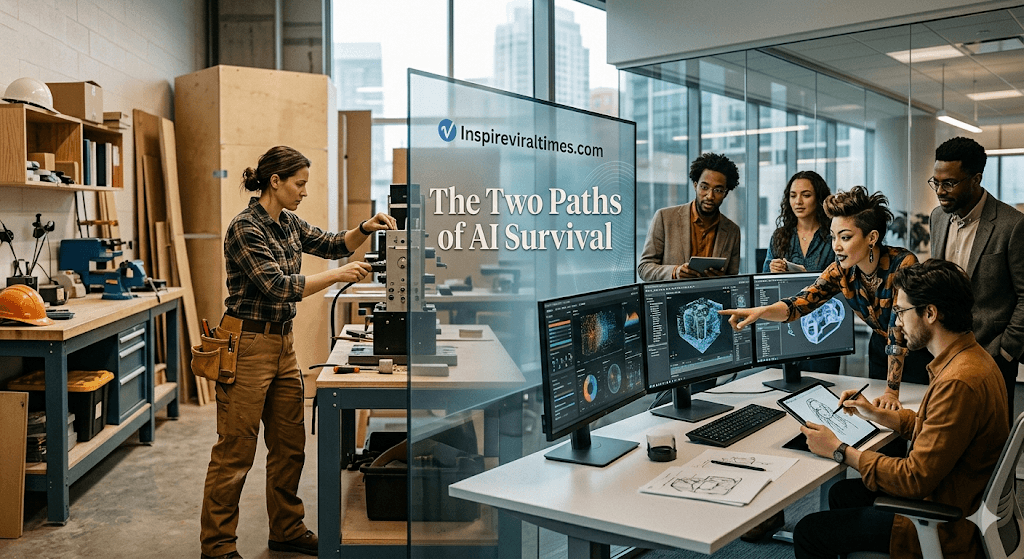
Recently, Palantir Technologies CEO Alex Karp sparked a massive online debate after claiming that only two types of people are likely to thrive in the future AI-driven job market:
- People with vocational or hands-on skills
- People who think differently — especially creative or neurodivergent thinkers
At first glance, the statement sounds dramatic.
Maybe even extreme.
But if you look deeper into what’s happening across industries right now, there’s a reason these warnings are gaining attention.
And honestly? The future of work may already be changing faster than most people realize.
Why AI Is Creating Panic in the Job Market
Over the last two years, AI tools have evolved from simple chatbots into systems capable of:
- Writing reports
- Creating presentations
- Generating code
- Analyzing data
- Designing graphics
- Automating customer support
- Replacing repetitive office tasks
Major executives across banking and tech are openly discussing workforce changes tied to AI adoption.
For example, Jamie Dimon recently said banks may hire fewer traditional bankers and more AI-focused workers in the future.
Meanwhile, Mustafa Suleyman warned that many repetitive white-collar roles could become heavily automated within the next 12–18 months.
Even Jensen Huang emphasized that workers who fail to learn AI tools risk becoming irrelevant in the changing economy.
This isn’t science fiction anymore.
This is corporate reality.
The First Group: People With Real-World Skills
According to Karp, vocational workers may become some of the safest professionals in the AI era.
Why?
Because AI is excellent at digital tasks — but terrible at physical unpredictability.
An AI chatbot can draft an email in seconds.
But it still can’t:
- Repair electrical wiring
- Install plumbing systems
- Fix HVAC equipment
- Handle construction work
- Perform skilled mechanical labor
- Adapt physically to real-world environments
That’s why many experts believe skilled trades could become even more valuable over the next decade.
Ironically, society spent years pushing everyone toward office jobs and college degrees while undervaluing hands-on professions.
Now the market may be shifting in the opposite direction.
And younger generations are beginning to notice.
The Second Group: Creative and Non-Linear Thinkers
The second category is even more interesting.
Karp suggested that people who think differently — especially neurodivergent individuals — may have an advantage in the AI economy.
Not because AI can’t think.
But because originality still matters.
AI is trained on existing information.
It predicts patterns.
It imitates.
But breakthrough ideas usually come from people who:
- Connect unrelated concepts
- Challenge assumptions
- Think creatively
- See patterns others miss
- Build unusual solutions
In other words, the future may reward people who are:
- Highly adaptable
- Deeply curious
- Creative problem-solvers
- Independent thinkers
That’s a major shift from the old corporate model where simply following instructions was enough.
In the AI age, average execution is becoming automated.
Human uniqueness is becoming valuable.
The Jobs Most at Risk From AI
While no one can perfectly predict the future, most experts agree that repetitive knowledge work is especially vulnerable.
This includes jobs heavily based on:
- Data entry
- Basic reporting
- Administrative tasks
- Routine customer support
- Simple coding
- Generic content creation
- Predictable office workflows
That doesn’t mean these careers disappear overnight.
But it does mean the number of humans needed for those roles could shrink dramatically.
AI doesn’t necessarily replace entire professions immediately.
It often replaces parts of jobs first.
And over time, companies need fewer workers to achieve the same output.
That’s the part many people underestimate.
But Here’s What Most AI Headlines Get Wrong
The internet loves fear-driven headlines.
“AI will destroy all jobs.”
“Humans are finished.”
“Robots will replace everyone.”
Reality is usually more complicated.
Historically, technology has always eliminated certain jobs while creating entirely new industries.
The internet destroyed some careers — but also created:
- YouTubers
- Social media managers
- App developers
- Influencers
- Digital marketers
- Remote freelancers
- Online educators
AI will likely do the same.
The people who struggle most may not be those replaced by AI.
It may be those who refuse to adapt to it.
The Smartest Career Strategy in 2026
Instead of panicking about AI, smart professionals are doing three things:
1. Learning AI Tools Early
Workers using AI productively are becoming dramatically faster and more efficient.
People who understand:
- ChatGPT
- AI automation
- Prompt engineering
- AI research tools
- AI design systems
- AI coding assistants
already have an advantage.
AI literacy is quickly becoming as important as internet literacy once was.
2. Building Human Skills AI Can’t Replicate Easily
The most valuable future skills may include:
- Communication
- Leadership
- Creativity
- Emotional intelligence
- Strategic thinking
- Sales
- Storytelling
- Adaptability
These remain difficult for AI to fully replace.
3. Combining AI + Human Expertise
The biggest winners probably won’t be humans or AI alone.
It’ll be humans who know how to work with AI.
A designer using AI.
A marketer using AI.
A programmer using AI.
A business owner using AI.
That combination is becoming incredibly powerful.
Final Thoughts
The AI revolution is real.
And yes, the job market is changing faster than many people expected.
But the future isn’t hopeless.
If anything, this shift is exposing a truth that was always there:
People who create value, solve real problems, adapt quickly, and think independently will always matter.
Maybe Alex Karp’s statement was intentionally provocative.
But underneath the controversy, there’s an important message:
The safest career in the AI era may not come from memorizing information anymore.
It may come from becoming more human — more creative, more adaptable, and more capable of doing what machines still can’t.
Published by Inspire Viral Times
Sources and reporting referenced from Newsweek, Fortune, and additional reporting on AI workforce transformation.