
The job market in 2026 feels completely different from just a few years ago. Recruiters are using AI to scan resumes, companies are automating hiring workflows, and applicants are fighting for attention in a sea of thousands of submissions.
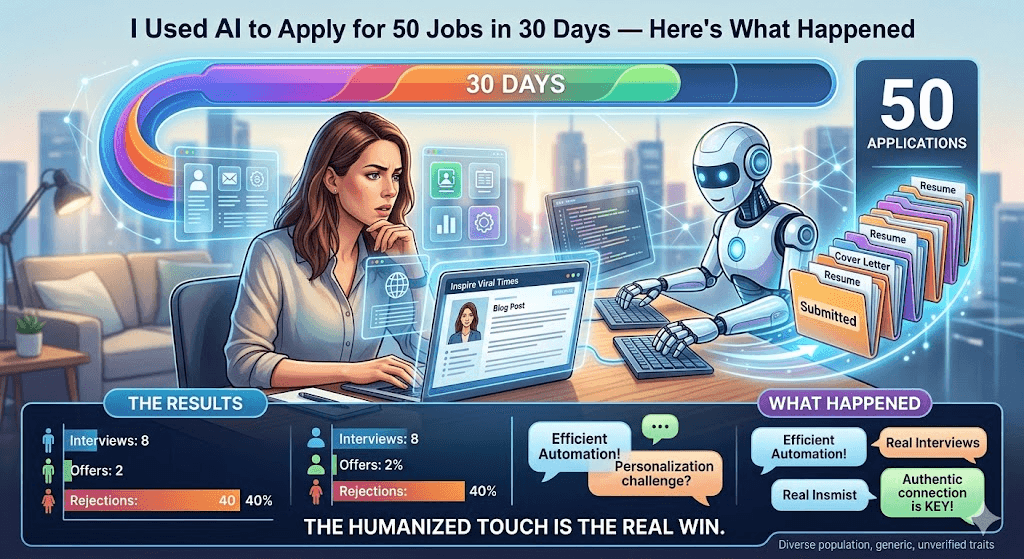
So I decided to run an experiment.
For 30 days, I used AI tools to apply for 50 different jobs — from remote tech roles to content writing gigs and marketing positions. I wanted to see whether artificial intelligence could actually improve my chances of landing interviews, or if it was just another overhyped productivity trend.
What happened surprised me.
This wasn’t just about sending resumes faster. AI changed the entire process — resume writing, cover letters, interview prep, networking, and even job searching itself.
Here’s the complete breakdown of what worked, what failed, and what every job seeker should know before relying on AI to get hired.
Why I Started This Experiment
Like many people, I was frustrated.
Every job application seemed to disappear into a black hole. I spent hours tweaking resumes, writing cover letters nobody probably read, and searching through endless job boards.
At some point, I realized companies were already using AI to filter candidates.
So the obvious question became:
If recruiters are using AI to hire people, can applicants use AI to get hired too?
That single question started my 30-day challenge.
The rules were simple:
- Apply to 50 jobs in 30 days
- Use AI for as much of the process as possible
- Track interview requests, responses, and rejections
- Compare results against traditional job applications
The AI Tools I Used
Before starting, I built a small AI-powered workflow.
Here are the main tools that became part of my daily routine:
1. ChatGPT for Resume Customization
I used ChatGPT to:
- Rewrite resume bullet points
- Match keywords from job descriptions
- Generate tailored cover letters
- Improve LinkedIn summaries
- Practice interview questions
Instead of manually editing every application, I pasted job descriptions and asked AI to optimize my resume for ATS systems.
That alone saved hours.
2. Grammarly for Writing Quality
Grammarly helped polish:
- Cover letters
- Networking emails
- Follow-up messages
- LinkedIn outreach
It made my applications sound cleaner and more professional.
3. LinkedIn AI Features
LinkedIn now uses AI heavily in job recommendations and profile optimization.
I used it to:
- Discover remote jobs faster
- Improve profile visibility
- Generate better headlines
- Identify recruiter activity
4. Resume Scanners
I tested ATS optimization tools like:
These tools compared my resume against job descriptions and gave keyword match scores.
At first, I thought this was gimmicky.
Turns out, it mattered more than I expected.
Week 1: Excitement and Over-Optimization
The first week felt amazing.
AI made everything faster.
I could:
- Rewrite resumes in minutes
- Generate custom cover letters instantly
- Apply to more jobs per day
- Discover hidden keywords recruiters wanted
Instead of spending 2 hours per application, I was finishing some in 15 minutes.
But I made a huge mistake.
I relied too much on AI-generated wording.
My applications sounded polished… but also strangely robotic.
A few cover letters looked technically perfect yet emotionally empty.
That became obvious when I reread them later.
They lacked personality.
And employers notice that.
The Biggest Lesson: AI Can’t Fake Authenticity
This was the turning point of the experiment.
The applications that performed best were NOT the fully AI-generated ones.
The successful applications followed a simple formula:
- AI handled structure and optimization
- I added personal stories and human experiences
That combination worked far better.
For example:
Instead of saying:
“I am passionate about teamwork and innovation.”
I changed it to:
“In my previous role, I helped a small team launch a campaign that increased engagement by 42% in three months.”
Specific experiences beat generic AI language every time.
The Results After 30 Days
Here’s the final breakdown from 50 applications:
| Metric | Result |
|---|---|
| Total Applications | 50 |
| Interview Requests | 11 |
| Recruiter Responses | 17 |
| Rejections | 29 |
| No Responses | 21 |
| Final Job Offers | 2 |
Honestly, I expected worse.
An interview rate above 20% was significantly higher than my previous experience using traditional applications.
But the most interesting part wasn’t the numbers.
It was where the interviews came from.
What Actually Worked
Tailored Resumes
Generic resumes performed terribly.
AI was most effective when customizing resumes for each role.
Even small keyword adjustments improved visibility dramatically.
Better ATS Optimization
Many companies use Applicant Tracking Systems (ATS) to filter resumes before humans ever see them.
AI helped identify:
- Missing keywords
- Weak formatting
- Unclear achievements
- Poor role alignment
Once I optimized for ATS systems, response rates improved.
Faster Applications
Without AI, applying to 50 jobs would’ve taken forever.
AI reduced repetitive work so I could focus on:
- Researching companies
- Networking
- Interview preparation
That productivity boost alone made the experiment worthwhile.
Interview Preparation
This was one of the most underrated benefits.
I used AI to simulate mock interviews.
It generated:
- Behavioral questions
- Technical questions
- Company-specific interview scenarios
- Salary negotiation practice
By the second week, I felt noticeably more confident during interviews.
What Failed Miserably
Not everything worked.
Some AI-generated content was painfully obvious.
Recruiters can often tell when a cover letter feels copied, generic, or overly polished.
Here’s what consistently failed:
Mass Applying
Sending dozens of low-effort AI-generated applications did not work.
Quality still beats quantity.
Generic Cover Letters
AI tends to overuse phrases like:
- “Results-driven professional”
- “Passionate self-starter”
- “Dynamic team player”
These phrases sound corporate and forgettable.
Fake Expertise
AI can help explain concepts, but it cannot replace real experience.
One interviewer asked detailed follow-up questions about a skill mentioned on my resume.
If I had exaggerated my abilities using AI, it would’ve been obvious instantly.
The Emotional Side Nobody Talks About
Using AI for job applications creates a strange emotional experience.
On one hand:
- You feel productive
- Applications become easier
- The process feels less exhausting
But on the other hand:
- Rejections still hurt
- Ghosting still happens
- The uncertainty never disappears
AI can optimize applications.
It cannot remove the emotional reality of job searching.
That part remains deeply human.
Are Companies Detecting AI Applications?
Probably.
Many recruiters are becoming familiar with AI-generated writing patterns.
The safest strategy is not to hide AI usage.
Instead:
- Use AI as an assistant
- Keep your real voice
- Add genuine experiences
- Avoid robotic phrasing
Think of AI like a career coach — not a replacement for yourself.
The Most Surprising Discovery
Networking outperformed cold applications.
Every single serious interview came from one of these:
- LinkedIn connections
- Recruiter conversations
- Employee referrals
- Personalized outreach
AI helped me write better networking messages, but relationships still mattered more than automation.
That was the biggest reality check of the entire experiment.
Should You Use AI to Apply for Jobs?
Yes — but strategically.
AI is incredibly useful for:
- Resume optimization
- Faster editing
- Interview prep
- Research
- ATS keyword alignment
But relying on AI completely is a mistake.
The best applications still feel human.
The future of hiring probably belongs to people who can combine:
- Human creativity
- Authentic storytelling
- AI productivity tools
Not people who automate everything blindly.
Final Thoughts
After applying to 50 jobs in 30 days with AI, here’s my conclusion:
AI absolutely improves efficiency.
It can help you:
- Save time
- Write better resumes
- Prepare smarter
- Apply more strategically
But AI alone will not magically get you hired.
Recruiters still want:
- Real skills
- Real experiences
- Real personality
The candidates who stand out are the ones using AI as an advantage — not as a shortcut.
And honestly, that’s probably how work itself will evolve in the future.
Frequently Asked Questions
Is it okay to use AI for resumes?
Yes. Many professionals now use AI tools to improve resumes, grammar, and formatting. Just make sure the content remains truthful and personalized.
Can recruiters detect AI-generated cover letters?
Sometimes. Overly generic language and repetitive phrasing are major signs. Human editing is essential.
What’s the best AI tool for job seekers?
Tools like ChatGPT, LinkedIn, and Grammarly are among the most useful for resumes, networking, and interview preparation.
Does AI improve interview chances?
It can improve resume optimization and interview preparation, which may increase your chances of getting interviews.
Is AI replacing job seekers?
No — but it is changing how hiring works. People who learn to use AI effectively may gain a competitive advantage.
Published by InspireViralTimes.com
Exploring the future of AI, careers, technology, and digital trends shaping tomorrow.