
On November 19, 2026, Docker officially launched a new brand built around a single word: trust. Announced in Docker’s announcement on the Docker blog by chief marketing officer Terri Avnaim under the title “Meet the New Docker: Built to Run on Trust,” the rebrand is the company’s biggest public statement in years — and it makes one thing clear: Docker is no longer just about containers. It wants to be the trust layer for the age of AI agents.
The visual symbol of the change is a familiar one. Moby, Docker’s beloved whale mascot, has been redesigned for the new era with the help of brand transformation agency Motto. The new Moby keeps the character developers have known for over a decade, but evolved — a fitting metaphor for what Docker says it is doing to itself.
Containers Weren’t Designed for Agents
The core argument behind the rebrand is simple, and Docker states it bluntly: “Containers isolate workloads. But agents aren’t workloads. Agents are actors.”
That distinction matters. A container holds a predictable workload in place. An AI agent, by contrast, makes its own decisions about what to run, what to access and what to change. Give an agent real autonomy and the old isolation model is not enough — developers and enterprises need solutions built specifically to isolate and govern actors, not just workloads.
Docker’s answer is to extend what it has always done — packaging and isolation — into governance. The pitch is that teams should be able to hand agents meaningful work without feeling one step away from catastrophe.
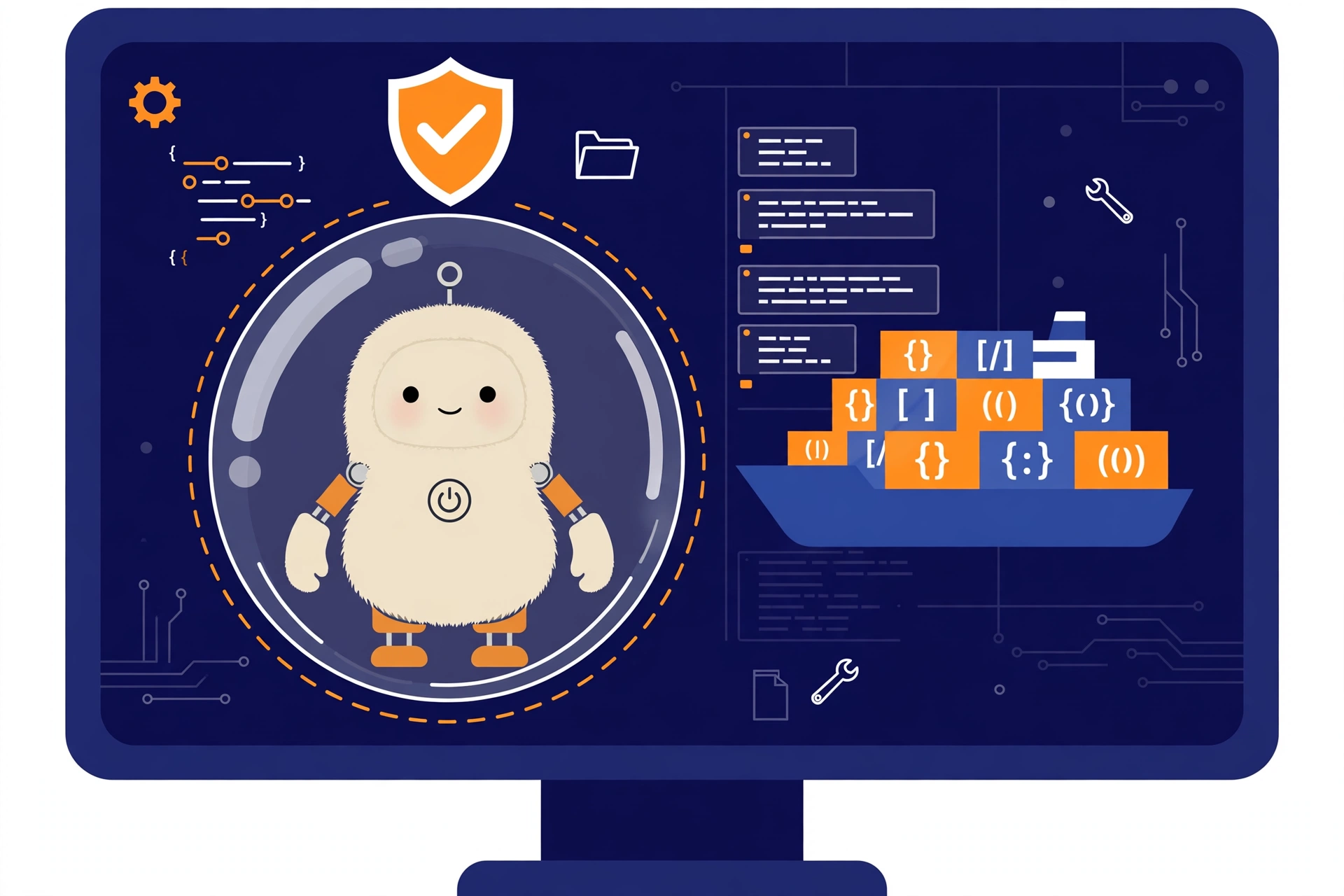
Three Pillars of Trust
The new brand is organized around three trust pillars that map directly onto Docker’s product lineup:
A trusted supply chain. Agents build software, so what they build from has to be verified. Docker Hardened Images sit at the center of this pillar, and the launch week underlined why: emergency patches for the Java4Shell vulnerability (CVE-2026-114938) were published in the Hardened Images catalog alongside the rebrand.
A trusted runtime. This is where agents run, and where isolation has to be strongest. Docker Sandboxes give agents an isolated place to execute, separate from the systems they might otherwise touch.
A trusted ecosystem. Docker says it will not solve a challenge this big alone. The company was named a founding member of the Blueprint Alliance, a 12-company reference architecture for securing AI agents, and the brand announcement stresses partnership over vendor lock-in.
What’s New: Sandboxes, AI Governance and an MCP Gateway
The rebrand arrives with real product movement, not just a new logo. Docker Sandboxes and Docker AI Governance are flagged as new, alongside a new MCP Enterprise Gateway that governs the tools agents connect to through the Model Context Protocol. Docker Desktop 4.100.0 launched the same day, wearing the new brand.
The through-line is governance of the whole agent lifecycle: what an agent is built from, where it runs, which tools it can reach and what it is allowed to do. That connects directly to the wider industry shift toward managed agent runtimes — Anthropic’s self-hosted Claude Managed Agents, for example, put sandboxes and credentials on the customer’s side of the perimeter, and NVIDIA’s OpenShell contribution to the CNCF enforces deterministic policy on agent actions. Docker is positioning its own stack as the neutral, developer-first version of the same idea.
The Model Context Protocol itself is spreading fast — GitHub Copilot recently added eight more MCP connectors — which is exactly why a governed gateway for MCP tools matters. And the security stakes are the same ones driving AI guardrails at the firewall, as in Fortinet’s FortiGuard Inline AI Security service. The open-source Cowork task queue shows the same agent-orchestration trend from the community side.
What Isn’t Changing
Docker is careful to say this is evolution, not abandonment. The containers developers know are not going anywhere — Docker says it will keep leading there as long as containers matter. The company also recommits to openness and industry collaboration, to being developer-first, and to simplicity. The message to long-time users is that the foundation they trusted for over a decade is being built on, not replaced. Docker’s homepage now carries the new brand.
That history is part of the pitch. Docker argues its track record — a software supply chain that became the standard for building securely, and isolation technology trusted by millions of developers — is precisely what qualifies it to govern agents. As Avnaim puts it in the announcement, “you can’t trust the agents to manage themselves.”
What This Means for Developers
For developers, the rebrand is less about a whale and more about a workflow shift:
- Sandbox first. If an agent can run code, change files or call APIs, run it in an isolated sandbox by default — the same discipline teams already apply to untrusted code.
- Mind the supply chain. Agents that write and install software inherit every vulnerability in their dependencies. Hardened, patched base images are the cheapest layer of defense.
- Govern the tools, not just the model. An agent is only as safe as the tools it can reach. MCP gateways and policy controls decide which systems an agent may touch.
- Expect the ecosystem to converge. With Docker, NVIDIA, Anthropic and others all shipping agent isolation and governance in the same month, sandboxing and policy enforcement are becoming table stakes rather than differentiators.
The Bottom Line
Docker’s rebrand is a bet that the next decade of developer tooling will be judged not by how fast agents can work, but by how safely they can be trusted to work. The new Moby is the friendly face of that bet; the sandboxes, governance tools and hardened images are the substance behind it. Developers who start treating agents as actors — isolated, governed and audited — will be ahead of the curve when the rest of the industry catches up.

