
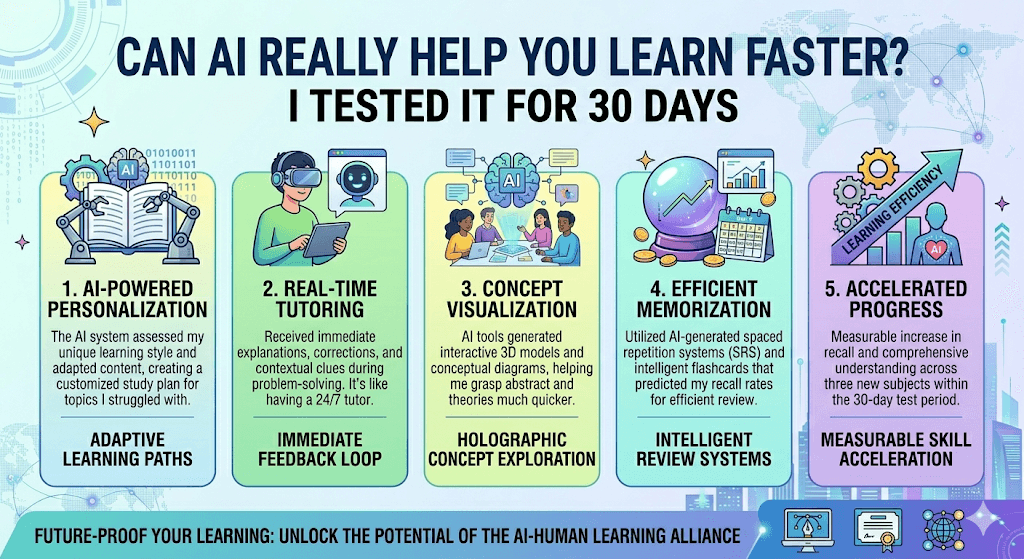
Can AI really help you learn faster? I tested it for 30 days
The hype around AI as a personal tutor is everywhere right now. Every productivity influencer swears that using Claude or ChatGPT slashed their learning curve in half. Every LinkedIn post promises a “10x faster” path to mastery. I’ve been skeptical — not because AI isn’t impressive, but because learning is complicated, human, and often messy in ways that a chat interface can’t always honor.
So I ran a real experiment. Thirty days. Three distinct subjects. One consistent methodology. No shortcuts, no cherry-picking results. Here’s what I found — the good, the frustrating, and the genuinely surprising.
The setup: what I was trying to learn
I picked three subjects on purpose — one language-based, one technical, and one hands-on creative skill — because I suspected AI would behave very differently across these categories.
For each subject, I spent roughly 45 minutes per day. Half of that time was AI-assisted (using Claude as my primary tool, with some cross-testing on Perplexity and specialized tools). The other half was deliberate solo practice — no AI involved.
Week by week: what the experiment actually looked like
The first week was, honestly, borderline magical for Python and Spanish. I could generate custom exercises at exactly my level, get instant grammar corrections with explanations (not just red marks), and ask embarrassingly basic questions without the social awkwardness of a human tutor. Within 4 days, I was writing Pandas DataFrames that would have taken me two weeks of YouTube tutorials to reach. The AI compressed the scaffolding phase dramatically.
Week two is where things got interesting. With a human teacher, a plateau usually means they notice your hesitation and adjust. With AI, I had to get very intentional about prompting my way past stagnation. “Give me an exercise that specifically targets my weak spots” only works if you know what your weak spots are. I started keeping a daily error log, which changed everything — feeding it back to Claude produced shockingly targeted practice sets.
Technical subjects (Python) continued to accelerate. Having a patient, infinitely available debugger that explains why something broke — not just how to fix it — is genuinely transformative. Spanish showed solid gains in reading and writing. But watercolor? That’s where the limits became clear. AI can describe technique beautifully. It can reference masters. It cannot feel the paper saturate, cannot warn you the brush is overloaded before you’ve already drowned the wash. Embodied skills revealed AI’s ceiling sharply.
By the final week, I had developed a rhythm. AI for concepts, explanations, and rapid iteration. Solo practice for consolidation and real feel. The combination felt more powerful than either alone. I also noticed something subtle: the weeks I relied on AI heavily for understanding felt like faster progress, but the weeks I wrestled solo felt like deeper retention. The research backs this up — retrieval practice without assistance often outperforms assisted learning for long-term memory.
The numbers after 30 days
The honest caveat: these numbers are self-assessed and single-subject. I didn’t run a control group. What I can say is that the feeling of forward momentum was nearly constant — and that matters more than people admit for sustaining motivation over a month.
What AI genuinely excels at — as a learning tool
On-demand Socratic dialogue. The ability to ask “but why does that rule exist?” infinitely, without frustrating anyone, might be the single biggest unlock. Understanding the reason behind a rule embeds it far better than memorization.
Personalized pacing without judgment. You set the pace. You decide when to move on. There’s no class to keep up with, no tutor’s hourly rate ticking in the background. This psychological safety is underrated — I asked questions in Spanish that I would have been embarrassed to ask a native speaker for years.
Instant feedback loops. Modern AI tools (especially Claude’s newer versions) are remarkably good at nuanced error correction — not just flagging mistakes but explaining the conceptual gap behind them. For coding, this is transformative. A bug that would have cost me an hour of Stack Overflow hunting took 90 seconds to diagnose and understand.
Adaptive content generation. “Give me five intermediate Spanish sentences that use subjunctive but feel like natural conversation, not textbook examples” — that kind of bespoke request would have required an expensive human tutor before. Now it takes ten seconds.
Where AI genuinely struggles
It doesn’t know what you don’t know. AI responds to what you ask. If you don’t know enough to ask the right question, you can build elaborate knowledge with a hidden gap underneath. This is the single most dangerous failure mode of AI-assisted learning.
Embodied and physical skills. Watercolor, pottery, surgery, rock climbing — any skill where your body needs to develop proprioception or muscle memory — AI can help with the intellectual framework, but the body learns by doing, failing, and adjusting with feedback that a text window cannot provide.
It can rob you of productive struggle. There’s strong evidence from cognitive science that struggling with a problem before seeing the solution improves retention significantly (the “desirable difficulties” principle). AI makes it too easy to shortcut to the answer, and if you’re not disciplined, you can mistake smooth progress for deep learning.
Hallucination in specialized domains. For Spanish and Python, AI errors were rare and easy to catch. In more niche technical areas I tested informally, I hit subtle inaccuracies that were convincingly presented. Trust but verify — always — especially outside mainstream subject matter.
My final verdict on each dimension
So: does AI help you learn faster?
Yes. Meaningfully, measurably, and in ways that surprised even a skeptic. But it’s not a replacement for the hard work of actually learning — it’s more like having a brilliant study partner available around the clock who never gets tired and never judges you for asking something obvious.
The trap is mistaking speed for mastery. AI compresses the time to get moving in a subject — it does not compress the time your brain needs to genuinely own it. Use it to accelerate; still do the solo reps. The learners who will thrive in this environment are the ones who understand the difference between understanding something in a conversation and being able to produce it under pressure, alone.
I’ll keep using it. But I’ll keep struggling too — on purpose.