
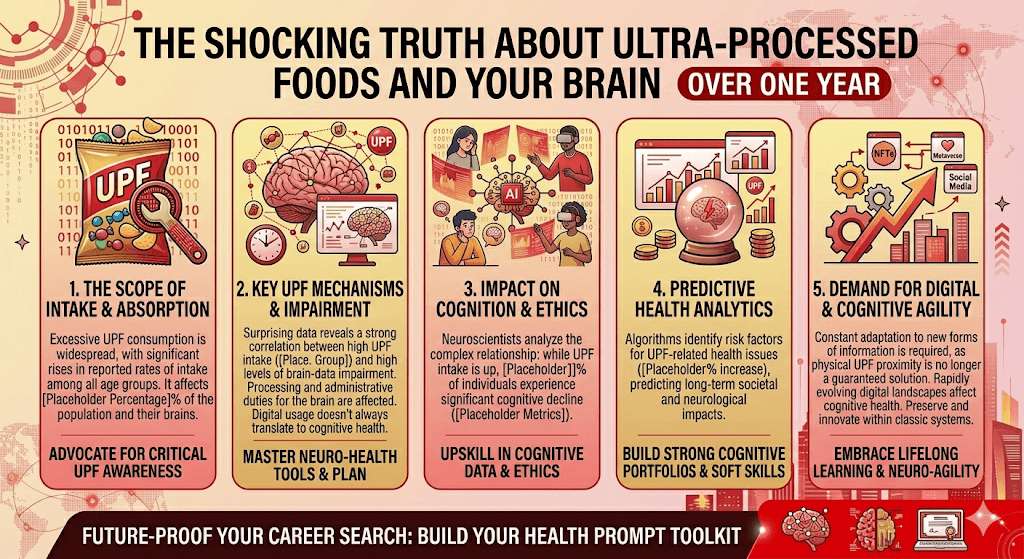
What you grab from the snack aisle isn’t just expanding your waistline — it’s quietly rewiring the very organ that makes you, you. Scientists are only now beginning to grasp how deep the damage goes.
of the average American diet is ultra-processed food
higher risk of depression linked to high UPF consumption
faster cognitive decline observed in heavy UPF eaters
Let me ask you something honest. When was the last time you ate something that didn’t come in a package with more than five ingredients you couldn’t pronounce? If you’re like most people, it was probably longer ago than you’d care to admit. And that’s not a character flaw — it’s by design. These foods were engineered to be irresistible. But here’s what the companies making them really don’t want you to know: what they’re doing to your brain is far more sinister than simply making you overeat.
We’re not just talking about empty calories. We’re talking about a slow, measurable erosion of memory, mood, focus, and mental resilience. The science is in, and it’s alarming.
First — what actually counts as “ultra-processed”?
Not everything in a package is the enemy. A bag of frozen peas is processed. A can of chickpeas is processed. What separates ultra-processed foods (UPFs) from the rest is their reliance on industrial formulations — synthetic additives, artificial colors, flavor enhancers, emulsifiers, and preservatives that you’d never find in a home kitchen.
Common ultra-processed foods hiding in plain sight
- Flavored breakfast cereals and “energy” granola bars marketed as healthy
- Packaged bread with more than 5–6 ingredients (most supermarket loaves qualify)
- Flavored yogurts, dairy-based desserts, and most protein shakes
- Chips, crackers, instant noodles, and microwave meals
- Soft drinks, sports drinks, fruit juices with added flavoring
- Chicken nuggets, hot dogs, deli meats with added nitrates
- Most fast food, regardless of how it’s marketed
Researchers use the NOVA classification system to categorize foods by the degree of processing. Under NOVA, ultra-processed foods are defined not by their nutrient content alone, but by their industrial manufacturing process and additive cocktails. This distinction matters enormously — because it’s not just the sugar or saturated fat doing damage. It’s the whole chemical package.
Your brain on ultra-processed: the neuroscience is disturbing
Here’s where things get genuinely unsettling. Your brain is not just a passive victim of a bad diet — it actively changes in response to what you eat. And ultra-processed foods, it turns out, are extraordinarily good at hacking those changes in the wrong direction.
A landmark 2022 study published in JAMA Neurology tracked nearly 11,000 adults over nearly a decade and found that those who consumed the highest amounts of ultra-processed foods experienced significantly faster cognitive decline across multiple domains — memory, language, executive function — compared to those who ate the least. The difference was not trivial. It was the equivalent of aging your brain by several extra years.
But the dopamine story is just one chapter. Researchers have also identified gut-brain axis disruption as a major mechanism. Your gut microbiome — the trillions of bacteria living in your digestive tract — communicates directly with your brain through the vagus nerve. Ultra-processed foods systematically destroy the diversity of this microbiome, starving the beneficial bacteria that produce serotonin, GABA, and other neurotransmitters that regulate mood, anxiety, and sleep.
The inflammation connection nobody talks about enough
Chronic low-grade inflammation is the silent killer underlying almost every major modern disease — and it turns out ultra-processed foods are one of its most potent drivers. The additives, refined oils, and sugar in these products trigger inflammatory pathways that, crucially, cross the blood-brain barrier.
Neuroinflammation — inflammation inside the brain — is now understood to be a core feature of depression, anxiety disorders, and even early-stage neurodegenerative diseases like Alzheimer’s. When researchers look at the brains of heavy UPF consumers, they’re finding elevated inflammatory markers in cerebrospinal fluid. They’re finding changes to the hippocampus — the brain’s memory center. They’re finding structural differences that mirror what we see in aging brains decades older.
This isn’t theoretical. A 2023 study from the European Journal of Nutrition found that replacing just 10% of ultra-processed food intake with equivalent calories from whole foods significantly reduced biomarkers of neuroinflammation in participants after eight weeks. Eight weeks. That’s how responsive the brain can be — but only if you give it a chance.
Mental health: the crisis hiding in your grocery cart
Depression is now the leading cause of disability worldwide. Anxiety disorders affect hundreds of millions. And while causes are complex and multifactorial, the evidence linking ultra-processed food consumption to mental health outcomes has become impossible to ignore.
A major meta-analysis pooling data from over 260,000 participants found a 22% higher risk of depression among those who ate the most ultra-processed foods. A separate study from University College London tracked 72,000 adults and found that even after controlling for lifestyle factors like exercise and sleep, ultra-processed food consumption independently predicted poor mental health outcomes.
Children and adolescents are especially vulnerable. The developing brain is particularly sensitive to dietary inputs, and early exposure to high-UPF diets appears to establish neurological patterns that persist into adulthood — influencing impulse control, emotional regulation, and susceptibility to mood disorders. This is not a peripheral concern. This is a public health emergency unfolding in school cafeterias and convenience stores across the country.
The memory thief you eat every day
We talk a lot about protecting memory as we age — taking supplements, doing crossword puzzles, staying socially active. What we talk about far less is what’s actively destroying it, one snack at a time.
The hippocampus — the seahorse-shaped structure buried deep in your temporal lobe — is ground zero for memory formation and spatial navigation. It’s also one of the first regions to show damage in Alzheimer’s disease. And it is exquisitely sensitive to diet.
Animal studies (which typically precede human trials by a decade or more) have shown that high-UPF diets reduce hippocampal neurogenesis — the birth of new brain cells — and impair synaptic plasticity, the brain’s ability to strengthen connections between neurons. Human imaging studies are beginning to confirm similar patterns: reduced hippocampal volume, reduced cortical thickness, and disrupted white matter integrity in people who consume the most ultra-processed foods.
Here’s the part that should stop you mid-chip: many of these changes begin showing up in people in their 30s and 40s — decades before any symptoms emerge. The cognitive debt is accumulating quietly, invisibly, with every processed meal.
So what can you actually do about it?
Here’s the genuinely hopeful part of this story — and there is one. The brain is remarkably plastic. It can heal. The microbiome can be restored. Inflammation can be reduced. Cognitive trajectories can be bent. But it requires actually changing what you eat, not just adding a supplement and calling it a day.
You don’t have to be perfect. You don’t have to eliminate everything overnight. Research consistently shows that even modest, sustained improvements in diet quality produce measurable neurological benefits. Start somewhere.
Swap breakfast first
Replace one ultra-processed breakfast item with whole oats, eggs, or fruit. Morning nutrition sets the neurochemical tone for the day.
Feed your gut
Add fermented foods — plain yogurt, kefir, sauerkraut — and prebiotic fiber from onions, garlic, and legumes to rebuild microbiome diversity.
Go omega-3 rich
Fatty fish, walnuts, and flaxseed provide DHA and EPA — the structural fats your brain literally needs to function and repair itself.
Read the ingredient list
More than 5 ingredients? Can’t pronounce them? That’s your signal. The label is more honest than the marketing on the front.
Cook one extra meal
You don’t need to be a chef. One home-cooked meal per day more than you currently make is a meaningful shift over weeks and months.
Hydrate, don’t medicate
Many cravings for processed food are amplified by dehydration. Drink water before reaching for a snack and notice what happens.
The bottom line
We are living through an unprecedented experiment in human nutrition, and the preliminary results are not encouraging. Ultra-processed foods now dominate the global food supply. They’re cheap, convenient, engineered to be addictive, and marketed aggressively to our most vulnerable populations. And every day, quietly and invisibly, they are reshaping millions of brains in ways that may take decades to fully understand.
But here’s what we know right now: the food you eat today is building — or eroding — your cognitive future. Your mood, your memory, your resilience, your risk of depression and dementia — all of it is being influenced, meal by meal, by what lands on your plate.
That’s not meant to scare you into paralysis. It’s meant to remind you that you are not powerless. Every meal is a choice. And choices, stacked consistently over time, are the most powerful biological intervention available to any of us.
Your brain built everything you’ve ever thought, felt, loved, or created. The least it deserves is real food.
Share this with someone who needs to read it
If this changed how you think about what you eat, it’ll do the same for someone you care about. Knowledge is the first step — sharing it is the second.