
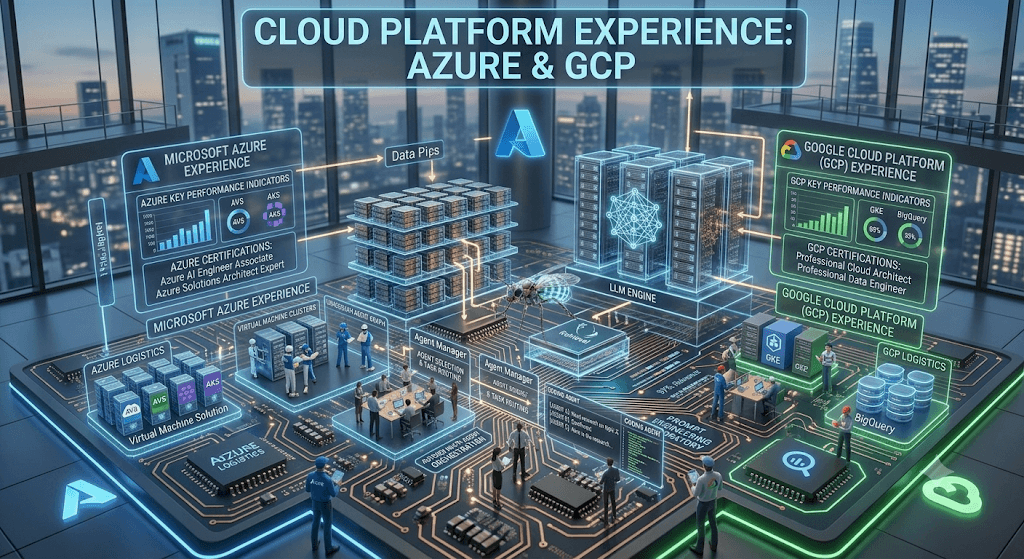
Based on your resume and the experience you’ve been preparing, the strongest answer is to position yourself as AWS-first while demonstrating that your cloud architecture skills are transferable to Azure and GCP. Don’t claim hands-on expertise you don’t have.
A good interview answer would be:
My primary expertise is in AWS, where I have over 13 years of experience designing and implementing enterprise cloud solutions, particularly in Healthcare and Life Sciences. I’ve architected scalable data platforms using services such as Amazon S3, AWS Lambda, AWS Glue, Amazon Redshift, Amazon RDS/Aurora, DynamoDB, IAM, CloudFormation, Amazon EKS, and Amazon Bedrock for Generative AI applications.
Although AWS has been my primary platform, I understand the core cloud architecture principles that are common across all major cloud providers, including Azure and GCP—such as identity and access management, networking, serverless computing, containers, Kubernetes, storage, monitoring, CI/CD, and infrastructure as code.
For Azure, I’m familiar with services such as Azure Functions, Azure Kubernetes Service (AKS), Azure Data Factory, Azure Synapse Analytics, Azure Blob Storage, Azure SQL Database, Azure Key Vault, Microsoft Entra ID (formerly Azure AD), and Azure OpenAI Service. I understand where these services fit architecturally and how they compare to equivalent AWS offerings.
Similarly, for GCP, I’m familiar with Cloud Storage, Cloud Functions, BigQuery, Cloud Run, Google Kubernetes Engine (GKE), Vertex AI, Cloud SQL, IAM, Pub/Sub, and VPC networking concepts.
While my production experience has primarily been on AWS, I’ve successfully learned new technologies throughout my career, and I’m confident in quickly becoming productive on Azure or GCP because the underlying architectural patterns remain consistent.
If asked: “How would you compare AWS, Azure, and GCP?”
You can say:
| AWS | Azure | GCP |
|---|---|---|
| Strongest overall cloud ecosystem | Excellent Microsoft enterprise integration | Best analytics and AI/ML ecosystem |
| Amazon Bedrock | Azure OpenAI Service | Vertex AI |
| AWS Lambda | Azure Functions | Cloud Functions |
| Amazon EKS | AKS | GKE |
| Amazon S3 | Azure Blob Storage | Cloud Storage |
| AWS Glue | Azure Data Factory | Dataflow |
| Amazon Redshift | Azure Synapse | BigQuery |
| DynamoDB | Cosmos DB | Firestore/Bigtable |
| IAM | Entra ID + RBAC | Cloud IAM |
If they ask: “Have you worked on Azure or GCP production projects?”
Answer honestly:
My production experience has primarily been on AWS. However, I’ve studied Azure and GCP services, understand their architecture and service mappings, and I’m confident in designing solutions across cloud platforms. My focus has always been on solving business problems rather than being tied to a specific cloud vendor, so adapting to Azure or GCP would be a natural progression.
This response is credible, technically sound, and avoids overstating experience while emphasizing your strengths in cloud architecture.
What I do have:
- Strong knowledge across Azure and GCP (and AWS) from extensive training data, documentation, architecture patterns, best practices, troubleshooting, cost optimization, security, IaC, etc.
- Ability to help you with:
- Designing architectures
- Writing Terraform / Bicep / Deployment Manager / Pulumi code
- Explaining services (e.g., AKS vs GKE, Azure Functions vs Cloud Run, Cosmos DB vs Firestore, etc.)
- Troubleshooting errors
- Migration strategies
- Security & compliance (IAM, networking, encryption)
- Cost optimization and FinOps
- CI/CD pipelines (GitHub Actions, Azure DevOps, Cloud Build, etc.)
- Scripting (Python, PowerShell, gcloud CLI, az CLI)
- I can generate code snippets, review your configurations, compare services between Azure and GCP, or walk you through specific scenarios in real time.
While I don’t have hands-on personal experience, I can provide a clear and detailed comparison of Azure and Google Cloud Platform (GCP) based on their key strengths, core services, and typical use cases. This information should give you a solid framework for understanding what each platform offers and how they differ.
Azure vs. GCP: A High-Level Comparison
Comparing Core Services
Both platforms offer core services for compute, storage, and networking, but their branding and specific features can differ. Here is a mapping of equivalent services :
| Service Category | Azure Service | GCP Equivalent |
|---|---|---|
| Serverless Functions | Azure Functions | Cloud Functions |
| Workflow Orchestration | Durable Functions | Workflows |
| Messaging & Queues | Service Bus | Pub/Sub |
| Event Routing | Event Grid | Eventarc |
| Real-time Data Ingestion | Event Hubs | Pub/Sub (Streaming) |
| Containers (Orchestration) | Azure Kubernetes Service (AKS) | Google Kubernetes Engine (GKE) |
| Object Storage | Blob Storage | Cloud Storage |
| Relational Database (Serverless) | Azure SQL Database (Serverless) | Cloud SQL (with autoscaling) |
| Natural Language AI | Cognitive Services (Language API) | Cloud Natural Language API |
| Infrastructure as Code (IaC) | Azure Resource Manager (ARM) / Bicep | Deployment Manager / Terraform (commonly used) |
When to Choose Which Platform
- Choose Azure if:
- Your organization is a “Microsoft shop” using technologies like Active Directory, Windows Server, or SQL Server .
- You need a sophisticated hybrid cloud strategy that seamlessly connects your on-premises data centers with the cloud .
- You require extensive global coverage with a massive network of data centers and availability zones .
- Choose GCP if:
- Your work is centered around big data analytics, AI, and machine learning, with services like BigQuery and TensorFlow being a major draw .
- You are committed to an open-source, Kubernetes-first approach for building and deploying applications .
- You are looking for a developer-friendly platform with a reputation for straightforward pricing and innovation in data and AI .
Modern cloud adoption is increasingly multi-cloud, allowing organizations to leverage the best services from each provider. For example, a company might use Azure DevOps for CI/CD and project management while deploying workloads on GCP to take advantage of its AI and data analytics capabilities