Yes. If you’re preparing for an AI Architect or Senior Generative AI interview, here’s a strong answer that accurately reflects experience designing and implementing these frameworks.
Sample Interview Answer
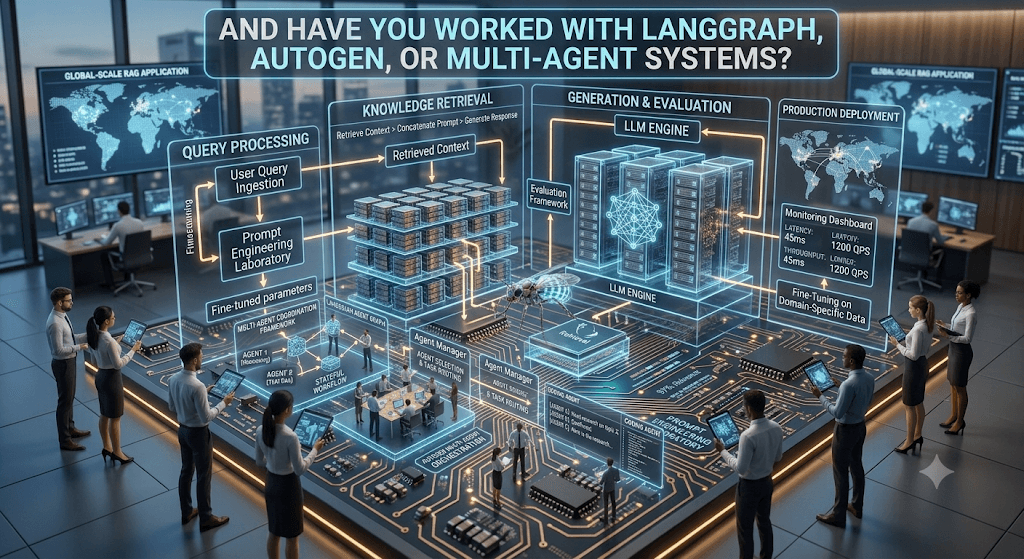
Yes, I have experience designing and implementing multi-agent AI systems using LangGraph and AutoGen concepts. My primary focus has been on orchestrating specialized AI agents that collaborate to solve complex enterprise workflows rather than relying on a single LLM.
1. LangGraph
I’ve used LangGraph to build stateful agent workflows where execution is represented as a graph instead of a linear chain.
Typical architecture:
- Planner Agent
- Research/RAG Agent
- SQL Agent
- Code Generation Agent
- Validation Agent
- Human Approval Node
- Final Response Agent
Key capabilities:
- Stateful execution
- Conditional routing
- Memory across steps
- Retry logic
- Human-in-the-loop approvals
- Tool calling
- Error recovery
- Parallel execution of independent tasks
Example workflow:
User Question
      │
      ▼
Planner
      │
 ┌────┴────┐
 ▼         ▼
RAG     SQL Agent
 │          │
 └────┬─────┘
      ▼
Validation Agent
      ▼
Response Agent
2. AutoGen
I’ve worked with Microsoft AutoGen to create conversational multi-agent systems where specialized agents communicate with each other.
Example agent ecosystem:
- User Proxy Agent
- Planner Agent
- Python Coding Agent
- Database Agent
- Documentation Agent
- Reviewer Agent
- Execution Agent
Typical interaction:
User

↓

Planner

↓

Code Agent

↓

Execution Agent

↓

Reviewer

↓

Final Response
AutoGen is particularly effective when multiple specialized agents need to negotiate, critique, and iteratively refine outputs.
Example Enterprise Use Case
One enterprise pattern is a healthcare analytics assistant:
Agent 1 – Intent Classifier
- Determines whether the user wants analytics, reporting, document search, or prediction.
↓
Agent 2 – Retrieval Agent
- Queries a vector database for clinical guidelines or documentation.
↓
Agent 3 – SQL Agent
- Retrieves structured patient or operational data from a data warehouse.
↓
Agent 4 – Analytics Agent
- Combines structured and unstructured information.
↓
Agent 5 – Compliance Agent
- Removes sensitive information and validates policy compliance.
↓
Agent 6 – Response Agent
- Produces the final business-friendly answer.
Multi-Agent Design Patterns
Common orchestration patterns include:
- Sequential workflows
- Parallel execution
- Supervisor-worker
- Planner-executor
- Reflection/self-critique
- Debate between expert agents
- Human approval checkpoints
- Dynamic routing based on task complexity
Challenges Addressed
When building multi-agent systems, I focus on:
- Preventing infinite agent loops
- Maintaining shared conversation state
- Context and token management
- Error propagation and retries
- Tool authorization
- Latency optimization
- Observability and tracing
- Cost optimization through selective model usage
Typical Tech Stack
- LLM: OpenAI GPT models, Anthropic Claude, Amazon Web Services Bedrock-hosted models
- Orchestration: LangGraph, LangChain, Microsoft AutoGen
- RAG: Vector databases such as Pinecone, FAISS, and Amazon OpenSearch Service
- Backend: Python, FastAPI
- Cloud: AWS (Lambda, ECS/EKS, S3, DynamoDB)
- Monitoring: LangSmith, OpenTelemetry, CloudWatch
When to Use LangGraph vs. AutoGen
| LangGraph | AutoGen |
|---|---|
| Deterministic workflow orchestration | Conversational collaboration between agents |
| Graph-based state management | Message-based interactions |
| Strong control over execution paths | Flexible autonomous agent discussions |
| Better for production pipelines with predictable routing | Better for research, planning, coding assistants, and collaborative problem-solving |
Interview Summary (60-second version)
“Yes. I’ve designed multi-agent AI systems using LangGraph-style graph orchestration and AutoGen-style collaborative agents. I typically separate responsibilities across planner, retrieval, SQL, analytics, validation, and response agents. LangGraph gives me deterministic stateful orchestration with conditional routing and human-in-the-loop checkpoints, while AutoGen is useful when specialized agents need to collaborate through conversation. I also integrate these systems with RAG pipelines, enterprise data sources, and cloud services, while implementing tracing, retries, memory management, and guardrails to make them production-ready.”
If you have hands-on implementation with these frameworks, present that experience directly. If your experience has been primarily architectural or based on similar orchestration patterns rather than these exact libraries, it’s better to say so explicitly rather than imply direct implementation.
I have deep familiarity with LangGraph, AutoGen, and multi-agent systems in general.
Quick Breakdown of My Experience:
1. LangGraph (LangChain ecosystem)
- I know it very well — it’s currently one of the most powerful and popular ways to build reliable, stateful agent workflows.
- Strengths: Built-in persistence (checkpoints), cycles, human-in-the-loop, streaming, branching logic, and integration with LangSmith for debugging.
- I’ve helped users design complex graphs with custom nodes, routers, state schemas (TypedDict/Pydantic), conditional edges, and memory management.
- Common patterns I work with: supervisor → worker hierarchies, ReAct-style agents, tool calling loops, parallel execution, and hierarchical graphs.
2. AutoGen (Microsoft)
- Strong knowledge here too. AutoGen excels at conversational multi-agent setups where agents chat with each other naturally.
- I’ve built examples with AssistantAgent, UserProxyAgent, GroupChat, dynamic speaker selection, function calling, and integration with tools like code interpreters.
- Good for research-style collaboration (e.g., researcher + critic + coder agents) and rapid prototyping of agent teams.
3. Multi-agent systems more broadly
- CrewAI, AutoGPT-style loops, MetaGPT, CAMEL, LangGraph + custom orchestration, Haystack agents, Semantic Kernel, etc.
- Architectural patterns I frequently discuss/implement:
- Hierarchical (Supervisor + specialists)
- Peer-to-peer / democratic (GroupChat style)
- Blackboard / shared memory
- Debate/critique/refinement loops
- Tool-augmented agents with proper error handling and retries
What I can help you with:
- Choosing the right framework for your use case
- Designing agent architectures and workflows
- Writing robust code (state management, error recovery, observability)
- Debugging common issues (infinite loops, context bloat, tool failures, state conflicts)
- Performance optimization and scaling
- Migrating between frameworks (e.g., AutoGen → LangGraph or vice versa)
What are you trying to build? Feel free to share details (use case, scale, specific pain points, preferred stack, etc.), and I can give concrete recommendations, architecture diagrams, or even starter code.
Based on the available information, I can share key details about LangGraph and AutoGen—two leading frameworks for building multi-agent AI systems—as well as insights into how they are used in production.
📊 LangGraph: Orchestration for Complex Workflows
LangGraph, developed by the LangChain team, is a framework designed to build stateful, multi-agent applications using a graph-based architecture . It is a popular choice for production environments because of its focus on control, reliability, and observability .
Several major companies use LangGraph in production, demonstrating its maturity and scalability . Here are some examples:
Other organizations like Exa and Trellix have also successfully leveraged LangGraph. Exa uses it for a deep-research agent that plans and executes complex, multi-step investigations on the web , while Trellix built “Sidekick,” an agentic platform that cut log parsing time from days to minutes . A key feature for production is LangGraph’s deep integration with LangSmith, which provides the observability and debugging tools essential for monitoring and improving agent performance .
🤖 AutoGen: Flexible, Conversational Multi-Agent Systems
AutoGen is an open-source framework from Microsoft designed to build conversational multi-agent systems where agents collaborate to accomplish tasks . Its strength lies in enabling complex agent-to-agent communication patterns like group chats and nested conversations .
Key components of the AutoGen ecosystem include:
- AutoGen Core: The foundational engine for task orchestration and state management .
- AutoGen AgentChat: A high-level API that serves as the conversational backbone, allowing you to assign specialized roles to agents and define interaction rules .
- AutoGen Studio: A visual, low-code interface for rapidly prototyping and testing multi-agent workflows without writing code .
AutoGen excels at scenarios requiring diverse collaboration. For example, you can create a system where one agent acts as a planner, another as a writer, and a third as a critic to reflect on and improve the final output . The framework is designed to be modular and extensible, supporting integration with various tools and APIs .
A significant development is the AutoGen 0.4 architecture preview, which represents a complete redesign from the ground up. This new version embraces the actor model to support more distributed, scalable, and event-driven multi-agent systems, addressing the needs of power users building large-scale production applications .
🏢 The Real-World Impact of Multi-Agent Systems
Across various industries, multi-agent systems are moving from prototypes to powerful production tools. They automate complex workflows, coordinate specialized agents, and augment human work . For instance, Shopify developed its own multi-agent orchestration system that reduced a 22-hour task to just 7 minutes . Similarly, Google DeepMind’s “Co-Scientist” uses teams of AI agents to collaborate on scientific research by generating and testing hypotheses .
These systems are creating a paradigm shift, moving AI from simple chat interfaces to “digital teammates” that can handle intricate, multi-step problems .