
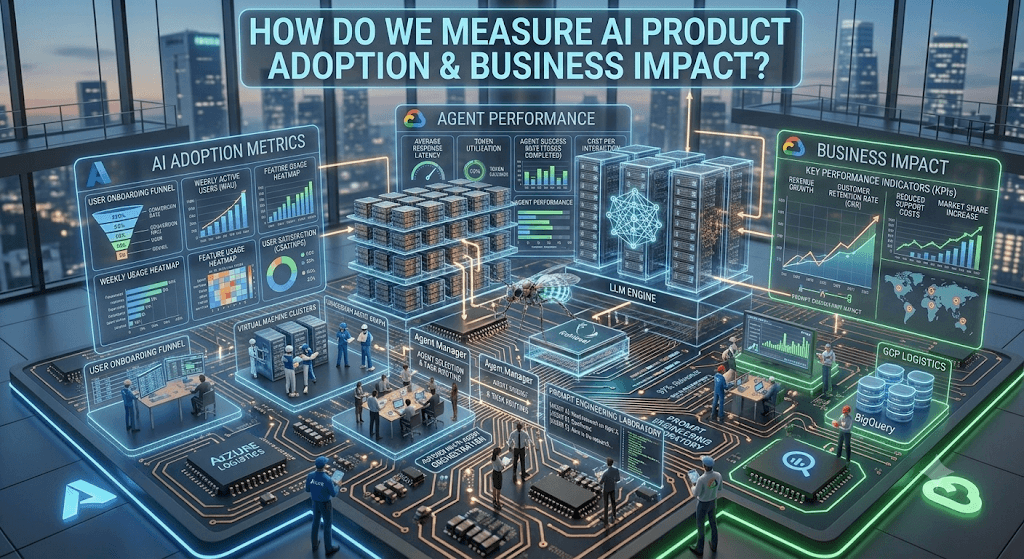
For an AI Architect or AI Product interview, interviewers want to know that you measure more than just model accuracy. The success of an AI product is determined by business outcomes, user adoption, operational efficiency, and model performance.
A strong answer is structured across four layers.
Sample Interview Answer
“I measure AI product success using a balanced scorecard that includes business KPIs, user adoption metrics, operational metrics, and AI model performance. My goal is to ensure the AI solution not only performs well technically but also delivers measurable business value and is actively adopted by users.”
1. Business Impact Metrics (Most Important)
These demonstrate ROI.
Typical KPIs include:
| Metric | Example |
|---|---|
| Revenue Growth | +15% sales from AI recommendations |
| Cost Savings | $2M annual operational savings |
| Productivity | 40% reduction in manual work |
| Time Saved | Processing reduced from 3 hours to 15 minutes |
| Customer Satisfaction | CSAT increased from 82% to 91% |
| Net Promoter Score (NPS) | +10 improvement |
| Conversion Rate | 8% → 14% |
| Customer Retention | +12% |
Example:
AI-powered document processing reduced manual review by 75%, saving over 5,000 analyst hours annually.
2. User Adoption Metrics
Even a highly accurate model fails if people do not use it.
Key metrics include:
- Daily Active Users (DAU)
- Monthly Active Users (MAU)
- Adoption Rate
- Feature Usage
- User Retention
- Session Duration
- Repeat Usage
- Task Completion Rate
- User Feedback
- Satisfaction Surveys
Example:
- 80% of customer service agents adopted the AI assistant within two months.
- Average daily AI interactions increased from 300 to 2,500.
3. AI Model Performance Metrics
These depend on the type of AI system.
Classification
- Accuracy
- Precision
- Recall
- F1 Score
- ROC-AUC
Regression
- RMSE
- MAE
- MAPE
Generative AI / LLM
- Answer Relevance
- Groundedness
- Hallucination Rate
- Citation Accuracy
- Toxicity Score
- Response Quality
- BLEU
- ROUGE
- BERTScore
- Human Evaluation
Example:
We reduced hallucination rates from 18% to below 4% after implementing a Retrieval-Augmented Generation (RAG) architecture and prompt optimization.
4. Operational Metrics
Production reliability is critical.
Monitor:
- API Latency
- P95 Response Time
- P99 Latency
- Availability (SLA)
- Throughput
- Error Rate
- Cost per Request
- GPU Utilization
- Token Usage
- Cache Hit Rate
Example:
- Average inference latency: 350 ms
- 99.9% uptime
- 35% reduction in inference costs through model optimization
5. Responsible AI Metrics
For enterprise deployments, measure:
- Fairness
- Bias
- Explainability
- Drift
- Privacy Compliance
- Security Incidents
- Audit Compliance
Example:
- Monthly bias assessments
- Automated model drift detection
- Explainability scores using SHAP or feature attribution techniques
6. RAG-Specific Metrics
For Retrieval-Augmented Generation systems:
Retrieval
- Recall@K
- Precision@K
- Mean Reciprocal Rank (MRR)
- Hit Rate
Generation
- Faithfulness
- Groundedness
- Context Relevance
- Citation Accuracy
- Hallucination Rate
Example:
We monitored retrieval precision separately from answer quality, enabling us to determine whether issues originated in retrieval or generation.
7. Agentic AI Metrics
For multi-agent systems, evaluate:
- Task Success Rate
- Planning Accuracy
- Tool Call Success Rate
- Average Steps per Task
- Human Intervention Rate
- Recovery Rate
- Autonomous Completion Rate
Example:
- 92% autonomous task completion
- Human intervention reduced by 65%
8. A/B Testing Metrics
When rolling out new AI capabilities:
Measure:
- Click-Through Rate (CTR)
- Conversion Rate
- Revenue per User
- Engagement
- Retention
- Support Ticket Reduction
Example:
| Metric | Before AI | After AI |
|---|---|---|
| Conversion | 8% | 12% |
| Customer Satisfaction | 82% | 91% |
| Resolution Time | 25 min | 8 min |
9. AI Dashboard
A typical executive dashboard includes:
Business
- Revenue impact
- Cost savings
- ROI
- Productivity gains
Adoption
- DAU/MAU
- Active users
- Feature adoption
- Retention
Model
- Accuracy
- Hallucination rate
- Groundedness
- Drift
Operations
- Latency
- Availability
- Error rate
- Infrastructure cost
Responsible AI
- Bias
- Fairness
- Explainability
- Compliance
Example from an Enterprise AI Project
“In one enterprise AI assistant project, we defined success across multiple dimensions. For business impact, we measured a 60% reduction in manual support effort and approximately $1.5M in annual operational savings. Adoption reached over 85% of target users within three months, with strong weekly engagement. From a model perspective, we tracked groundedness, hallucination rate, and user feedback, improving answer accuracy from 78% to 93% after enhancing our RAG pipeline. Operationally, we maintained sub-500 ms average response times, 99.9% service availability, and continuously monitored model drift and token costs. This balanced approach ensured the solution delivered sustained business value rather than just strong benchmark performance.”
This type of answer demonstrates that you understand AI product success as a combination of technical excellence, operational reliability, user adoption, and measurable business outcomes, which is the perspective interviewers typically expect for senior AI Architect and AI Product leadership roles.
Measuring AI product adoption and business impact requires a multi-layered framework that goes beyond vanity metrics like prompt volume or license counts. High usage doesn’t equal value—many organizations see strong adoption but minimal ROI due to poor integration, low trust, or unmeasured outcomes.
Effective measurement connects adoption (are people using it?) to engagement/quality (is it helpful and reliable?) to business impact (does it drive revenue, efficiency, or other outcomes?). Frameworks from sources like Mixpanel, McKinsey, and others commonly organize this into tiers or layers.
1. AI Product Adoption Metrics
Focus on whether users discover, try, and stick with the AI feature or tool. Track these for both human users and, increasingly, AI agents.
- Active AI Users %: Percentage of eligible/provisioned users who actively engage (e.g., submit prompts or complete tasks) in a period (7/30/90 days). Target: 60-80% for mature rollouts.
- User Adoption Rate: (AI feature users / Total active users) × 100. Low rates often signal discovery/onboarding issues.
- Prompts per Active User/Session: Measures depth of engagement. High volume with low interactions may indicate experimentation vs. habitual use.
- Power User Rate / Repeat Usage: % of users submitting N+ prompts or returning within 7-30 days. Cohort retention for AI users is key—faster drop-off than core product signals problems.
- Feature Adoption Rate & AI Dependency Ratio: % of eligible users trying/regularly using it; % of workflows involving AI.
- Agent-specific (for AI agents as users): Task completion rate, human-to-agent usage ratio.
Qualitative signals: Time-to-first-use, Time-to-Proficiency (days to consistent value), NPS/advocacy for the AI feature.
Tools: Product analytics (e.g., Mixpanel), event logging for prompts/actions, cohort analysis.
2. Model/Quality & Experience Metrics
Adoption fails without trust. These bridge usage to outcomes.
- User Acceptance Rate (UAR) / Output Acceptance: % of suggestions applied or acted upon. Low rates indicate value or UX issues, not just model accuracy.
- Task/Goal Completion Rate & First-Attempt Success: Did the user achieve their intent? Track re-prompt rate (frustration signal) and abandonment.
- Latency, Error/Hallucination Rate, Safety/Refusal Rate: Operational health. Include “LLM-as-judge” scoring for quality.
- Override/Edit Rate & Regeneration Rate: How often users fix outputs.
Monitor drift, token efficiency, and cost per successful outcome.
3. Business Impact & ROI Metrics
This is the bottom line—link AI to financial/operational results using baselines, A/B tests, or phased rollouts for attribution.
Common categories (track leading/lagging indicators):
- Productivity/Efficiency: Time saved per task/workflow, throughput increase, cycle time reduction, FTE equivalents saved. E.g., hours reclaimed, process automation rate.
- Cost Metrics: Cost per prompt/task, total cost of ownership (TCO: licenses, infra, training, maintenance), cost savings (labor, errors, waste).
- Revenue/ Growth: Incremental revenue lift, conversion rate uplift, retention/churn improvement, win rate, new capabilities enabled.
- Quality/Risk: Error rate reduction, compliance improvements, customer/employee satisfaction (NPS, CSAT).
- ROI Calculation: (Net Benefits – Total Costs) / Total Costs × 100. Or NPV over 3-5 years with adoption discounts (e.g., 40-60% in Year 1). Include baselines pre-AI.
Example ROI Formula: Annualized Benefits (efficiency value + revenue uplift + avoided costs) minus TCO.
Frameworks:
- Mixpanel-style: Adoption/Engagement + Model Monitoring + Business Impact.
- McKinsey 5-Layer: Technical → User adoption → Operational change → Financial impact.
- DX or similar: Utilization + Impact + Cost.
Best Practices for Implementation
- Start with Baselines & Experimentation: Measure pre-AI performance. Use A/B tests, cohorts, or staggered rollouts for causal attribution.
- Holistic Dashboard: Combine product analytics, model observability (e.g., Langfuse), business intelligence, and finance data. Review regularly (weekly for ops, monthly/quarterly for impact).
- Avoid Pitfalls: Don’t rely solely on acceptance rates or prompt volume (misleading). Account for TCO, change management costs, and adoption curves. Distinguish activity from outcomes.
- Segment & Iterate: Analyze by user type, use case, or cohort. Tie to north star metrics (e.g., revenue per user).
- Governance: Define success upfront with stage gates. Track RONI (risk of not investing) for strategic cases.
Realistic benchmarks vary: Many see 15-30% productivity gains in targeted workflows; top performers achieve strong multi-year ROI, but many struggle with the “disappointment gap” between hype and results. Success depends on solving real problems, strong UX, and continuous measurement.
Measuring AI product adoption and business impact requires moving beyond simple usage statistics to a framework that connects technical performance with tangible business outcomes. The key is to measure what truly matters: whether the AI is solving real problems and delivering value.
📈 Measuring AI Product Adoption: Beyond Surface-Level Metrics
To understand adoption, you can’t just look at how many people click a button. AI products behave differently—high engagement can sometimes signal user frustration, not success.
A solid adoption strategy combines two layers of analysis:
Layer 1: Model Behavior (Infrastructure Signals)
This layer ensures the AI is technically functioning as designed. It tracks:
- Technical Performance: Latency, error rates, and token efficiency.
- Output Quality: Output acceptance rate, safety/refusal rate, and correction rate.
Layer 2: User Behavior (Product Signals)
This layer measures whether users are finding real value, which is a stronger indicator of long-term adoption.
- Active Usage: Track daily active users (DAU) and weekly active users (WAU). As Anthropic’s CPO notes, “People do not use tools over and over again every day if they’re not providing value”.
- Retention Impact: Does engagement with an AI feature correlate with higher downstream retention? This is one of the clearest signals of value.
- Task Completion & Follow-up Actions: Monitor whether users achieve their goals without needing excessive corrections or workarounds.
Traditional vs. AI Product Analytics
💰 Measuring Business Impact: Connecting AI to the Bottom Line
Measuring business impact means demonstrating ROI by connecting AI performance to key business drivers.
1. Define Value Drivers and Calculate ROI
The core question is the Net Impact: Net Impact = Business Value Created – Total Cost of Investment.
To quantify the “Business Value Created,” map your AI initiative to universal value drivers:
- Operational Efficiency: Cost savings, reduced manual effort, lower error rates.
- Revenue & Growth: New revenue streams, improved sales effectiveness, accelerated time-to-market.
- Experience & Engagement: Improved customer satisfaction (CSAT) or Net Promoter Score (NPS), and enhanced employee productivity.
- Strategic Advancement: Gaining market insights, strengthening regulatory compliance.
Example: A customer service AI chatbot could generate monthly value by automating routine inquiries (saving agent hours) and capturing sales leads 24/7. When compared against its total cost of ownership (TCO), you can calculate a clear ROI.
2. Use a Balanced Evaluation Framework
A framework like 2S/2E provides a more nuanced picture of AI’s operational performance:
- Satisfaction: Measures the impact on customers (e.g., CSAT, NPS) and employees. A critical but often overlooked factor; as one study shows, some generative AI models have NPS scores in the same range as utilities, indicating a lack of enthusiasm.
- Soundness: Assesses the accuracy and quality of the AI’s output. For example, in healthcare, it’s critical to measure whether an AI translation tool loses or misrepresents information.
- Efficiency: Evaluates the ratio of outputs to inputs, such as reduced handling time or time-to-value.
- Effort: Measures the reduction in friction for both employees and customers, enabling them to focus on higher-value tasks.
3. Build a System for Continuous Measurement
Don’t treat measurement as an afterthought.
- Instrument Early: Build observability into your AI features from the start. Track key technical metrics like latency, hallucination rate, and user override frequency.
- Define Counter-Metrics: For every success metric (e.g., ticket deflection), define a counter-metric (e.g., recontact rate) to ensure you aren’t optimizing for the wrong outcome.
- Use Cohort Analysis: Track the performance of teams or users who have access to an AI tool against a control group that doesn’t. This helps isolate the AI’s contribution to improved productivity.
💎 Key Takeaways for AI Leaders
- Shift from “Was it used?” to “Did it change outcomes?” Usage is a starting point, but impact is the ultimate measure.
- Solve the measurement problem, not just the model problem. The most successful AI deployments are those with a rigorous focus on measurability and business fit, not just technical novelty.
- Connect technical and business metrics. A centralized measurement architecture that combines data from user interactions, model outputs, and business systems is essential for attributing value accurately.
I hope this framework helps you effectively measure and communicate the value of your AI products.