
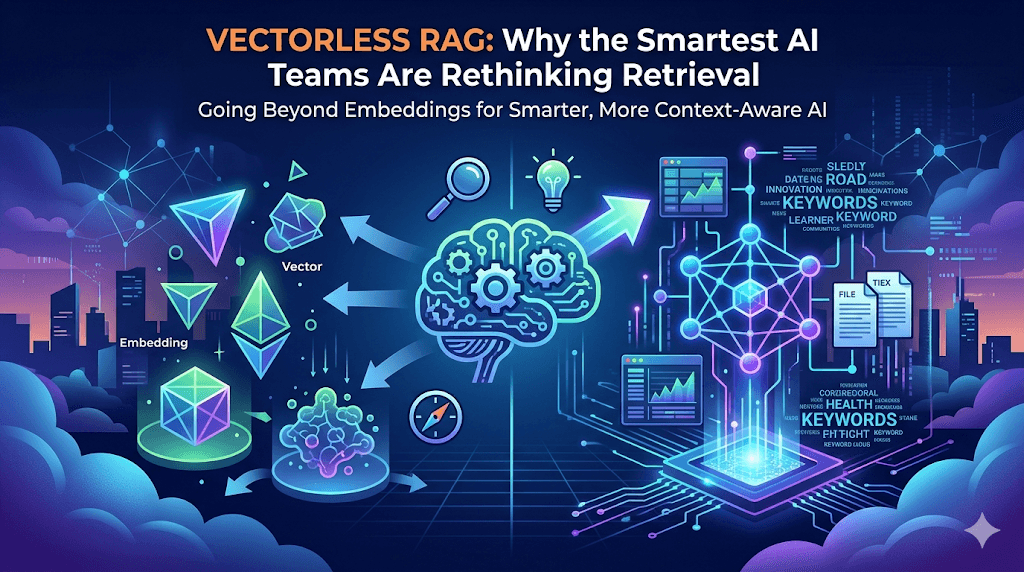
Artificial Intelligence has entered an era where Retrieval-Augmented Generation (RAG) has become the backbone of enterprise AI applications. For the past two years, nearly every GenAI demo, chatbot, and knowledge assistant has followed the same formula: embeddings, vector databases, and semantic search.
But a quiet shift is happening inside some of the world’s most advanced AI teams.
They’re asking a provocative question:
What if we don’t need embeddings at all?
Welcome to the emerging world of Vectorless RAG—an alternative retrieval architecture that prioritizes document structure, deterministic navigation, and factual precision over semantic similarity.
For many enterprise use cases, this approach isn’t just simpler. It can actually deliver more reliable results than traditional vector-based retrieval.The Rise of Traditional Vector RAG
Most modern RAG systems rely on vector search.
The workflow typically looks like this:
Document → Chunking → Embedding Model → Vector Database → Similarity Search → Retrieved Context → LLM Response
Popular technology stacks include:
- LangChain
- LlamaIndex
- OpenAI Embeddings
- BGE
- E5
- Pinecone
- Weaviate
- FAISS
- ChromaDB
The underlying idea is straightforward:
Documents are converted into numerical vectors using embedding models. User queries are also transformed into vectors. The system then searches for the most semantically similar document chunks and sends them to the LLM as context.
This works remarkably well for many applications.
But there’s a hidden problem.
Semantic Similarity Is Not the Same as Factual Relevance
A vector database retrieves content that looks similar in meaning to the query.
It does not guarantee retrieval of the most authoritative or correct section.
As a result, production systems often encounter:
- Contextually related but incorrect passages
- Partial answers spread across multiple chunks
- Retrieval drift
- Increased hallucinations
- Reduced explainability
Even advanced reranking models cannot fully eliminate these issues because the retrieval process itself is fundamentallyprobabilistic.
The system is making an educated guess.
And sometimes that guess is wrong.
Enter Vectorless RAG
Vectorless RAG takes a completely different approach.
Instead of searching through an abstract semantic space, it navigates documents through their structure.
The pipeline looks more like:
Document → Structural Parsing → Hierarchical Indexing → Query Routing → Section Traversal → Deterministic Retrieval → LLM
Notice what’s missing.
- No embeddings
- No vector database
- No Approximate Nearest Neighbor (ANN) search
Instead, the system relies on understanding how information is organized.
Think of it as giving the AI a detailed table of contents rather than asking it to search through millions of mathematical coordinates.
How Vectorless RAG Works
Vectorless architectures typically leverage:
Heading-Aware Retrieval
Documents are indexed according to headings and subheadings.
A query about “termination clauses” routes directly to the contract section covering termination terms rather than retrieving semantically similar legal language from elsewhere.
Metadata-Driven Navigation
Documents often contain rich metadata:
- Document type
- Department
- Version
- Effective date
- Product category
- Regulation code
Instead of semantic similarity, retrieval can be based on precise metadata matching.
Hierarchical Tree Structures
Information is organized into parent-child relationships.
For example:
Employee Handbook
 ├── Benefits
 ├── Leave Policy
 ├── Remote Work
 └── Code of Conduct
The retrieval engine traverses the hierarchy to locate the exact knowledge region.
Section-Level Grounding
Instead of retrieving arbitrary chunks, entire logical sections are selected.
This preserves context and reduces fragmentation.
Knowledge Graph Navigation
Some implementations connect entities, relationships, and document structures into graph-based retrieval systems.
The AI follows explicit connections rather than relying on semantic approximation.
Why Enterprises Are Paying Attention
Vectorless RAG shines in environments where documents already possess strong structure.
Examples include:
Legal Contracts
Law firms and compliance teams require exact clause retrieval.
A semantically similar clause isn’t enough.
The correct clause matters.
Financial Filings
Annual reports, SEC filings, audit documents, and financial statements follow highly structured formats.
Deterministic retrieval often outperforms vector search.
Standard Operating Procedures (SOPs)
Employees need precise instructions.
Returning “similar procedures” can create operational risks.
Technical Documentation
Product manuals, engineering specifications, and troubleshooting guides contain well-defined hierarchies.
Navigating structure often produces better answers than semantic search.
Regulatory Frameworks
Healthcare, banking, insurance, and government organizations require explainable retrieval and auditability.
Vectorless systems provide clear evidence of why specific content was selected.
Vector RAG vs Vectorless RAG
| Feature | Vector RAG | Vectorless RAG |
|---|---|---|
| Retrieval Type | Probabilistic | Deterministic |
| Infrastructure | Embeddings + Vector DB | Structural Index |
| Explainability | Moderate | High |
| Hallucination Risk | Higher | Lower |
| Semantic Flexibility | Strong | Moderate |
| Precision | Variable | Very High |
| Computational Cost | Higher | Often Lower |
| Auditability | Limited | Excellent |
At its core:
Vector RAG retrieves what appears similar.
Vectorless RAG retrieves what is structurally correct.
That distinction becomes critical in production environments.
When Should You Use Vector RAG?
Vector-based retrieval remains an excellent choice when:
- Documents are highly unstructured
- Information is scattered across many sources
- Users ask broad exploratory questions
- Cross-document discovery is important
- Semantic relationships matter more than exact locations
Examples include:
- Customer support knowledge bases
- Research assistants
- Academic search engines
- Enterprise search across thousands of document types
When Should You Use Vectorless RAG?
Vectorless retrieval becomes highly attractive when:
- Documents have clear hierarchies
- Accuracy is more important than flexibility
- Compliance requirements exist
- Explainability is mandatory
- Content follows predictable structures
Examples include:
- Legal AI systems
- Regulatory assistants
- Financial analysis tools
- Enterprise policy assistants
- Technical operations platforms
The Future Isn’t Vector vs. Vectorless
The most advanced architectures increasingly combine both approaches.
Many next-generation enterprise systems use:
Hybrid Retrieval
- Structural routing identifies relevant document sections.
- Vector search operates only within those sections.
- Rerankers optimize final context selection.
This creates:
- Higher precision
- Lower hallucination rates
- Reduced computational costs
- Better explainability
Rather than replacing vector search, Vectorless RAG often acts as an intelligent first layer that guides retrieval more effectively.
Final Thoughts
For years, the AI industry has focused heavily on improving embeddings, building larger vector databases, and optimizing semantic search.
But enterprise AI is teaching an important lesson:
Better retrieval doesn’t always require better embeddings.
Sometimes it requires a better understanding of document structure.
As organizations move from flashy demos to mission-critical AI systems, deterministic retrieval, structural indexing, and explainable navigation are becoming increasingly valuable.
The future of enterprise RAG may not belong exclusively to vector databases.
In many situations, the smartest retrieval strategy is the one that knows exactly where the answer lives.
And sometimes, the best vector database is no vector database at all.
For the past 18 months, the generative AI world has been obsessed with one architecture: Vector RAG. If you have watched a single tech demo, read a “How to Build a Chatbot” tutorial, or browsed GitHub’s trending repos, you’ve seen the classic stack:
LangChain → Chunking → OpenAI Embeddings → Pinecone/FAISS → Semantic Search → LLM
It’s elegant. It’s powerful. And for 90% of demos, it works beautifully.
But here is the uncomfortable truth the smartest AI teams are quietly admitting: Semantic similarity is not the same as factual relevance.
As highlighted in a recent viral thread by Tapabrata Halder, a quiet shift is underway. The pioneers of enterprise AI are abandoning the vector database entirely and embracing Vectorless RAG—a structural, deterministic retrieval method that is proving superior for legal contracts, financial filings, SOPs, and technical manuals.
Let’s break down the RAG wars, and why the best vector database might be no vector database at all.
1. The Problem with Traditional Vector RAG (The “Semantic Cloud”)
Vector RAG relies on a probabilistic gamble. You convert your documents into chunks, run them through an embedding model (like BGE or OpenAI text-embedding-3), and store them as vectors in a high-dimensional space. When a user asks a question, you convert that query into a vector and perform an Approximate Nearest Neighbor (ANN) search.
The flaw? ANN search returns semantic neighbors, not necessarily correct answers.
In practice, this leads to:
- Contextual drift: The retriever pulls chunks that “sound like” the answer but contain the wrong data.
- Hallucination fuel: The LLM receives partially relevant passages and invents the rest.
- The “Reranker tax”: Teams add rerankers to fix retrieval errors, increasing latency and complexity without solving the root cause.
As Halder notes, even with rerankers, retrieval drift is still a production headache. You aren’t searching for a fact; you are searching for a vibe.
2. Vectorless RAG: Navigating Documents Like a Human
Vectorless RAG rejects the “semantic cloud” model entirely. Instead of searching for similar meanings, it navigates structure. It treats documents not as bags of text, but as knowledge graphs or dynamic tables of contents.
The Pipeline:Document → Structural Parsing → Hierarchical Indexing → Query Routing → Section Traversal → Deterministic Retrieval → LLM
There are no embeddings. No ANN search. No vector database.
How it works:
- Heading-aware retrieval: The system understands that “Section 3.2(b)” exists physically below “Section 3.1.”
- Metadata-driven navigation: It uses titles, subheadings, page numbers, and JSON paths as routing keys.
- Deterministic selection: If a user asks about “Indemnification Clause in Section 8,” the system goes directly to Section 8. It does not guess.
This is the difference between asking a librarian for “books about the Roman Empire” (semantic) versus asking for “page 147 of Gibbon’s Decline and Fall” (structural).
3. Core Architectural Differences: Probability vs. Certainty
| Feature | Vector RAG | Vectorless RAG |
|---|---|---|
| Retrieval Type | Probabilistic | Deterministic |
| Search Method | ANN Similarity Search | Section Traversal / Tree Indexing |
| Infrastructure | Embedding models + Vector DB (Heavy) | Parser + Hierarchical Index (Lightweight) |
| Output Logic | “This chunk is contextually similar.” | “This is the correct section.” |
| Failure Mode | Semantic drift / Hallucination | Missing structure (if document is unformatted) |
One searches a cloud of meaning. The other reads a map.
4. The Enterprise Use Case: Precision Over Flexibility
Why is this suddenly critical? Because enterprises do not run on blog posts and Wikipedia articles. They run on contracts, compliance frameworks, technical manuals, and financial filings.
Where Vectorless RAG dominates:
- ✅ Legal Contracts: “Show me the force majeure clause in version 4.2.” (Structural retrieval ensures you don’t pull a clause from version 3.1 that sounds similar.)
- ✅ Financial Filings (10-Ks): “What was the revenue for Segment A in Q3?” (Deterministic routing to the specific table row.)
- ✅ Regulatory Frameworks (HIPAA/SOX): “What is the data retention rule under subsection D?” (Zero tolerance for hallucinated interpretations.)
When to stick with Vector RAG:
- ❄️ Unstructured data: Support tickets, free-form customer feedback, diverse web crawling.
- ❄️ Exploratory search: “Show me trends in climate tech.” (Where semantic flexibility is a feature, not a bug.)
5. The Verdict: Hybrid Futures and the “No DB” Advantage
The discussion on Halder’s thread revealed a mature consensus: This is not a religious war, but a toolbox distinction.
One commenter noted, “Vectorless RAG will become more efficient as context windows increase.” If your LLM can ingest an entire 500-page manual, you don’t need semantic chunking; you need a routing system that drops the correct 50 pages into the context window.
Another added, “You can combine both. Vectors for large collection discovery, vectorless for abstraction on top.”
The final takeaway:
The future of enterprise RAG is not “better embeddings.” We have exhausted the gains of semantic similarity. The future is smarter retrieval architectures that respect hierarchy, metadata, and deterministic logic.
Sometimes, the most advanced AI system is the one that knows exactly where the answer lives—and goes straight there.
“Sometimes the best vector database is no vector database at all.” – Tapabrata Halder
Original inspiration: View the LinkedIn discussion here: https://www.linkedin.com/posts/tapabrata-halder-06378042_rag-generativeai-llm-share-7465600308073902080-rgd3/