
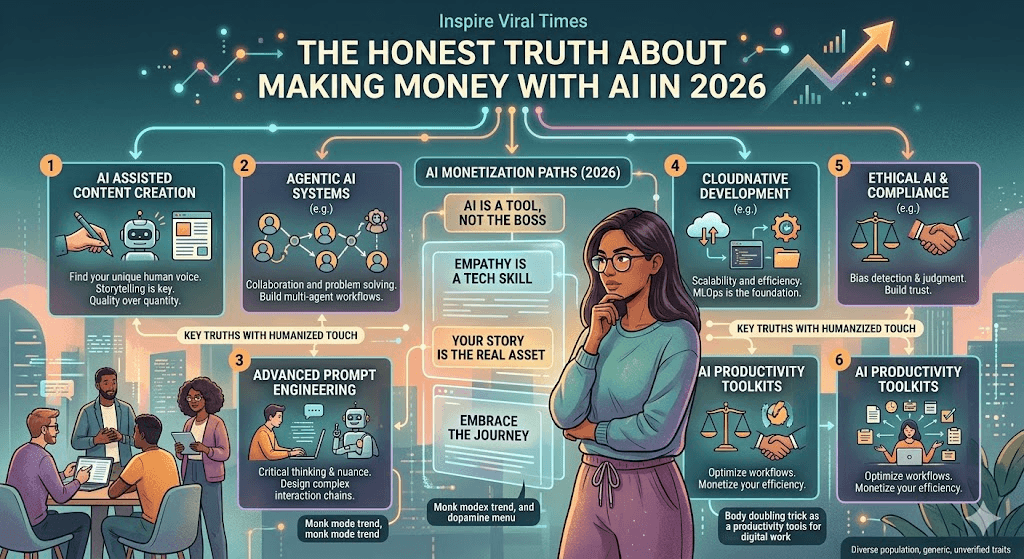
What actually works, what’s hype, and what most people get wrong
Artificial Intelligence is no longer a “future trend.” In 2026, it’s a full-blown economic layer sitting under content creation, marketing, design, coding, customer support, and even entrepreneurship.
But here’s the uncomfortable part most people avoid saying out loud:
AI is not a money machine. It’s a force multiplier for people who already understand value creation.
If you’re expecting “press a button → get rich,” you’re going to be disappointed. If you’re willing to treat AI like a tool that amplifies skill, speed, and execution, the opportunity is very real.
Let’s break down the honest truth.
1. AI Doesn’t Create Income — It Accelerates Existing Value
One of the biggest misconceptions in 2026 is that AI itself is a business model.
It’s not.
AI tools like ChatGPT (by OpenAI), Claude, Midjourney, and others don’t generate money on their own. They reduce friction in tasks that already have economic value.
That means AI helps you:
- Write faster
- Design faster
- Analyze faster
- Build faster
- Sell faster
But it does not automatically create demand for your output.
If no one wants what you produce, AI just helps you fail faster.
2. The “AI Money Boom” Is Real — But Uneven
Yes, people are making money with AI in 2026. But the distribution is extremely uneven.
Winners:
- Freelancers who learned to package AI skills into services
- Agencies using AI to scale output (not replace strategy)
- Developers building AI-powered micro SaaS tools
- Content creators using AI to increase publishing speed
- Marketers using AI for conversion optimization
Strugglers:
- People selling “AI prompts” without a system
- Copy-paste content farms
- Beginners relying entirely on automation without judgment
- Anyone chasing viral “AI side hustle hacks” weekly
The gap is simple:
operators vs. spectators.
3. The 3 Real Ways People Make Money With AI in 2026
Forget the hype. Most sustainable income falls into three categories.
A) Selling Services (Fastest Path)
This is still the most reliable entry point.
Examples:
- AI-assisted copywriting
- Social media management
- Video editing + AI enhancement
- Resume optimization
- Website content packages
AI reduces your delivery time, but clients still pay for:
- clarity
- results
- trust
- communication
AI is the engine. You are the driver.
B) Building Digital Products (Scalable Path)
This is where leverage kicks in.
Examples:
- Notion templates
- AI-powered workflows
- Digital courses
- Micro SaaS tools
- Automation systems for businesses
The key shift in 2026:
You don’t need a massive product. You need a narrow problem solved extremely well.
C) Content + Distribution (Long-Term Asset)
AI has massively lowered the barrier to content creation. But it has also increased competition.
So what matters now?
- Consistency
- Perspective
- Trust
- Personal voice
AI can help you write, but it cannot replace your lived experience.
The people winning here are treating content like an asset, not a hobby.
4. The Hard Truth: AI Has Also Made Average Work Worth Less
This is the part many avoid discussing.
Basic work is becoming:
- cheaper
- faster
- more automated
- more replaceable
If your skill is easily replicated by AI, your pricing power drops.
But here’s the counterbalance:
High-context thinking is becoming more valuable than ever.
Things AI still struggles with:
- real-world judgment
- business intuition
- emotional understanding
- strategic decision-making
- original positioning
That’s where human advantage is shifting.
5. Why Most People Fail With AI Income Ideas
Not because AI doesn’t work.
Because of execution failure.
Common patterns:
1. Tool obsession
They keep switching tools instead of building systems.
2. No niche clarity
“AI freelancer” is not a business.
3. No distribution strategy
They build but don’t market.
4. Unrealistic expectations
They expect income in days, not months.
AI reduces effort — not the need for strategy.
6. What Actually Works in 2026 (Realistic Framework)
If you want a grounded approach, use this model:
Step 1: Pick a painful problem
Not “make money with AI”
But something like:
- “small businesses don’t have content”
- “job seekers struggle with resumes”
- “creators can’t scale editing”
Step 2: Use AI to compress execution time
Not replace thinking — accelerate output.
Step 3: Sell a simple outcome
Not “AI service”
But:
- “10 social posts in 48 hours”
- “resume optimized for ATS”
- “landing page copy that converts”
Step 4: Build distribution slowly
Content, outreach, or partnerships.
This is not glamorous. But it works.
7. The Real Opportunity in 2026
The biggest shift is not “AI replacing jobs.”
It’s this:
AI is turning solo individuals into micro-companies.
One person can now:
- research like a team
- write like an agency
- design like a studio
- code like a startup
But only if they know what they’re building.
Final Truth
Making money with AI in 2026 is absolutely real.
But it is not:
- passive
- automatic
- guaranteed
- beginner-friendly in the way social media claims
It is:
- skill-based
- execution-heavy
- strategy-driven
- highly competitive
The winners are not the ones using the most AI tools.
They are the ones who understand something simple:
AI does not replace thinking. It rewards people who think better and move faster.