
A $180 Billion Question
In the first quarter of 2026 alone, investors poured more than $180 billion into artificial intelligence companies — a figure larger than the entire AI funding total for all of 2025. Let that sink in. An industry that barely existed in its current form five years ago is now absorbing capital at a pace that rivals the largest infrastructure booms in modern history.
If you have ever wondered who is actually behind the chatbots writing your emails, the systems screening medical scans, or the assistants helping engineers ship code faster, you are asking the right question at the right time. The names matter, but so does understanding how these companies fit together — because the AI industry is not one race. It is several overlapping ones.
This guide breaks down the current AI landscape into the layers that actually drive it, explains what each leading company does, and gives you a practical way to make sense of an industry that reinvents itself every few months.
How to Think About AI Companies: The Three-Layer Stack
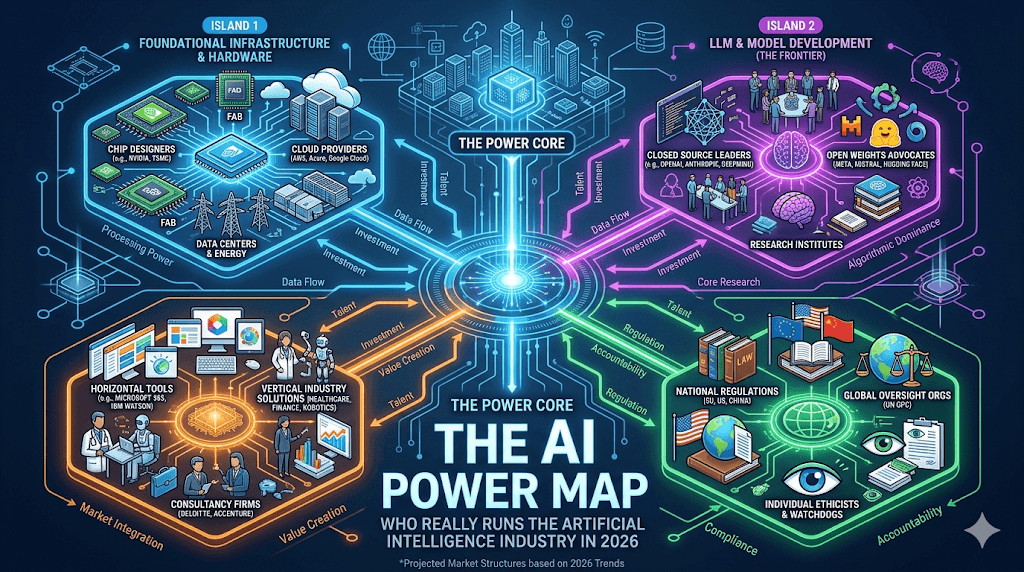
Before naming names, it helps to have a mental model. Most confusion about “AI companies” comes from lumping very different businesses together. In reality, the industry sorts into three layers.
1. The Infrastructure Layer
These are the companies that make AI physically possible — the chips, data centers, and networking hardware. Without them, nothing else runs.
2. The Frontier Model Layer
These are the labs building the large foundation models — the “brains” that power chatbots, coding assistants, and reasoning engines.
3. The Application and Adoption Layer
These are the companies that take AI and embed it into real products, workflows, and industries — turning raw capability into measurable business value.
A useful analogy: if AI were the electricity revolution, the infrastructure layer builds the power plants and grid, the model layer designs the generators, and the application layer wires AI into your home and office. Each layer has its own giants.
The Infrastructure Layer: The Companies Powering Everything
Nvidia
If there is a single indispensable company in AI, it is Nvidia. Its graphics processing units (GPUs) have become the default hardware for training large models, and the company powers the vast majority of AI data centers worldwide. Just as importantly, Nvidia’s software ecosystem creates a lock-in advantage that competitors have struggled to break.
TSMC and Broadcom
Behind Nvidia sits TSMC, the Taiwanese foundry that physically manufactures the most advanced chips in the world. It is arguably the industry’s biggest bottleneck — when TSMC’s capacity is constrained, the entire AI buildout slows. Broadcom, meanwhile, has become essential to how large compute systems connect and scale, supplying custom silicon and networking technology to the hyperscalers building their own AI architectures.
Key insight: For everyday users, these companies are invisible. For investors and strategists, they are often the clearest way to understand AI’s growth, because every model trained and every query answered flows through silicon first.
The Frontier Model Layer: Where the Headlines Happen
This is the layer most people picture when they hear “AI company.” It is also the most fiercely competitive — and the most expensive to compete in.
Anthropic
Founded in 2021 by former OpenAI researchers, Anthropic has become the most valuable AI startup in the world. In May 2026, it raised $65 billion in a single funding round, reaching a valuation near $965 billion and overtaking its larger rival. Its Claude family of models — including the Claude Opus and Claude Sonnet lines — is widely used for coding, research, and enterprise workflows, with the company reporting an annualized revenue run rate around $47 billion. Anthropic has built its brand on a reputation for safety, reliability, and responsible deployment, which has made it especially attractive to risk-sensitive industries.
OpenAI
The company that put generative AI on the map with ChatGPT remains a titan. OpenAI closed a record-breaking $122 billion funding round in early 2026, reaching a valuation around $852 billion, and serves close to 900 million weekly users. Its deep partnership with Microsoft gives it both enormous distribution and the cloud capacity to keep scaling. OpenAI’s strategy leans toward consumer ubiquity and platform reach.
Google DeepMind
Google’s AI arm pairs frontier research with unmatched distribution. Its Gemini model family is woven directly into Search, Android, YouTube, Workspace, and Google Cloud, giving it access to billions of users. DeepMind’s strengths in scientific research, healthcare, and multimodal AI — combined with Google’s custom TPU chips — make it one of the few labs that controls its own hardware destiny.
xAI
Elon Musk’s xAI took an unusual path, effectively merging its interests with SpaceX in early 2026. That move means public investors may eventually gain exposure to xAI’s models through SpaceX rather than a standalone listing. The company has raised tens of billions and represents a third strategic vision: tightly integrating AI with Musk’s broader ecosystem of companies.
ByteDance
Often overlooked in Western coverage, ByteDance — the company behind TikTok — has transformed into an AI-first powerhouse. Its Doubao assistant has reached well over 150 million weekly active users, making China one of the first countries to adopt AI assistants at genuine mass-market scale. With a valuation reported above half a trillion dollars, ByteDance is a reminder that AI leadership is global, not just American.
Meta and the Open-Source Camp
Meta has staked its position on open-source models with its Llama family, betting that openness will drive adoption and innovation. This stands in contrast to the closed, proprietary approach favored by OpenAI and Anthropic — a philosophical divide that may shape the industry for years.
The Application Layer: Where AI Meets Real Work
Microsoft
Microsoft has arguably done more than anyone to bring AI into daily work. Its Copilot assistant runs inside Word, Excel, Outlook, Teams, Windows, and Azure, letting employees draft documents, build presentations, and automate multi-step tasks using plain language. Microsoft’s emphasis on security and compliance has made large enterprises comfortable adopting AI at scale.
Amazon
Amazon built its empire on e-commerce and cloud computing, and it is now a central infrastructure player in AI. Through Amazon Web Services and its Bedrock platform, it offers businesses access to a range of models — including a major investment in Anthropic — positioning itself as a neutral arms dealer in the model wars.
The Fast-Growing Challengers
Beyond the giants, a vibrant tier of specialized companies is reshaping specific niches:
- Perplexity AI — reimagining search as a conversational, citation-backed experience.
- Mistral AI — Europe’s leading open-weight model lab and a symbol of regional AI independence.
- Cohere — focused on enterprise and retrieval-augmented applications.
- Databricks — combining data infrastructure with AI tooling for businesses.
- Anysphere (Cursor) and Cognition — building AI tools that write and manage software, among the fastest-growing names in the industry.
Key Trends Shaping the Industry Right Now
A few patterns define the current moment and are worth watching:
- A three-tier funding system has emerged. OpenAI and Anthropic occupy the top tier with hundred-billion-dollar rounds, a handful of well-funded challengers form the second tier, and everyone else competes for what remains.
- The IPO race is heating up. Both OpenAI and Anthropic are preparing for public listings, which could finally give ordinary investors direct exposure to frontier AI — and a real-world test of whether current valuations hold.
- Capital is concentrating. In 2025, AI startups captured more than 40% of all global venture funding, and that concentration has only intensified.
- Foundation models are no longer the only differentiator. Increasingly, the companies creating the most value are those that deploy AI successfully inside real businesses and prove measurable outcomes.
How to Evaluate an AI Company (A Practical Checklist)
Whether you are an investor, a business leader choosing a partner, or simply a curious professional, use these questions to cut through the hype:
- Which layer does it operate in? Infrastructure, model, or application — each has different economics and risks.
- Does it have real revenue, or just a valuation? Run-rate revenue and paying customers matter more than headline funding numbers.
- What is its distribution advantage? A great model with no users loses to a good model embedded where people already work.
- Open or closed? This affects flexibility, cost, and control.
- Does it solve a real problem? Look for measurable outcomes, not demos.
Key Takeaways
- The AI industry sorts into three layers: infrastructure (Nvidia, TSMC, Broadcom), frontier models (Anthropic, OpenAI, Google DeepMind, xAI, ByteDance, Meta), and application/adoption (Microsoft, Amazon, and specialized challengers).
- Anthropic is currently the most valuable AI startup, narrowly ahead of OpenAI, with both racing toward public listings.
- AI funding has reached historic levels — over $180 billion in just the first quarter of 2026 — and is concentrating in a small group of leaders.
- The real value is shifting from building models to deploying them effectively inside real-world workflows.
- When evaluating any AI company, focus on its layer, revenue, distribution, and the actual problems it solves.
Frequently Asked Questions
Q1: Which is the most valuable AI company in 2026?
Among dedicated AI startups, Anthropic currently leads with a valuation near $965 billion, just ahead of OpenAI. Among public companies, Nvidia remains the most valuable AI-related business by market capitalization due to its dominance in chips.
Q2: What is the difference between OpenAI and Anthropic?
Both build frontier large language models, but they emphasize different priorities. OpenAI leans toward broad consumer reach and platform scale, while Anthropic positions itself around safety, reliability, and enterprise trust. Their flagship products are ChatGPT and Claude, respectively.
Q3: Can I invest in these AI companies?
Some, like Nvidia, Microsoft, Alphabet (Google), Amazon, and Meta, are publicly traded. Others, including OpenAI, Anthropic, and xAI, are still private — though several are preparing IPOs that could change this in the near future.
Q4: Are American companies the only major AI players?
No. ByteDance in China has built one of the world’s most-used AI assistants, and Mistral AI in France leads Europe’s open-model efforts. AI leadership is increasingly global.
Q5: Is the AI boom a bubble?
Opinions are genuinely divided. The capital concentration and circular investment structures worry some analysts, while others point to fast-growing real revenue as evidence of durable demand. The upcoming IPOs will offer one of the clearest public tests yet.
Conclusion: The Map Is the Advantage
The artificial intelligence industry moves fast enough that any snapshot ages quickly — new models, funding rounds, and rankings arrive almost weekly. But the structure underneath is far more stable than the headlines suggest. Once you understand the three layers and the strategic role each major company plays, you can interpret tomorrow’s news instead of being surprised by it.
That clarity is the real advantage. In an industry where everyone is selling certainty, the people who understand the map will always navigate better than those chasing the hype.
Your move: Which layer of the AI stack matters most to your work or investments? Pick one company from this list, spend twenty minutes understanding how it makes money, and you will already know more than most. If you found this breakdown useful, subscribe for future deep dives — and share it with someone who is still trying to tell their Claude from their Copilot.