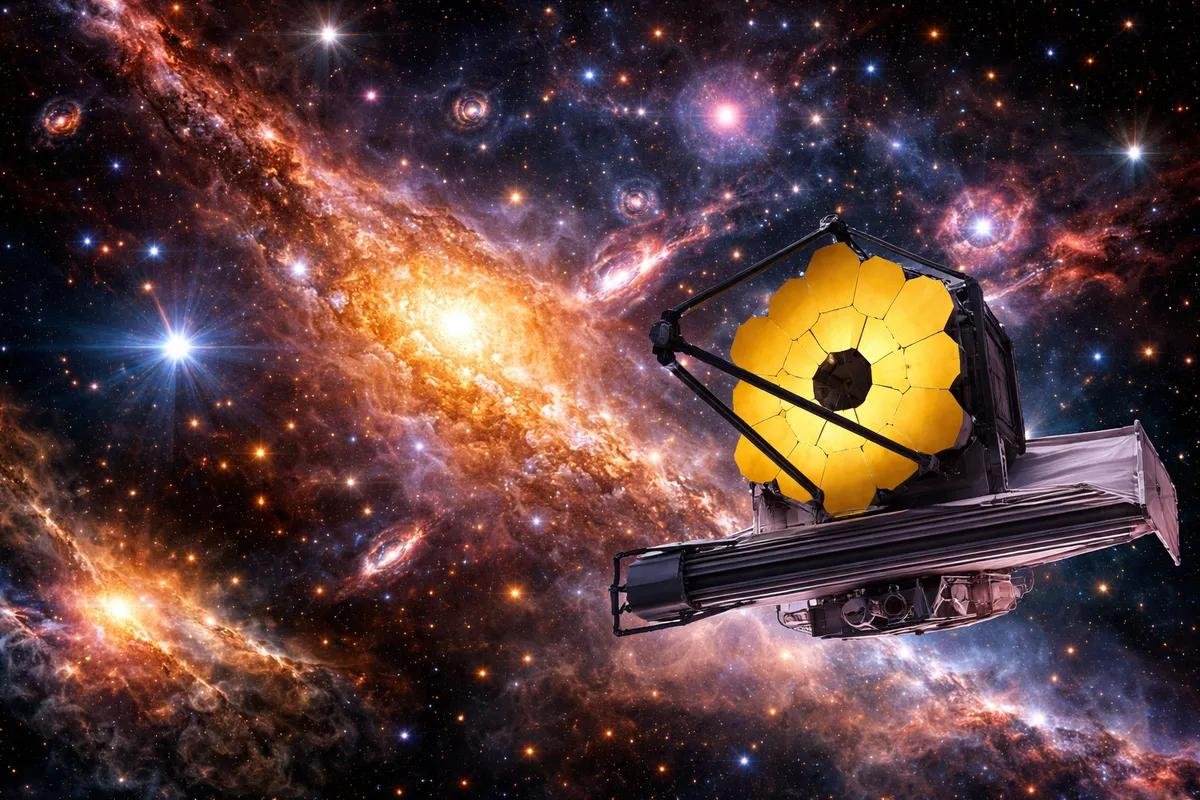
Space has always captured the human imagination.
From the first observations of the Moon to modern space telescopes exploring distant galaxies, humanity has continued to search for answers about the universe.
Today, astronomy is experiencing a remarkable period of discovery.
Advanced observatories, powerful cameras, artificial intelligence, and increasingly sophisticated data-processing systems are helping scientists observe objects and events that were once difficult to detect.
The latest developments are showing us that the universe is far more dynamic and mysterious than we once imagined.
A New Generation of Telescopes Is Changing Astronomy
Modern astronomy is no longer limited to looking through a telescope and recording what appears in the sky.
Today’s observatories collect enormous amounts of data.
Scientists use specialized software to analyze images, compare observations, and identify changes that may indicate a new astronomical discovery.
One important example is the NSF–DOE Vera C. Rubin Observatory.
Its powerful camera and wide-field survey capabilities are designed to repeatedly observe large areas of the sky.
This approach can help astronomers discover:
- Previously unknown asteroids
- Distant objects beyond Neptune
- Supernovae and other transient events
- Changes in stars and galaxies
- Objects that move against the background of distant stars
The observatory’s work is expected to contribute significantly to our understanding of the solar system and the wider universe.
Why Are Astronomers Studying the Outer Solar System?
The region beyond Neptune contains some of the oldest and most distant objects in our solar system.
These objects can provide clues about how the solar system formed.
The discovery of the dwarf planet candidate 2026 ED138 is one example of how modern astronomical surveys are revealing new objects in this region.
Scientists are interested in these distant worlds because they may preserve information about the early stages of planetary formation.
Studying their orbits, sizes, and compositions can help researchers understand how the planets and smaller bodies evolved over billions of years.
Telescopes Can Reveal More Than Distant Galaxies
Some of the most fascinating discoveries involve objects closer to home.
Astronomers continue to study the Sun, planets, moons, asteroids, and comets.
Even familiar objects can reveal new information when observed using different instruments or techniques.
For example, observations in infrared, radio, ultraviolet, and other wavelengths can reveal characteristics that are difficult to see in ordinary visible-light images.
Each observation adds another piece to the scientific picture.
Artificial Intelligence Is Becoming an Important Astronomy Tool
Modern astronomical surveys generate more data than researchers can easily examine manually.
AI and machine-learning systems can help scientists identify patterns, classify objects, and detect unusual signals.
These tools can assist in finding objects that might otherwise be overlooked.
However, AI-generated discoveries still require scientific validation.
Researchers must determine whether a detected signal represents a genuine astronomical object, an observational artifact, or something else.
AI is therefore becoming an important assistant in astronomy rather than a replacement for scientific investigation.
Why Space Research Matters to Everyday Life
Space research may seem distant from everyday concerns, but its influence reaches many areas of modern technology.
Scientific research has contributed to developments in:
- Imaging technologies
- Materials science
- Computer systems
- Satellite communication
- Earth observation
- Navigation and positioning systems
Space exploration also helps scientists understand Earth’s climate, monitor natural disasters, and study the conditions that make life possible.
The benefits are not always immediate, but the knowledge gained can influence technology and society for decades.
What Could We Discover Next?
The next generation of astronomical observations may help answer some of humanity’s biggest questions.
How did the solar system form?
What is the nature of dark matter?
Are there other worlds with conditions suitable for life?
How did the first galaxies develop?
These questions remain open, but increasingly powerful observatories are giving scientists new ways to investigate them.
Frequently Asked Questions
What is the biggest development in astronomy today?
There is no single answer. New observatories, improved data analysis, and discoveries of distant solar system objects are all contributing to major advances.
How does AI help astronomers?
AI can analyze large datasets, identify patterns, classify astronomical objects, and help researchers locate unusual signals.
Why are scientists studying objects beyond Pluto?
These objects provide information about the formation and evolution of the solar system.
Can new space discoveries affect everyday life?
Yes. Space research contributes to technologies used in communication, imaging, navigation, and Earth observation.
Conclusion
Astronomy is entering a period in which technology is expanding the boundaries of what humanity can observe.
The universe has not become less mysterious. Instead, we are developing better tools to explore its mysteries.
Every new observation brings us closer to understanding our place in the cosmos.
And perhaps the most exciting possibility is that some of the discoveries that will reshape our understanding of space have not yet been made.
This article is a general astronomy feature, not a report of a single breaking event. Add verified, dated discoveries and mission updates before publishing it as current space news.
Reference for a current astronomy development: Space.com – Astronomy Photo of the Day, October 29, 2026