
Most robots and drones today run one AI model per compute board. A drone that needs vision, depth estimation and a language model typically carries separate boards, separate power rails and separate thermal problems for each one. On November 17, 2026, SiMa.ai announced Palette 3.0, software that lets a single one of its Modalix MLSoC chips run several AI models at the same time — a change aimed squarely at the bill of materials, the power budget and the integration workload of every robot and drone that carries more than one model.
SiMa.ai, headquartered in San Jose, California, describes itself as a Physical AI company: it builds low-power chips and the software to run AI on them at the physical edge, on drones, robots and cameras, rather than in a data centre. Palette 3.0 builds on the company’s June 2026 Agentic Palette announcement, and it is the clearest evidence yet that the edge-AI contest is now being fought on software capability as much as on silicon.
What Is SiMa.ai Palette 3.0?
Palette 3.0 is the software suite that runs on SiMa.ai’s Modalix MLSoC chips. Its headline feature is concurrent model execution: a perception model, a depth model and a language or vision-language model can run as separate containers on the same chip at the same time, each isolated in its own on-chip Docker container.
The release also folds in sensor-fusion tooling, a neural approach to depth estimation, and a closed-loop simulation workflow for digital twins, built with ecosystem partners. Alongside it, SiMa.ai published a new Model Browser with benchmarks for the key models behind fully autonomous drones and robotics, measured, the company says, within real-world power constraints.
One timing detail matters. The Palette SDK 3.0 itself has been available since October 31, 2026, according to a SiMa.ai community notice. The November 17 announcement added the detailed performance measurements and the upgraded Model Browser around that release — so this is a capability briefing and benchmark drop, not the software’s first day in the world.
One Chip, Several Models at Once
For a robotics integrator, the practical change is consolidation. Running a large language model alongside a vision pipeline on a drone or a mobile robot today usually means two boards, two power rails, two sets of thermal management and two points of integration risk on an already weight- and power-constrained platform.
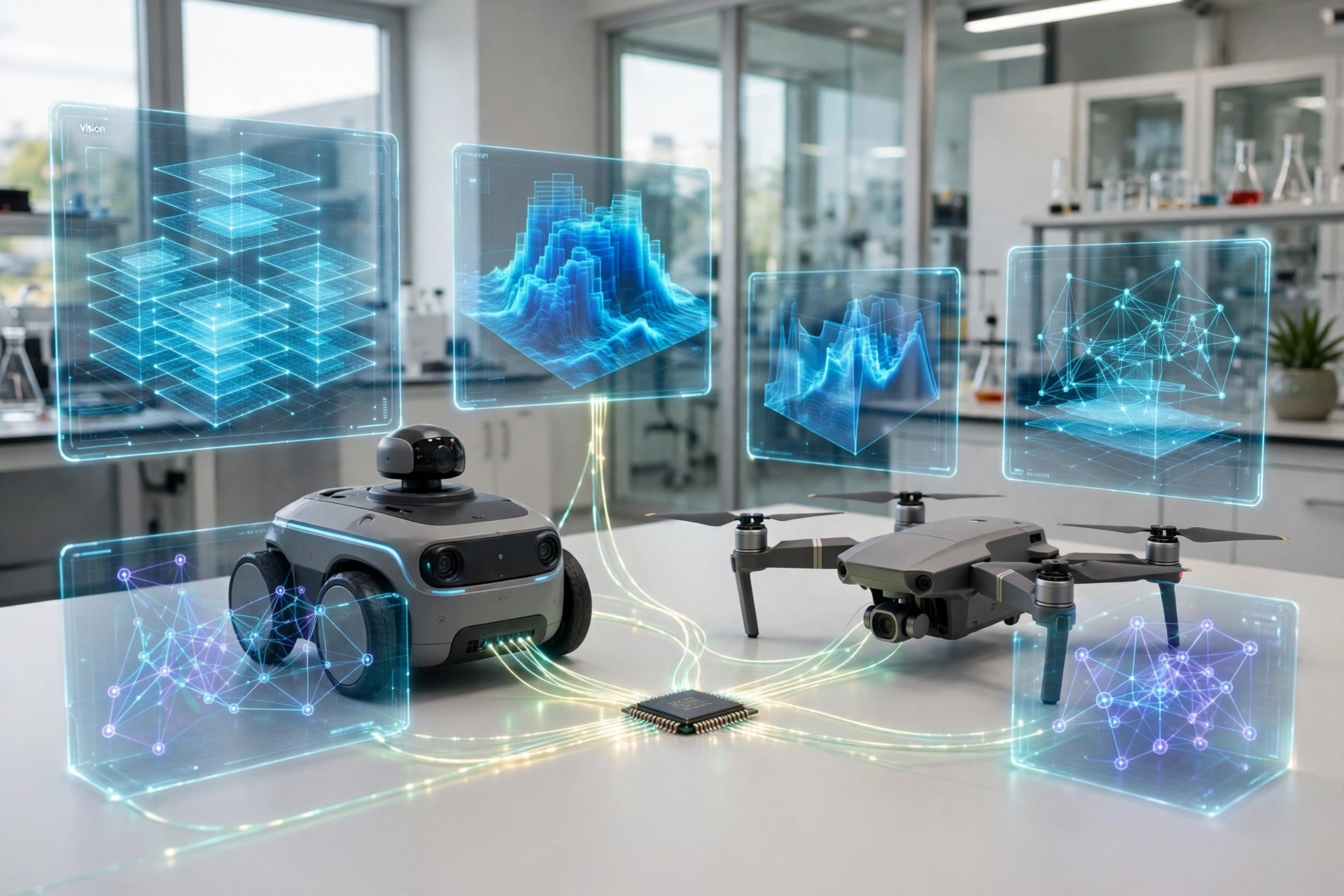
Putting that workload on one chip is not a convenience feature; it is a bill-of-materials decision. Fewer boards means fewer power supplies, less wiring harness, less enclosure volume and fewer firmware images to validate and update across a fleet. On a drone, every gram and every watt not spent on a second compute board is a gram and a watt available for payload, sensors or flight time. On a mobile robot, it is one less thermal zone to manage and one less supply-chain dependency to track across a production run.
There is a trade-off buyers should not skip: running everything on one chip means a single point of failure for every model a robot depends on, and it raises the stakes of thermal and power engineering on that one part. That is the concentration risk that comes with consolidation, and it is worth pricing into any fleet decision.
Up to 3.5x Faster Text Generation — With a Caveat
The headline number is the speed claim. SiMa.ai says Palette 3.0 can generate text up to 3.5 times faster — more precisely, up to 3.49 times higher decoding throughput, measured with DFlash N16 and Qwen3.5 9B against conventional generation on the same hardware. In the company’s tests, Qwen3.5 9B rose from 11.98 to 41.75 tokens per second at about 7.5 watts.
That figure needs its qualifier, because it measures decoding throughput, not full application response time. The technique behind it is speculative decoding: a smaller model proposes text that the main model checks in batches, using the EAGLE3, DFlash and Gemma 4 multi-token-prediction algorithms. It accelerates the generation of tokens, but it does not accelerate prompt processing — and an in-car assistant test SiMa.ai shared delivered smaller gains of 1.35 to 2.06 times. Buyers should treat the 3.5x figure as a starting point for their own benchmarking against their actual model mix, not as a settled fact to design around.
The release also adds support for running large Mixture-of-Experts models, such as OpenAI’s GPT-OSS-20B, on the Modalix MLSoC 16GB system-on-module. That signals SiMa.ai is chasing the same generative-AI workloads data centres run, compressed into a power envelope that fits inside a drone or a mobile robot — a notable step for a chip family built for the edge. The release lands in a crowded model season that has also brought the K2-Horizon open-model fleet and Claude Haiku 5.5.
Open Source Software on Proprietary Silicon
Palette 3.0’s code is open source and available on GitHub, under the sima-neat organisation, with documentation in SiMa.ai’s Developer Center. The Palette Neat core library, part of the application-development layer, carries an Apache 2.0 licence. That is a meaningfully different posture from the fully proprietary software stacks that typically ship with edge-AI silicon. The open-model direction echoes recent releases such as OVHcloud Olala mini.
Open-sourcing the software layer lowers one kind of lock-in: integrators can inspect, modify and extend the container orchestration, model-serving and sensor-fusion code themselves, rather than depending entirely on SiMa.ai’s roadmap and support cycle. It also means the code is auditable before it goes into a safety-relevant deployment, which matters more in robotics than in most software categories.
What it does not do is remove the hardware dependency. The software still runs on Modalix MLSoC silicon, and the most advanced capabilities in this release are tied to specific hardware variants. An integrator adopting Palette 3.0 is still committing to SiMa.ai’s silicon roadmap, pricing and supply chain, even while gaining more control over the software stack. That is a genuinely better lock-in profile than a closed stack on closed silicon — but it is not the same as true platform independence.
There is also a practical migration note. Moving from platform version 2.1.3 to 3.0.0 requires a full migration, because the new version changes the operating-system and update layout, so existing customers should plan for rebuild work rather than an in-place update. Developers can start with DevKit 3.0, priced at $1,499 in the US and Europe, which includes a Modalix module, carrier board, enclosure, power supply and 500GB of storage.
Palette 3.0 vs. Nvidia’s Jetson and Orin
Nvidia’s Jetson and Orin families remain the default reference point for edge robotics compute, with a large existing developer base, broad framework support and years of integrator familiarity behind them. SiMa.ai is not trying to out-market that incumbency; it is trying to out-compete on power efficiency and on a software layer purpose-built for running several models concurrently rather than one model well.
The practical question for a procurement manager is not which chip benchmarks higher on a single model. It is which platform’s total cost of ownership is lower once you account for the number of boards, the integration engineering hours and the power budget needed to run the actual multi-model stack a modern robot or drone requires. A chip that runs three models adequately on one power budget can beat a chip that runs one model superbly if the buyer’s real workload is the former. SiMa.ai is explicitly positioning Modalix MLSoC and Palette 3.0 to win that comparison, and the Model Browser benchmarks it published alongside the release exist so buyers can run that math themselves.
That ambition sits alongside the company’s other recent news. SiMa.ai raised US$150 million for physical-AI chips in a funding round reported in late September 2026. Palette 3.0 is a separate software release, not a restatement of that funding news — and it is the clearer signal of where the money is being pointed: toward a software platform that can run increasingly sophisticated generative and perception models concurrently, on hardware that already exists in the field. No new silicon is needed to use it, which the company’s product team confirmed to VentureBeat.
What It Means for Robotics and Drone Builders
For teams building autonomous machines, Palette 3.0 changes the architecture conversation. The shift from one-board-per-model to several-models-per-chip is a genuine inflection point for how robotics and drone platforms get designed, not a marketing reframe of incremental silicon progress. Concurrent execution changes the bill of materials, the power budget and the integration workload for any buyer running more than one AI model on an edge platform — which by 2026 describes most serious robotics deployments.
The open-source posture helps too. A team that can inspect and extend the orchestration layer is less exposed to a vendor’s shifting priorities, and the Apache 2.0 licence on the Neat core library gives developers a clear legal basis to build on it. The $1,499 DevKit 3.0 also lowers the cost of evaluating the platform before committing a fleet to it.
The same week brought other signs that AI is moving from chat to action. OpenAI’s GPT-6.2 Astra and Sol launch and Google making Gemini Tasks free both point the same way: assistants are becoming agents that complete multi-step work. And Cognition’s Devin Bots show agents beginning to manage other agents. Palette 3.0 is the hardware-side mirror of that trend — the models those agents run are increasingly expected to live on the device, inside the robot or drone itself, rather than in a distant data centre.
The Questions Still Open
Palette 3.0 is a strong release, but several questions have no public answer yet. All performance figures come from SiMa.ai’s own tests, not independent benchmarking, and the headline 3.5x figure has not been published against a specific baseline configuration in the company’s own materials. The company is offering competitive-benchmarking details on request, and buyers evaluating Modalix against Nvidia’s Jetson and Orin lines should run their own concurrent-workload benchmarks before specifying either platform at fleet scale.
Founder and chief executive Krishna Rangasayee framed the release as delivering “hardware at the speed of software,” adding that Palette 3.0 is “completely rewriting the roadmap for fully autonomous systems.” That is a bold claim from a company still building name recognition against a much larger incumbent, and it should be read as a statement of intent rather than an independently verified industry shift. What it does accurately reflect is a company moving quickly from raising capital to shipping a differentiated software capability — which is the sequence buyers should want to see from any physical-AI chip vendor before committing a fleet to its platform.
SiMa.ai is running two webinars to walk integrators through the release: “Inside Palette 3.0: Any Physical AI Model. Real Machine Autonomy.” on December 2, 2026, and “Drone and Robot Intelligence at Flight Speed: Build, Develop and Deploy Faster.” on December 8, 2026. For a technical buyer, both are a reasonable next step — a chance to see the concurrent multi-model execution claims demonstrated rather than described.
Sources: SiMa.ai’s official site at https://sima.ai/, Superpower Daily’s coverage at https://superpowerdaily.com/posts/sima-ai-details-palette-3-0-claiming-up-to-3-5-faster-ai-text-generation, and RobotAIGeek’s coverage at https://www.robotaigeek.com/news/simaais-palette-30-runs-several-physical-ai-models-on-one-chip.

