
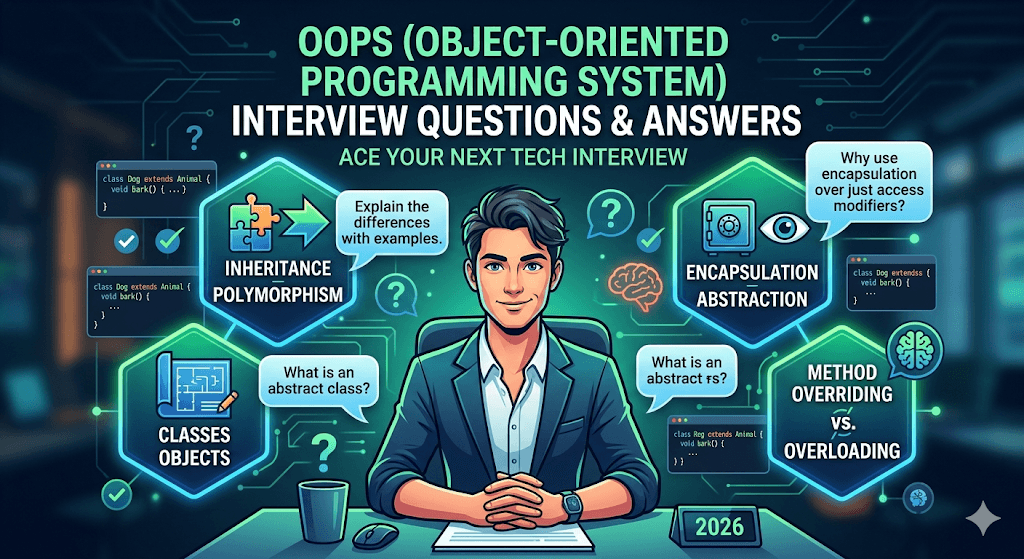
For IT interviews, OOPS (Object-Oriented Programming System) is one of the most frequently asked topics, especially for Java, C++, C#, Python, and technical architect roles.
Below is a comprehensive interview preparation document with questions and answers.
OOPS (Object-Oriented Programming System) Interview Questions & Answers
1. What is OOPS?
Answer:
Object-Oriented Programming System (OOPS) is a programming paradigm that organizes software design around objects rather than functions and logic.
An object contains:
- Data (Attributes/Properties)
- Methods (Functions/Behavior)
Benefits
- Reusability
- Scalability
- Maintainability
- Security
- Flexibility
2. What are the four pillars of OOPS?
1. Encapsulation
2. Abstraction
3. Inheritance
4. Polymorphism
These are the foundation of OOPS.
ENCAPSULATION
3. What is Encapsulation?
Answer:
Encapsulation is wrapping data and methods into a single unit (Class) and restricting direct access to data.
Example (Java)
class Employee {
    private String name;

    public void setName(String name){
        this.name = name;
    }

    public String getName(){
        return name;
    }
}
Advantages
- Data Security
- Better Control
- Easy Maintenance
Interview One-Liner
“Encapsulation means binding data and methods together and hiding implementation details using access modifiers.”
4. Difference Between Encapsulation and Data Hiding?
| Encapsulation | Data Hiding |
|---|---|
| Wrapping data and methods together | Restricting access to data |
| Achieved through classes | Achieved through private variables |
| Broader concept | Part of encapsulation |
ABSTRACTION
5. What is Abstraction?
Answer:
Abstraction means showing only essential information and hiding implementation details.
Example
When driving a car:
- You know accelerator, brake, steering.
- You don’t know engine internals.
This is abstraction.
6. How is Abstraction Achieved in Java?
Using:
- Abstract Class
- Interface
Example
abstract class Vehicle {
    abstract void start();
}
7. Difference Between Abstract Class and Interface
| Abstract Class | Interface |
|---|---|
| Can have abstract and concrete methods | Mostly abstract methods |
| Supports constructors | No constructors |
| Single inheritance | Multiple inheritance |
| Use “extends” | Use “implements” |
INHERITANCE
8. What is Inheritance?
Answer:
Inheritance allows one class to acquire properties and methods of another class.
Example
class Animal {
   void eat() {
      System.out.println("Eating");
   }
}

class Dog extends Animal {
}
Dog inherits Animal properties.
9. Advantages of Inheritance
- Code Reusability
- Reduced Redundancy
- Better Maintainability
- Extensibility
10. Types of Inheritance
Single Inheritance
A → BMultilevel Inheritance
A → B → CHierarchical Inheritance
    A
   / \
  B   C
Multiple Inheritance
A + B → C(Java supports through interfaces.)
11. Why Multiple Inheritance is Not Supported in Java?
Because of the Diamond Problem.
Example:
class A {
    void display(){}
}

class B extends A{}
class C extends A{}

class D extends B, C {}
Compiler becomes confused about which method to call.
POLYMORPHISM
12. What is Polymorphism?
Answer:
Polymorphism means “One Interface, Multiple Forms.”
13. Types of Polymorphism
Compile-Time Polymorphism
(Method Overloading)
Run-Time Polymorphism
(Method Overriding)
14. What is Method Overloading?
Same method name with different parameters.
class Calculator {
   int add(int a,int b){
      return a+b;
   }

   int add(int a,int b,int c){
      return a+b+c;
   }
}
15. What is Method Overriding?
Subclass provides specific implementation of parent method.
class Animal {
   void sound(){
      System.out.println("Animal Sound");
   }
}

class Dog extends Animal {
   void sound(){
      System.out.println("Bark");
   }
}
16. Difference Between Overloading and Overriding
| Overloading | Overriding |
|---|---|
| Same class | Parent-child class |
| Compile Time | Run Time |
| Different parameters | Same parameters |
| Faster | Slightly slower |
CLASS AND OBJECT
17. What is a Class?
Blueprint of an object.
Example:
class Employee {
   int id;
   String name;
}
18. What is an Object?
Instance of a class.
Employee emp = new Employee();19. Difference Between Class and Object
| Class | Object |
|---|---|
| Blueprint | Real Instance |
| No Memory | Occupies Memory |
| Logical Entity | Physical Entity |
CONSTRUCTOR
20. What is a Constructor?
Special method executed automatically when object is created.
class Employee {
   Employee(){
      System.out.println("Constructor Called");
   }
}
21. Types of Constructor
- Default Constructor
- Parameterized Constructor
- Copy Constructor (C++)
22. Constructor vs Method
| Constructor | Method |
|---|---|
| Same name as class | Any name |
| No return type | Has return type |
| Called automatically | Called explicitly |
THIS KEYWORD
23. What is this Keyword?
Refers to current object.
this.name = name;Used to resolve variable ambiguity.
SUPER KEYWORD
24. What is super Keyword?
Refers to parent class object.
super.display();Used to:
- Access Parent Method
- Access Parent Variable
- Call Parent Constructor
STATIC KEYWORD
25. What is Static?
Belongs to class instead of object.
static int count;Only one copy exists.
ACCESS MODIFIERS
26. Explain Access Modifiers
| Modifier | Same Class | Same Package | Subclass | Other Package |
|---|---|---|---|---|
| Private | Yes | No | No | No |
| Default | Yes | Yes | No | No |
| Protected | Yes | Yes | Yes | No |
| Public | Yes | Yes | Yes | Yes |
IMPORTANT SCENARIO QUESTIONS
27. Real-Life Example of Encapsulation
ATM Machine
- User enters PIN
- Internal validation hidden
28. Real-Life Example of Abstraction
Car Driving
- User sees controls
- Engine logic hidden
29. Real-Life Example of Inheritance
Vehicle → Car
Car inherits:
- Speed
- Fuel
- Brake
30. Real-Life Example of Polymorphism
Payment System
pay()Can be:
- Credit Card Payment
- UPI Payment
- Net Banking Payment
Same method, different behavior.
Frequently Asked Experienced-Level Questions
31. What is Association?
Relationship between two independent objects.
Example:
Teacher ↔ Student32. What is Aggregation?
“Weak HAS-A” relationship.
Example:
Department HAS EmployeesEmployees can exist independently.
33. What is Composition?
“Strong HAS-A” relationship.
Example:
House HAS RoomsIf House is destroyed, Rooms cease to exist.
34. Difference Between Aggregation and Composition
| Aggregation | Composition |
|---|---|
| Weak Relationship | Strong Relationship |
| Independent Lifecycle | Dependent Lifecycle |
| HAS-A | Strong HAS-A |
35. What is Object Cloning?
Creating duplicate object.
Cloneable Interface36. What is Dynamic Binding?
Method call resolved during runtime.
Used in Method Overriding.
37. What is Tight Coupling?
Classes depend heavily on each other.
Bad design.
38. What is Loose Coupling?
Minimal dependency between classes.
Preferred in Microservices and Enterprise Applications.
Architect-Level OOPS Questions
39. Why is OOPS Important in Enterprise Applications?
Because it provides:
- Reusability
- Modularity
- Testability
- Scalability
- Maintainability
40. How OOPS Helps in Microservices?
- Encapsulation of business logic
- Better modularity
- Reusable components
- Easier testing
41. Which OOPS Principle is Most Important?
For enterprise systems:
- Encapsulation
- Abstraction
- Composition over Inheritance
- Polymorphism
Modern architecture heavily favors Composition over deep Inheritance.
Top 10 Quick Interview Answers
What is OOPS?
Object-Oriented Programming based on objects and classes.
Four Pillars?
Encapsulation, Abstraction, Inheritance, Polymorphism.
Overloading vs Overriding?
Compile-time vs Runtime polymorphism.
Class?
Blueprint of object.
Object?
Instance of class.
Constructor?
Special method called during object creation.
Encapsulation?
Binding data and methods together.
Abstraction?
Hiding implementation details.
Inheritance?
Acquiring properties of parent class.
Polymorphism?
One interface, multiple implementations.
These 40+ questions cover roughly 80–90% of the OOPS questions commonly asked in Java, C#, C++, Python, Full Stack, Senior Developer, Technical Lead, and Architect interviews.
Object-Oriented Programming (OOP) Concepts – Complete Interview Preparation Guide
1. Basic OOP Concepts
Q1. What is Object-Oriented Programming (OOP)? Answer: OOP is a programming paradigm based on the concept of “objects” that contain data (attributes/properties) and methods (behaviors). It emphasizes code reusability, modularity, and maintainability. Main languages: Java, C++, C#, Python, etc.
Q2. What are the four main pillars of OOP? Answer:
- Encapsulation
- Abstraction
- Inheritance
- Polymorphism
Q3. What is a Class? Answer: A class is a blueprint or template for creating objects. It defines properties (data members) and methods (member functions).
Example (Java):
Java
class Car {
    String model;      // Property
    int year;          // Property

    void start() {     // Method
        System.out.println("Car started");
    }
}
Q4. What is an Object? Answer: An object is an instance of a class. It is a real-world entity that has state (data) and behavior (methods).
Example:
Java
Car myCar = new Car();  // Creating an object
myCar.model = "Tesla Model 3";
2. Encapsulation
Q5. What is Encapsulation? Answer: Encapsulation is the bundling of data (variables) and methods that operate on that data into a single unit (class). It also involves data hiding using access modifiers (private, protected).
Q6. Why do we use Encapsulation? Answer:
- Protects data from unauthorized access
- Makes code more maintainable and flexible
- Reduces coupling between classes
Q7. How do you implement Encapsulation in Java? Answer:
Java
class Employee {
    private String name;   // Private data

    public String getName() {  // Getter
        return name;
    }

    public void setName(String name) {  // Setter
        this.name = name;
    }
}
3. Abstraction
Q8. What is Abstraction? Answer: Abstraction is the process of hiding complex implementation details and showing only the necessary features of an object. It focuses on “what” an object does rather than “how”.
Q9. How is Abstraction achieved in Java? Answer:
- Abstract Classes (0 to 100% abstraction)
- Interfaces (100% abstraction)
Q10. Difference between Abstract Class and Interface?
| Feature | Abstract Class | Interface |
|---|---|---|
| Keyword | abstract class | interface |
| Methods | Can have abstract + concrete | All methods abstract (before Java 8) |
| Variables | Can have instance variables | Only constants (public static final) |
| Constructor | Can have constructor | Cannot have constructor |
| Multiple Inheritance | Not supported | Supported (multiple interfaces) |
| Access Modifiers | Can be public/protected/private | Methods are public |
4. Inheritance
Q11. What is Inheritance? Answer: Inheritance is a mechanism where a new class (child/sub/derived) acquires the properties and behaviors of an existing class (parent/super/base).
Q12. Types of Inheritance?
- Single Inheritance: One parent → One child
- Multilevel Inheritance: Grandparent → Parent → Child
- Hierarchical Inheritance: One parent → Multiple children
- Multiple Inheritance: Not supported in Java (via classes), but supported via interfaces
- Hybrid Inheritance: Combination of above
Q13. What is super keyword? Answer: Used to refer to parent class members (methods, constructors, variables).
Q14. What is Method Overriding? Answer: Redefining a method in the child class that already exists in the parent class (Runtime Polymorphism).
Rules:
- Same method name, parameters, and return type
- Access modifier cannot be more restrictive
- @Override annotation is recommended
5. Polymorphism
Q15. What is Polymorphism? Answer: “Many forms” – The ability of an object to take many forms. It allows the same method to behave differently based on the object.
Q16. Types of Polymorphism?
- Compile-time (Static) Polymorphism → Method Overloading
- Runtime (Dynamic) Polymorphism → Method Overriding
Q17. What is Method Overloading? Answer: Multiple methods with the same name but different parameters (number, type, or order) in the same class.
Example:
Java
void add(int a, int b) { }
void add(double a, double b) { }
void add(int a, int b, int c) { }
6. Advanced OOP Concepts
Q18. What is Constructor? Answer: Special method used to initialize objects. Same name as class, no return type.
Types:
- Default Constructor
- Parameterized Constructor
- Copy Constructor (in C++)
Q19. What are Access Modifiers? Answer:
- private → Same class only
- default (package-private) → Same package
- protected → Same package + subclasses (even different package)
- public → Everywhere
Q20. What is final keyword? Answer:
- final variable → Constant
- final method → Cannot be overridden
- final class → Cannot be inherited
Q21. What is Static keyword? Answer: Belongs to class rather than instance.
- Static variable
- Static method (can only access static members)
- Static block (executed once when class is loaded)
- Static nested class
7. Important Interview Questions
Q22. What is the difference between Composition and Aggregation?
| Feature | Composition | Aggregation |
|---|---|---|
| Relationship | Strong (Whole-Part) | Weak (Has-A) |
| Lifecycle | Part dies with Whole | Part can exist independently |
| Example | Car and Engine | University and Student |
Q23. Can you explain the Diamond Problem? Answer: Ambiguity that occurs in multiple inheritance when two parent classes have the same method. Java avoids this by not supporting multiple class inheritance.
Q24. What are SOLID Principles? (Very Important)
- S – Single Responsibility Principle
- O – Open/Closed Principle
- L – Liskov Substitution Principle
- I – Interface Segregation Principle
- D – Dependency Inversion Principle
Q25. What is an Interface in Java 8+? Answer: Interfaces can now have:
- Default methods
- Static methods
- Private methods (Java 9+)
8. Scenario-Based Questions
Q26. Why is String immutable in Java? Q27. What is the difference between == and .equals()? Q28. Can we override static methods? (No – Method Hiding) Q29. What is Covariant Return Type? Q30. Explain this vs super keyword.
9. Quick Revision Cheat Sheet
| Concept | Keyword/Feature | Purpose |
|---|---|---|
| Encapsulation | private + getters/setters | Data Hiding |
| Abstraction | abstract class, interface | Hide implementation |
| Inheritance | extends | Code Reusability |
| Polymorphism | Overloading + Overriding | Flexibility |
| Association | Has-A relationship | Code Reusability |
Pro Tips for Interview:
- Always explain with real-world examples (Car, Animal, Employee).
- Draw class diagrams when possible.
- Be ready to code examples on the spot (especially Java/Python).
- Know differences between Java vs C++ OOP implementation.
- Practice explaining Runtime Polymorphism with examples.
Would you like me to:
- Provide this content in Markdown format for easy document creation?
- Add code examples in Python as well?
- Include more advanced topics (Design Patterns, Generics, etc.)?
- Create a PDF-ready structured document version?
This is an excellent idea. Object-Oriented Programming (OOP) is the most asked topic in any IT interview (Java, C++, Python, C#, etc.), regardless of experience level.
Below is a comprehensive list of OOP questions categorized by difficulty, along with answers you can use directly in your document. I have structured this so you can copy-paste it into a Word/Google Doc.
DOCUMENT: OOP Concepts for Interview Preparation
Part 1: Basic Level (Fresher / 0-2 Years)
Q1: What is OOP? Why do we use it?
Answer: OOP (Object-Oriented Programming) is a programming paradigm that organizes code into objects (data + methods) rather than functions/logic alone.
Why use it?
- Real-world mapping: Easier to model real entities (Car, Employee, Bank Account).
- Reusability: Through Inheritance.
- Security: Through Data Hiding (Encapsulation).
- Maintenance: Easier to debug and update.
Q2: What is a Class vs. an Object?
Answer:
- Class: A blueprint or template. No memory is allocated when you define a class. Example: “Blueprints of a House.”
- Object: An instance of a class. Memory is allocated. Example: “The actual house built from the blueprint.”
Q3: What are the 4 main pillars of OOP?
Answer: (Memorize this list perfectly)
- Encapsulation (Data Hiding)
- Inheritance (Reusability)
- Polymorphism (Many forms)
- Abstraction (Hiding complexity)
Part 2: The 4 Pillars (Detailed)
Q4: Explain Encapsulation with an example.
Answer: Wrapping data (variables) and code (methods) together into a single unit (class), and hiding internal details from the outside world.
- Implementation: Make variables
privateand providepublic getter/settermethods. - Real-world: A Capsule (medicine). You don’t need to know the powder inside; you just take the pill.
- Code:javapublic class BankAccount { private double balance; // Hidden public void deposit(double amount) { … } // Public interface }
Q5: Explain Inheritance and its types.
Answer: Creating a new class (Child/Derived) from an existing class (Parent/Base). Child gets all properties of Parent + adds its own.
Types:
- Single: Class B inherits Class A.
- Multilevel: Class B inherits A, Class C inherits B.
- Hierarchical: B and C both inherit A.
- Multiple (via Interfaces only in Java/C#): Class inherits from two parents. (C++ allows this).
Note: “Has-A” relationship (Composition) vs “Is-A” relationship (Inheritance).
Q6: What is Polymorphism? Overloading vs Overriding?
Answer: The ability of an object to take many forms.
| Feature | Compile-Time (Static) | Runtime (Dynamic) |
|---|---|---|
| Also called | Method Overloading | Method Overriding |
| Happens | Same class | Parent/Child classes |
| Method name | Same | Same |
| Parameters | Must differ (type/count) | Must be identical |
| Example | add(int a), add(int a, int b) | Animal.makeSound() vs Dog.makeSound() |
Q7: Abstraction vs Encapsulation (Very Common)
Answer:
- Abstraction: What you see from outside (Interface). Solves design level problems. Example: Car steering wheel (you know turning left works, not how hydraulics do it).
- Encapsulation: How you protect data internally. Solves implementation level problems. Example: The plastic casing around the engine wires.
Part 3: Intermediate Level (2-5 Years)
Q8: Abstract Class vs Interface. When to use which?
Answer:
| Feature | Abstract Class | Interface |
|---|---|---|
| Keyword | abstract | interface |
| State/Variables | Can have non-final variables | Usually static final (constants) |
| Constructor | Yes | No |
| Method types | Abstract + Concrete | Abstract (Java 8: default/static methods) |
| Inheritance | Single | Multiple |
| When to use? | “Is-A” relationship with shared code (e.g., Vehicle -> Car) | “Can-Do” capability (e.g., Serializable, Runnable) |
Q9: What is Constructor Chaining?
Answer: The process of calling one constructor from another constructor within the same class (this()) or parent class (super()).
- Rule: The first line of a constructor must be
super()orthis(). - Why: Ensures parent class is initialized before child.
Q10: What is the Diamond Problem?
Answer: A problem that occurs in Multiple Inheritance. If Class B & C inherit from A, and D inherits from B & C, and A has a method print(). Which print() does D inherit? (B’s or C’s?).
- Solution: Java/C# prohibit multiple inheritance of classes but allow multiple inheritance of Interfaces. C++ uses “virtual inheritance”.
Q11: What are Access Modifiers?
Answer:
- Private: Class only.
- Default (no keyword): Package only.
- Protected: Package + Subclasses (even outside package).
- Public: Everyone.
Q12: Composition vs Aggregation (Association)
Answer:
- Composition (Strong): Child cannot exist without Parent. Car has an Engine. If Car dies, Engine dies.
- Aggregation (Weak): Child can exist independently. Department has Teachers. If Department closes, Teachers still exist.
- Rule of thumb: “Has-A” relationship. Prefer Composition over Inheritance (Design principle).
Part 4: Advanced / Design Level (5+ Years / Architect)
Q13: SOLID Principles (Usually asked as “What are the 5 SOLID principles?”)
Answer:
- Single Responsibility: One class = one job.
- Open-Closed: Open for extension, closed for modification.
- Liskov Substitution: Child class must be substitutable for Parent.
- Interface Segregation: Don’t force a class to implement methods it doesn’t need (Fat interfaces are bad).
- Dependency Inversion: Depend on abstractions (Interfaces), not concretions (Classes).
Q14: What is a shallow copy vs deep copy?
Answer:
- Shallow Copy: Copies the object, but references inside point to the same memory location.
- Deep Copy: Copies the object AND creates new copies of referenced objects (Full independent clone).
Q15: Can we override a static method? (Tricky)
Answer: No. Static methods belong to the Class, not the Object. You can hide a static method (declare same method in Child), but it is not runtime polymorphism (Overriding). If you call Parent reference, Parent static method runs.
Q16: What is final in Java / sealed in C#?
Answer:
finalclass (Java) /sealedclass (C#) : Cannot be inherited.finalmethod: Cannot be overridden.finalvariable: Cannot be reassigned (Constant).
Q17: Cohesion vs Coupling
Answer:
- High Cohesion (Good): Methods in a class are highly related to the class’s purpose.
- Low Coupling (Good): Classes are independent; changing one doesn’t force changes in many others.
- Goal: High Cohesion + Low Coupling.
Part 5: Scenario-Based & Code Output Questions
Q18: Predict the output (Inheritance + Constructor)
java
class Parent {
    Parent() { System.out.print("Parent "); }
}
class Child extends Parent {
    Child() { System.out.print("Child "); }
}
// new Child(); -> Output?
Answer: Parent Child (Parent constructor always runs first).
Q19: What is the difference between Overloading and Overriding (Code example)?
Answer:
java
// Overloading (Compile time)
class Math {
    int add(int a, int b) { return a+b; }
    double add(double a, double b) { return a+b; } // Different parameter
}

// Overriding (Runtime)
class Animal { void sound() { System.out.println("Generic"); } }
class Dog extends Animal { void sound() { System.out.println("Bark"); } } // Same signature
Part 6: Language Specific OOP Questions
Choose based on your stack:
For Java:
Q: What is Object class parent of all?
A: Yes. Methods: equals(), hashCode(), toString(), clone(), wait(), notify().
For Python:
Q: What is __init__ vs __new__?
A: __new__ creates the instance (Constructor). __init__ initializes it (Initializer).
For C++:
Q: What is Virtual Table (vtable)?
A: A lookup table of function pointers used to resolve virtual function calls at runtime (Polymorphism mechanism).
Checklist for Interview (Cheat Sheet)
- Define OOP: “Paradigm using objects to model real-world.”
- 4 Pillars: E, I, P, A.
- Difference between: Abstract vs Interface, Overload vs Override, Shallow vs Deep.
- Pro tip: Always say “Favor Composition over Inheritance” for senior roles.
Good luck with your interview preparation! Save this document and practice explaining these concepts out loud (not just reading).