
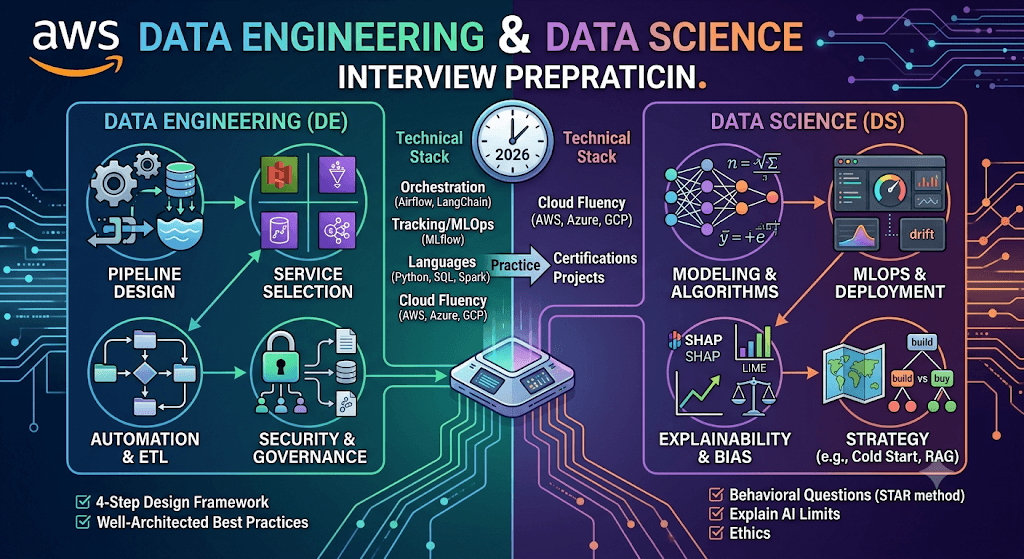
For an IT role focused on AWS Data Engineering and Data Science, interviewers typically assess:
- AWS Core Services
- Data Engineering Concepts
- Big Data Technologies
- ETL & Data Pipelines
- Data Warehousing
- Data Science & Machine Learning
- Python & SQL
- Cloud Architecture
- Security & Governance
- Scenario-Based Questions
Below is a comprehensive interview preparation guide.
AWS Data Engineering Interview Questions & Answers
1. What is AWS?
Answer:
AWS (Amazon Web Services) is a cloud computing platform offering services such as computing, storage, databases, analytics, networking, machine learning, and security on a pay-as-you-go model.
2. What is Amazon S3?
Answer:
Amazon S3 (Simple Storage Service) is an object storage service used to store and retrieve any amount of data from anywhere.
Features:
- Unlimited storage
- 99.999999999% durability
- Versioning
- Lifecycle Management
- Encryption
3. Difference Between S3, EBS, and EFS?
| Feature | S3 | EBS | EFS |
|---|---|---|---|
| Storage Type | Object | Block | File |
| Attached To | Any Service | EC2 | Multiple EC2 |
| Scalability | Unlimited | Limited | Auto Scaling |
| Use Case | Data Lake | Databases | Shared File System |
4. What is AWS Glue?
Answer:
AWS Glue is a fully managed ETL service used to discover, prepare, transform, and load data.
Components:
- Glue Crawlers
- Data Catalog
- ETL Jobs
- Workflows
5. What is AWS Lake Formation?
Answer:
AWS Lake Formation helps build, secure, and manage data lakes on Amazon S3.
Benefits:
- Centralized security
- Data cataloging
- Fine-grained access control
6. What is Amazon Redshift?
Answer:
Amazon Redshift is AWS’s fully managed petabyte-scale data warehouse service.
Features:
- Columnar Storage
- Massively Parallel Processing (MPP)
- Compression
- High Performance Analytics
7. Difference Between Redshift and RDS?
| Redshift | RDS |
|---|---|
| Data Warehouse | Relational Database |
| OLAP | OLTP |
| Analytics | Transactions |
| Petabyte Scale | GB/TB Scale |
8. What is AWS Athena?
Answer:
Athena is a serverless interactive query service used to analyze data directly in S3 using SQL.
Benefits:
- No infrastructure
- Pay per query
- Integrates with Glue Catalog
9. What is EMR?
Answer:
Amazon EMR (Elastic MapReduce) is a managed big data platform.
Supports:
- Hadoop
- Spark
- Hive
- HBase
- Presto
10. What is Apache Spark?
Answer:
Apache Spark is an in-memory distributed processing engine used for large-scale data processing.
Advantages:
- Fast Processing
- Fault Tolerance
- Machine Learning Support
ETL & Data Pipeline Questions
11. Explain ETL Process.
Answer:
ETL = Extract → Transform → Load
- Extract data from source systems.
- Transform data according to business rules.
- Load data into warehouse/data lake.
12. Difference Between ETL and ELT?
| ETL | ELT |
|---|---|
| Transform Before Load | Transform After Load |
| Traditional DW | Modern Cloud DW |
| Slower | Faster |
13. How would you build a data pipeline in AWS?
Answer:
Source → S3 → Glue → Redshift → QuickSight
Example:
- Data arrives in S3
- Glue crawler catalogs data
- Glue ETL cleans data
- Redshift stores transformed data
- QuickSight creates dashboards
14. What is AWS Data Pipeline?
Answer:
AWS Data Pipeline automates movement and transformation of data between AWS services and on-premise systems.
15. Difference Between Batch and Streaming Processing?
| Batch | Streaming |
|---|---|
| Large chunks | Real-time |
| Periodic | Continuous |
| Example: Daily Reports | Fraud Detection |
16. What AWS Services Support Streaming?
Answer:
- Amazon Kinesis
- MSK (Kafka)
- Lambda
- Firehose
Amazon Kinesis Questions
17. What is Amazon Kinesis?
Answer:
Real-time data streaming platform used for collecting and processing streaming data.
Components:
- Kinesis Data Streams
- Kinesis Firehose
- Kinesis Analytics
18. Difference Between Kinesis and Kafka?
| Kinesis | Kafka |
|---|---|
| AWS Managed | Open Source |
| Easier Setup | More Flexible |
| AWS Ecosystem | Multi-Cloud |
SQL Interview Questions
19. Difference Between ROW_NUMBER(), RANK(), and DENSE_RANK()?
ROW_NUMBER()
RANK()
DENSE_RANK()
Example:
Scores: 100,100,90
ROW_NUMBER:
1,2,3
RANK:
1,1,3
DENSE_RANK:
1,1,2
20. Find Second Highest Salary
SELECT MAX(Salary)
FROM Employee
WHERE Salary <
(SELECT MAX(Salary)
FROM Employee);
21. Difference Between DELETE, TRUNCATE, DROP
| DELETE | TRUNCATE | DROP |
|---|---|---|
| Remove Rows | Remove All Rows | Delete Table |
| Rollback Possible | Limited | No |
Python Questions
22. Why Python in Data Engineering?
Answer:
- Automation
- ETL Development
- Data Processing
- Machine Learning
23. What are Pandas DataFrames?
Answer:
A tabular data structure used for data analysis.
import pandas as pd
df = pd.read_csv("data.csv")
24. Difference Between List and Tuple?
| List | Tuple |
|---|---|
| Mutable | Immutable |
| [] | () |
25. What is PySpark?
Answer:
PySpark is the Python API for Apache Spark.
Used for:
- Distributed processing
- Big data transformations
Data Science Interview Questions
26. What is Data Science?
Answer:
Data Science combines statistics, programming, and domain knowledge to extract insights from data.
27. Explain Machine Learning.
Answer:
Machine Learning enables systems to learn from data and make predictions without explicit programming.
28. Types of Machine Learning
Supervised Learning
- Classification
- Regression
Unsupervised Learning
- Clustering
- Association
Reinforcement Learning
- Reward-based learning
29. What is Overfitting?
Answer:
Model performs well on training data but poorly on unseen data.
Solutions:
- Cross Validation
- Regularization
- More Data
30. What is Underfitting?
Answer:
Model cannot capture patterns from training data.
31. Explain Bias vs Variance.
| Bias | Variance |
|---|---|
| Underfitting | Overfitting |
| Simpler Model | Complex Model |
32. What is Cross Validation?
Answer:
Technique to evaluate model performance using multiple train-test splits.
33. What is Precision?
Answer:
Precision = TP / (TP + FP)
Precision=TP+FPTP
34. What is Recall?
Answer:
Recall = TP / (TP + FN)
Recall=TP+FNTP
35. What is F1 Score?
Answer:
F1 Score = Harmonic Mean of Precision and Recall
F1=2⋅Precision+RecallPrecision⋅Recall
AWS Machine Learning Questions
36. What is Amazon SageMaker?
Answer:
Fully managed machine learning service used to build, train, and deploy ML models.
Features:
- Notebooks
- Training Jobs
- Model Deployment
- AutoML
37. What is SageMaker Autopilot?
Answer:
Automatically builds and trains ML models with minimal coding.
38. What is SageMaker Feature Store?
Answer:
Centralized repository for storing, sharing, and managing ML features.
Security Questions
39. Difference Between IAM Role and IAM User?
| IAM User | IAM Role |
|---|---|
| Permanent Identity | Temporary Access |
| Login Credentials | Assumed By Services |
40. How Do You Secure Data in AWS?
Answer:
- IAM Policies
- Encryption at Rest
- Encryption in Transit
- VPC
- Security Groups
- KMS Keys
Scenario-Based Questions
41. Design a Data Lake on AWS.
Answer:
Architecture:
Source Systems
      |
      v
Amazon S3
      |
AWS Glue
      |
Lake Formation
      |
Athena / Redshift
      |
QuickSight
42. How Would You Process 10 TB of Daily Data?
Answer:
- Store in S3
- Use Spark on EMR
- Partition Data
- Use Glue ETL
- Load into Redshift
- Query with Athena
43. How Would You Build a Real-Time Analytics Platform?
Answer:
Applications
      |
Kinesis Streams
      |
Lambda/Spark
      |
Redshift/OpenSearch
      |
QuickSight
Frequently Asked AWS Data Engineering Tools
| Service | Purpose |
|---|---|
| S3 | Data Lake |
| Glue | ETL |
| Athena | Query S3 |
| Redshift | Data Warehouse |
| EMR | Big Data Processing |
| Kinesis | Streaming |
| Lambda | Serverless Processing |
| SageMaker | Machine Learning |
| Lake Formation | Data Lake Governance |
| QuickSight | BI Dashboard |
Top 15 Questions Asked by Senior Interviewers
- Explain a Data Lake architecture on AWS.
- Redshift vs Snowflake?
- Glue vs EMR?
- Athena vs Redshift?
- Batch vs Streaming pipelines?
- How do you optimize Spark jobs?
- Explain partitioning and bucketing.
- How do you secure data lakes?
- Explain CDC (Change Data Capture).
- What is Delta Lake?
- What is Apache Iceberg?
- How would you handle schema evolution?
- Design a real-time fraud detection system.
- How would you process billions of records daily?
- Explain an end-to-end ML pipeline in AWS.
For a 5–10 year experienced IT professional targeting AWS Data Engineer, Data Scientist, AI Engineer, or Cloud Architect roles, I can also create a 100+ page interview preparation document with 200+ advanced questions and answers, including architecture diagrams, SQL/Python coding rounds, Spark, Databricks, GenAI, LLMs, and scenario-based design questions.
Here’s a comprehensive preparation guide for AWS Data Engineering and Data Science interviews. I’ve organized it into categories with common questions, concise answers, and key concepts. This draws from frequently asked topics in 2025-2026 interviews.
Copy this into a document (e.g., Google Doc or Markdown) and expand with your experiences/examples. Practice explaining concepts aloud, drawing diagrams (e.g., data pipelines), and discussing trade-offs (cost, performance, scalability).
1. General AWS Data Engineering Concepts
Q1: What is the role of a Data Engineer in AWS? A Data Engineer designs, builds, and maintains scalable data infrastructure. This includes ingesting, transforming, storing, and making data available for analytics/ML. Key responsibilities: ETL/ELT pipelines, data lakes/warehouses, orchestration, monitoring, and ensuring data quality/security.
Q2: Common challenges for AWS Data Engineers?
- Handling massive/scalable data volumes
- Integrating diverse sources (structured/unstructured, batch/streaming)
- Managing costs (storage, compute)
- Ensuring performance, reliability, schema evolution, and data governance
- Real-time processing and fault tolerance
Q3: Explain a typical modern data architecture on AWS (Data Lakehouse). Raw data → S3 (Data Lake) → Glue Crawler/Catalog → Glue/EMR/Spark for transformation → Redshift/Athena for querying → SageMaker for ML → QuickSight for visualization. Orchestrate with Step Functions, MWAA (Airflow), or EventBridge. Use Lake Formation for governance.
Q4: Difference between Data Lake, Data Warehouse, and Lakehouse?
- Data Lake (S3): Cheap, schema-on-read, all data types.
- Data Warehouse (Redshift): Schema-on-write, structured, optimized for BI.
- Lakehouse (S3 + Glue/Redshift Spectrum/Iceberg): Combines both with ACID, governance.
2. Amazon S3 and Storage
Q5: Why is S3 the foundation for data engineering pipelines? Durable (11 9s), scalable, cheap, integrates with nearly everything (Glue, Athena, Redshift, EMR, Lambda, SageMaker). Supports versioning, lifecycle policies, encryption.
Q6: Explain S3 storage classes and when to use them.
- Standard: Frequent access, low latency.
- IA/One Zone-IA: Infrequent access.
- Glacier/Deep Archive: Archival, retrieval times vary.
- Intelligent-Tiering: Auto-moves based on access patterns.
Q7: How do you optimize S3 for analytics? Use partitioning (e.g., by date), columnar formats (Parquet, ORC), compression (Snappy/Zstd), and prefix optimization. Enable S3 Inventory and use Athena/Glue for querying.
3. AWS Glue and ETL
Q8: What is AWS Glue? Fully managed, serverless ETL service. Includes Data Catalog (Hive Metastore), Crawlers (schema discovery), Jobs (Spark/Python), and Studio for visual ETL.
Q9: Explain Glue Crawler, Job, and Data Catalog.
- Crawler: Scans data (S3, RDS, etc.) and populates/updates the Catalog.
- Data Catalog: Central metadata repository.
- Job: Executes ETL (PySpark/Scala/Python shell). Supports schema evolution.
Q10: How does Glue handle schema evolution? Dynamic Frames handle schema changes automatically. Use mergeSchema or relationalize for complex cases. Glue supports versioning in the Catalog.
Q11: How do you optimize Glue job performance?
- Increase workers/DPU
- Use Pushdown predicates
- Partition data
- Cache DataFrames
- Choose right job type (Glue 3.0/4.0 with Spark)
- Monitor with CloudWatch
Q12: Glue vs. EMR? Glue: Serverless, easier for simple ETL. EMR: More control, custom Spark/Hadoop clusters, better for complex big data/ML workloads.
4. Amazon Redshift and Data Warehousing
Q13: What is Amazon Redshift? Fully managed, petabyte-scale data warehouse using columnar storage (Massively Parallel Processing – MPP). Good for BI/analytics.
Q14: Redshift vs. RDS vs. S3/Athena?
- Redshift: Analytics, joins, aggregations on structured data.
- RDS: OLTP (transactions).
- S3 + Athena: Ad-hoc queries on raw/lake data (serverless, pay-per-query).
Q15: Key Redshift features for performance? Sort keys, distribution styles (KEY, EVEN, ALL), materialized views, concurrency scaling, AQUA (advanced query acceleration), RA3 nodes.
5. Amazon Athena and Querying
Q16: What is Amazon Athena? Serverless SQL query service for S3 data. Uses Presto/Trino under the hood. No infrastructure management.
Q17: Best practices for Athena? Partition data, use columnar formats (Parquet), avoid SELECT *, use Glue Catalog, federated queries, workgroups for cost control.
6. Streaming and Real-time (Kinesis, etc.)
Q18: What is Amazon Kinesis? Family for streaming:
- Data Streams: Real-time ingestion/processing.
- Firehose: Load streaming data to S3/Redshift/OpenSearch (with Lambda transformation).
- Data Analytics: SQL on streams.
Q19: When to use Kinesis vs. Lambda for processing? Kinesis for high-throughput, ordered, durable streaming. Lambda for simple event-driven or low-volume.
7. EMR and Big Data Processing
Q20: What is Amazon EMR? Managed Hadoop/Spark cluster service. Supports Spark, Hive, Presto, etc. Good for large-scale batch/ML.
8. AWS SageMaker for Data Science/ML
Q21: What is Amazon SageMaker? Fully managed service to build, train, deploy, and monitor ML models. Includes Studio (IDE), Pipelines (MLOps), AutoML, and built-in algorithms.
Q22: Explain the SageMaker workflow.
- Data prep (SageMaker Processing)
- Training (Training Jobs, Hyperparameter Tuning)
- Evaluation
- Deployment (Endpoints – real-time/batch)
- Monitoring (Model Monitor, Clarify for bias/explainability)
Q23: Real-time inference vs. Batch Transform?
- Real-time: Low-latency endpoints.
- Batch: Process large datasets offline, cheaper.
Q24: How do you handle model drift in SageMaker? Use Model Monitor to detect drift (data/model quality). Set alarms and trigger retraining via Pipelines.
Q25: SageMaker features for cost optimization? Spot instances for training, Inference Recommender, multi-model endpoints, serverless endpoints.
9. Orchestration, Security, and Best Practices
Q26: How do you orchestrate pipelines? AWS Step Functions, MWAA (Managed Airflow), EventBridge, Glue Workflows, or SageMaker Pipelines.
Q27: Data security in AWS pipelines?
- IAM roles/policies (least privilege)
- Encryption (SSE-KMS, client-side)
- VPC endpoints, Lake Formation
- Glue/Redshift IAM auth
- Macie for discovery, GuardDuty for threats
Q28: Design a scalable data pipeline (common scenario question). Example: Ingest from sources → Kinesis/Firehose → S3 → Glue ETL → Redshift → SageMaker. Monitor with CloudWatch/X-Ray. Use IaC (CDK/Terraform).
Q29: Cost optimization strategies? Reserved/Spot instances, S3 Intelligent-Tiering, Glue auto-scaling, Athena workgroups, Redshift concurrency scaling, right-sizing.
Q30: How do you handle large-scale data ingestion? Use DMS for databases, Snowball for offline, Kinesis for streaming, Glue/S3 for batch. Parallelize with partitions.
Additional Tips for Interview Success
- Behavioral: Use STAR method. Prepare examples of pipeline failures, migrations, cost savings.
- Hands-on: Know console/CLI (e.g., aws glue, aws sagemaker). Practice on free tier.
- Trade-offs: Always discuss when to choose Glue vs. EMR vs. custom EC2, serverless vs. provisioned.
- Emerging: Lake Formation, Iceberg tables, SageMaker Canvas (no-code), Bedrock for GenAI integration.
- Coding/SQL: Expect PySpark, SQL window functions, partitioning optimization.
Resources to deepen:
- AWS Documentation (Glue, SageMaker, Redshift)
- Whizlabs/Edureka/A Cloud Guru courses
- Practice projects: Build ETL with Glue + S3 + Redshift, end-to-end ML with SageMaker
Review your resume projects and map them to these services. Good luck — this covers 80-90% of typical questions. If you need more details on any section or sample diagrams/code, let me know!