
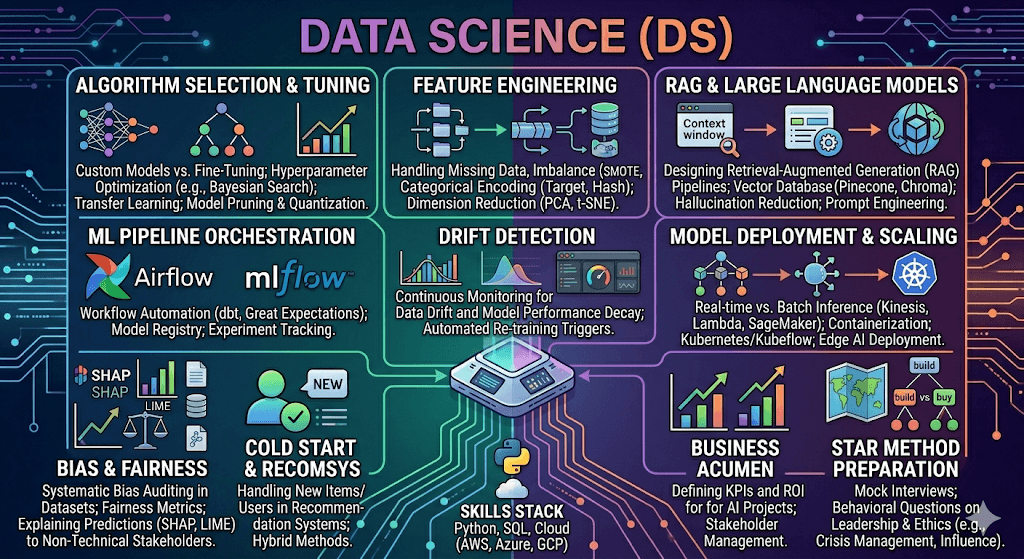
This guide consolidates the most relevant and frequently asked questions for AWS Data Engineering and Data Science roles, based on the provided search results. The questions are categorized by domain and service, ranging from fundamental concepts to advanced architectural scenarios. Each section includes strategic advice on what interviewers are looking for and sample answers where appropriate.
Table of Contents
- Core Data Engineering & Storage (S3, Glue, EMR)
- Data Warehousing & Querying (Redshift, Athena)
- Streaming & Real-Time Analytics (Kinesis, MSK, Lambda)
- Data Science & Machine Learning (SageMaker, MLOps, Statistics)
- Architecture & System Design Scenarios
- Security, Governance & Compliance
- Leadership Principles & Behavioral Questions
1. Core Data Engineering & Storage (S3, Glue, EMR)
Amazon S3
- How would you design a scalable data lake architecture on AWS using S3, Glue, and Athena?
- What is your strategy for partitioning data in S3 for performance?
- How do you manage schema evolution in a Glue Data Catalog?
AWS Glue vs. EMR
- Compare EMR and Glue for large-scale ETL workloads. When would you use each?
- Strategy: Use AWS Glue for serverless, cost-effective ETL for jobs that run on a schedule, are under a few hours, or for simple transformations. Use Amazon EMR for large-scale, complex, or custom big data frameworks (like custom Spark, HBase, or Presto) where you need more control over the cluster (e.g., specific Spark configurations or libraries) .
- How do you optimize AWS Glue ETL jobs for large datasets?
- How do you implement incremental ETL using AWS Glue and S3?
Amazon EMR
- What is your approach to optimizing Spark jobs on EMR?
- Explain the difference between Glue Job bookmarks and Spark checkpoints.
2. Data Warehousing & Querying (Redshift, Athena)
Amazon Redshift
- Explain the difference between a data lake and a data warehouse in AWS.
- How do you optimize queries in Amazon Redshift?
- When would you prefer Redshift over Athena or vice versa?
- Explain how Redshift Spectrum works with S3 data.
AWS Athena
- What are the best practices for optimizing Athena query performance?
3. Streaming & Real-Time Analytics (Kinesis, MSK, Lambda)
Amazon Kinesis
- Describe a high-throughput data ingestion pipeline architecture you’ve built using Kinesis or MSK.
- How do you ensure exactly-once processing in AWS streaming systems?
- Compare AWS Kinesis vs Kafka (MSK) — which would you pick for different use cases?
- How would you handle late-arriving events in Kinesis?
AWS Lambda
- What are the retry and error-handling mechanisms in AWS Lambda when processing streams?
4. Data Science & Machine Learning (SageMaker, MLOps, Statistics)
Machine Learning with SageMaker
- What AWS services do you use to build and deploy an end-to-end ML model?
- Describe how SageMaker Pipelines automates an end-to-end ML workflow.
- What is your approach to handling data drift and concept drift in production models?
- Strategy: Use SageMaker Model Monitor to automatically capture data and predictions. Data drift is detected by comparing input feature distributions to the baseline. Concept drift is inferred by monitoring model accuracy against ground truth labels (which may arrive with a delay). Set up CloudWatch alarms to trigger model retraining .
- How do you handle unbalanced datasets in a classification problem?
Statistics & Analytics
- How would you design an A/B test to evaluate a new recommendation algorithm on Amazon.com?
- Strategy: Randomly assign users to control (old algorithm) and treatment (new algorithm) groups. Define key metrics (e.g., click-through rate, conversion rate, average order value). Use statistical tests (e.g., t-test or chi-squared test) to determine significance. Ensure a large enough sample size and test duration to account for daily/ weekly seasonality .
- Define the five assumptions of linear regression. How do you handle multicollinearity?
- Strategy: The five assumptions are: linear relationship, no multicollinearity, independence of errors, homoscedasticity, and normality of errors. Multicollinearity (independent variables highly correlated) can be handled by dropping one of the correlated features, using Principal Component Analysis (PCA), or using a regularization technique like Ridge regression .
- Explain the process of Maximum Likelihood Estimation (MLE) for a coin toss.
5. Architecture & System Design Scenarios
Scenario: IoT Data Pipeline
Question: *”Your company ingests 5 TB/day of IoT sensor data (JSON) from thousands of devices. Analysts want real-time dashboards + daily aggregates. Compliance requires data retention for 7 years, but only last 6 months of hot data needs to be queryable.” How would you design this?* .
Sample Answer:
- Ingestion: Use Kinesis Data Streams to handle the high-throughput ingestion from IoT devices.
- Processing: Use AWS Glue (or EMR with Spark Streaming) to read from Kinesis. Implement two paths: 1) A streaming job to store raw JSON in an S3 Bronze layer. 2) A microbatch job to clean, validate, and write the data as Parquet in a Silver layer.
- Real-time Dashboard: Use Kinesis Data Analytics for real-time aggregations and sink the results to a DynamoDB table, which feeds a QuickSight dashboard.
- Daily Aggregates: Use a scheduled Glue ETL job to read the Silver layer, compute daily aggregates, and store them in a Redshift cluster for BI tools.
- Compliance & Cost: Use S3 Lifecycle Policies to move data after 6 months from S3 Standard to S3 Glacier Deep Archive for the remaining 6.5 years. Partition data by
device_idanddatefor efficient querying .
Scenario: E-Commerce Analytics Platform
Question: “Design an end-to-end data pipeline for a global e-commerce analytics platform.” .
Sample Answer:
- Sources: Clickstream data (web/mobile) goes to Kinesis Data Streams. Transactional data (orders, users) is pulled via AWS DMS or AppFlow.
- Lake & Catalog: Land all data into S3. Use Glue Crawlers to build a Glue Data Catalog.
- Processing: Use EMR or Glue for complex joins and aggregations. Handle GDPR with Lake Formation for fine-grained access control.
- Consumption: Provide Athena for data scientists/ad-hoc queries. Load aggregated data into Redshift for standard BI reports. Use QuickSight for dashboards.
6. Security, Governance & Compliance
- How do you implement data encryption at rest and in transit in S3, Glue, and Redshift?
- Explain the role of AWS Lake Formation in data governance.
- How do you ensure GDPR or HIPAA compliance in AWS data pipelines?
- Strategy: Use Macie to discover and protect sensitive data (like PII). Use KMS for encryption with controlled key rotation. Implement CloudTrail for API audit logs and S3 Access Logs for object-level access. Use Lake Formation for fine-grained access and VPC endpoints to ensure data doesn’t traverse the public internet .
7. Leadership Principles & Behavioral Questions
Amazon interviews heavily emphasize the 16 Leadership Principles. You must prepare stories using the STAR (Situation, Task, Action, Result) method.
- Customer Obsession: “Describe a time when you had to push back against a business requirement to protect the customer experience or data quality.”
- Ownership: “Tell me about a time you saw a broken process in your data pipeline that no one was responsible for. What did you do?”
- Invent and Simplify: “Give an example of a complex ETL process you significantly simplified, resulting in faster delivery or lower cost.”
- Learn and Be Curious: “Describe a new AWS service (e.g., Glue DynamicFrame, EMR Serverless) you learned to solve a specific problem.”
- Dive Deep: “Walk me through how you debugged a particularly difficult data quality issue or performance problem in a Redshift or Spark job.”
- Deliver Results: “Tell me about the toughest SLAs you had to meet for a data pipeline and how you managed to deliver on time.”
Final Preparation Tips
- Do not memorize: Interviewers want to see trade-off analysis. Always explain why you chose one service over another (e.g., “I chose Kinesis over MSK because it’s serverless and reduces our operational overhead”).
- Hands-on experience: Be prepared to write small scripts (Python/Boto3) to interact with S3, Glue, or to run SQL on Athena/Redshift .
- Be ready for “How would you…” scenarios: Focus on end-to-end thinking, covering data ingestion, storage, processing, consumption, security, and cost .
- Quantify your impact: When discussing past projects, use numbers (e.g., “reduced query costs by 40%”, “improved job runtime from 6 hours to 45 minutes”).