
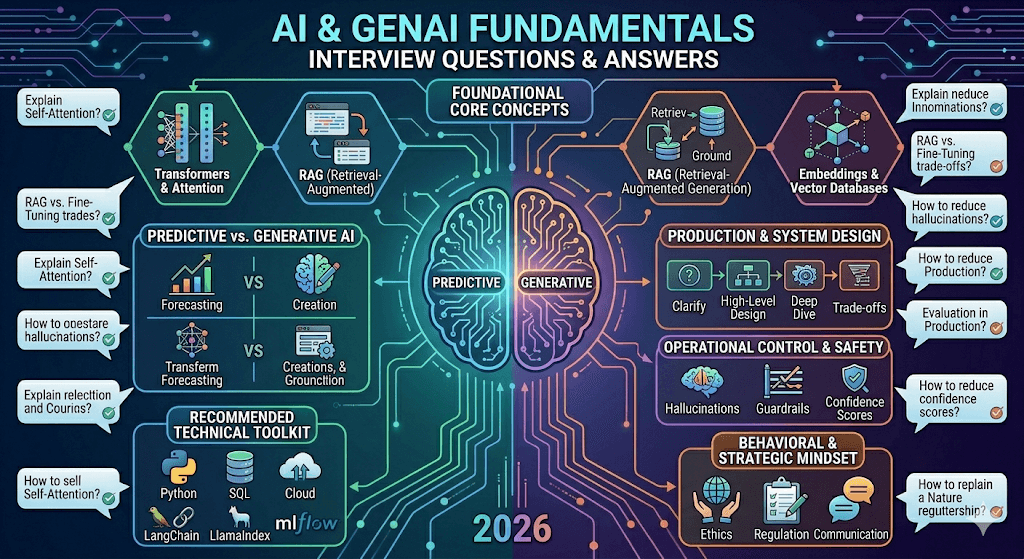
This guide covers the most important AI and Generative AI concepts frequently asked in Technical Architect, Solution Architect, Data Engineer, Data Scientist, and AI Engineer interviews.
1. What is Artificial Intelligence (AI)?
Answer:
Artificial Intelligence (AI) is a branch of computer science that enables machines to simulate human intelligence and perform tasks such as:
- Learning from data
- Problem-solving
- Decision-making
- Language understanding
- Image recognition
Example:
- Virtual assistants like ChatGPT
- Self-driving cars
- Recommendation systems
2. What are the different types of AI?
Answer:
| Type | Description |
|---|---|
| Narrow AI | Designed for specific tasks |
| General AI | Human-level intelligence across domains |
| Super AI | Intelligence surpassing humans |
Current Reality:
Most existing AI systems are Narrow AI.
3. What is Machine Learning (ML)?
Answer:
Machine Learning is a subset of AI where systems learn patterns from data without explicit programming.
Formula:
Prediction=Model(Data)
Examples:
- Fraud detection
- Spam filtering
- Product recommendations
4. What is Deep Learning?
Answer:
Deep Learning is a subset of Machine Learning that uses neural networks with multiple hidden layers.
Applications:
- Image Recognition
- Speech Recognition
- NLP
- Autonomous Vehicles
5. Difference Between AI, ML, and Deep Learning
| AI | ML | Deep Learning |
|---|---|---|
| Broad concept | Subset of AI | Subset of ML |
| Mimics intelligence | Learns patterns | Uses neural networks |
| Rule-based + Learning | Data-driven | Large-scale data-driven |
6. What is Generative AI?
Answer:
Generative AI refers to AI models capable of creating new content such as:
- Text
- Images
- Audio
- Video
- Code
Examples:
- ChatGPT
- OpenAI’s image models
- Google Gemini
- Claude AI
7. What is the difference between AI and Generative AI?
Answer:
| AI | Generative AI |
|---|---|
| Analyzes data | Creates data |
| Classification | Content generation |
| Prediction | Creation |
| Decision Making | Text/Image/Video Generation |
8. What is Natural Language Processing (NLP)?
Answer:
NLP enables computers to understand, process, and generate human language.
Examples:
- Translation
- Chatbots
- Sentiment Analysis
- Text Summarization
9. What is a Large Language Model (LLM)?
Answer:
LLM is a deep learning model trained on massive datasets to understand and generate human-like text.
Popular LLMs:
10. What is a Foundation Model?
Answer:
A Foundation Model is a large pre-trained AI model that can be adapted to multiple downstream tasks.
Examples:
- GPT
- Gemini
- Llama
11. What is GPT?
Answer:
GPT stands for:
Generative Pre-trained Transformer
Three Stages:
- Pre-training
- Fine-tuning
- Inference
12. What is a Transformer Model?
Answer:
Transformer is a neural network architecture introduced in the paper:
Attention Is All You Need
Key Feature:
Attention Mechanism
Benefits:
- Parallel Processing
- Better Context Understanding
- Scalability
13. What is Attention Mechanism?
Answer:
Attention helps models focus on important words while processing input.
Example:
Sentence:
“The cat sat on the mat because it was tired.”
Attention helps determine that “it” refers to “cat.”
14. What is Tokenization?
Answer:
Tokenization converts text into smaller pieces called tokens.
Example:
Input:
I love AITokens:
["I", "love", "AI"]15. What are Tokens in LLMs?
Answer:
Tokens are the smallest units processed by an LLM.
Examples:
- Words
- Parts of words
- Characters
16. What is Embedding?
Answer:
Embeddings are numerical vector representations of text, images, or data.
Purpose:
Capture semantic meaning.
Example:
- King → Vector
- Queen → Similar Vector
17. What is Vector Database?
Answer:
A Vector Database stores embeddings for similarity search.
Popular options:
18. What is RAG (Retrieval-Augmented Generation)?
Answer:
RAG combines:
- Retrieval System
- LLM
Flow:
User Query
     ↓
Vector Search
     ↓
Relevant Documents
     ↓
LLM
     ↓
Response
Benefits:
- Reduced hallucinations
- Access to enterprise data
- Up-to-date responses
19. What is Fine-Tuning?
Answer:
Fine-tuning trains a pre-trained model on domain-specific data.
Example:
Healthcare GPT
Legal GPT
Banking GPT
20. What is Prompt Engineering?
Answer:
Prompt Engineering is the process of designing effective prompts to obtain desired outputs from AI models.
Example:
Weak Prompt:
Explain AI.Strong Prompt:
Explain AI to a beginner using real-world examples in 200 words.21. What are Hallucinations in AI?
Answer:
Hallucinations occur when an AI model generates incorrect or fabricated information while sounding confident.
Mitigation:
- RAG
- Fine-tuning
- Grounding
- Human Review
22. What is Context Window?
Answer:
Context Window is the amount of information an LLM can process in a single interaction.
Includes:
- Prompt
- Conversation history
- Documents
23. What is Temperature in LLMs?
Answer:
Temperature controls randomness.
| Temperature | Behavior |
|---|---|
| 0.0 | Deterministic |
| 0.3 | Focused |
| 0.7 | Balanced |
| 1.0+ | Creative |
24. What is Zero-Shot Learning?
Answer:
Model performs a task without examples.
Example:
Translate English to French.25. What is One-Shot Learning?
Answer:
Model receives one example before performing the task.
26. What is Few-Shot Learning?
Answer:
Model receives multiple examples before solving the task.
27. What is AI Agent?
Answer:
An AI Agent is an autonomous system that can:
- Observe
- Reason
- Plan
- Act
Examples:
- Customer Support Agents
- Autonomous Research Agents
- Coding Agents
28. What is Agentic AI?
Answer:
Agentic AI refers to AI systems capable of independently planning and executing multi-step tasks toward a goal.
Capabilities:
- Tool Usage
- Memory
- Planning
- Decision Making
29. What is Multi-Agent Architecture?
Answer:
Multiple AI agents collaborate to solve complex tasks.
Example:
- Planner Agent
- Research Agent
- Coding Agent
- Reviewer Agent
30. What is Responsible AI?
Answer:
Responsible AI ensures systems are:
- Fair
- Transparent
- Explainable
- Secure
- Accountable
31. What are AI Governance Principles?
Answer:
Key pillars:
- Ethics
- Privacy
- Security
- Compliance
- Risk Management
32. What are the biggest challenges in Generative AI?
Answer:
- Hallucinations
- Data Privacy
- Bias
- Security Risks
- High Compute Costs
- Regulatory Compliance
Architect-Level Interview Question
Q: How would you design an Enterprise GenAI Solution?
Answer:
Architecture:
User
 ↓
Application Layer
 ↓
API Gateway
 ↓
RAG Layer
 ↓
Vector Database
 ↓
LLM
 ↓
Response
Components:
- Authentication
- Knowledge Base
- Vector Store
- Prompt Layer
- Guardrails
- Monitoring
- Human Feedback Loop
Top 10 Must-Know Topics for AI Architect Interviews
- LLM Fundamentals
- Transformer Architecture
- Prompt Engineering
- RAG
- Vector Databases
- Fine-Tuning
- AI Agents
- Agentic AI
- Responsible AI
- Enterprise GenAI Architecture
These topics form the foundation for most AI Architect, Generative AI Architect, Technical Architect, and Solution Architect interviews in 2026.
What is Artificial Intelligence (AI)?
Artificial Intelligence is the field of computer science focused on creating systems that can perform tasks that typically require human intelligence. These tasks include:
- Reasoning and problem-solving
- Learning from experience
- Understanding natural language
- Perception (vision, speech)
- Planning and decision making
- Creativity
Core Types of AI:
- Narrow AI (Weak AI): Specialized for specific tasks (e.g., chess engines, spam filters, recommendation systems, facial recognition). This is what powers almost all AI today.
- General AI (Strong AI / AGI): Can understand, learn, and apply intelligence across any intellectual task that a human can do. Still theoretical / in development.
- Super AI (ASI): Surpasses human intelligence across all fields. Speculative.
Key Subfields of AI
| Subfield | Description | Examples |
|---|---|---|
| Machine Learning (ML) | Algorithms that learn patterns from data | Regression, Decision Trees |
| Deep Learning (DL) | ML using multi-layered neural networks | Image recognition, LLMs |
| Computer Vision | Enabling machines to “see” | Object detection |
| Natural Language Processing (NLP) | Understanding and generating human language | Translation, Chatbots |
| Reinforcement Learning | Learning through rewards and penalties | Game-playing AIs (AlphaGo) |
How Modern AI Works: The Data → Model → Prediction Pipeline
- Data Collection — Large amounts of labeled or unlabeled data.
- Feature Engineering — Selecting relevant patterns (less important now with deep learning).
- Training — Model adjusts internal parameters (weights) to minimize error.
- Inference — Using the trained model to make predictions on new data.
Neural Networks are the backbone:
- Inspired by biological neurons.
- Layers: Input → Hidden → Output.
- Learn via backpropagation + gradient descent.
Rise of Generative AI
Generative AI is a subset of AI focused on creating new content rather than just analyzing or classifying existing data.
Traditional AI is mostly discriminative (e.g., “Is this a cat or dog?”). Generative AI is generative (e.g., “Create an image of a cat riding a bike”).
Key Generative AI Technologies
- Generative Adversarial Networks (GANs) (2014, Ian Goodfellow)
- Two networks: Generator + Discriminator.
- They compete: Generator tries to fool the Discriminator.
- Excellent for images, but can be unstable to train.
- Variational Autoencoders (VAEs)
- Encode data into a latent space, then decode to generate variations.
- Good for controlled generation.
- Transformers (2017, “Attention is All You Need”)
- Revolutionized NLP and beyond.
- Use self-attention mechanism.
- Foundation for GPT, BERT, LLaMA, Claude, Grok, etc.
- Diffusion Models (2020s)
- Current state-of-the-art for images (Stable Diffusion, DALL·E 2/3, Midjourney, Flux).
- Work by gradually adding noise, then learning to reverse it.
- Large Language Models (LLMs)
- Trained on massive text data (trillions of tokens).
- Use next-token prediction as primary training objective.
- Emergent abilities: reasoning, coding, translation, creativity.
Training Paradigms
- Supervised Learning: Labeled data.
- Unsupervised Learning: Finding patterns without labels.
- Self-Supervised Learning: Modern foundation (predicting parts of the data itself).
- Reinforcement Learning from Human Feedback (RLHF): Aligns models with human preferences (critical for ChatGPT-like behavior).
Scale Laws (The Bitter Lesson)
Performance improves dramatically with:
- More data
- More parameters (model size)
- More compute
This is captured in scaling laws (Kaplan, Hoffmann, etc.).
Important Concepts
- Tokens: How text is broken down (subword units).
- Embeddings: Dense vector representations of words/tokens/images.
- Attention Mechanism: Allows models to focus on relevant parts of input.
- Hallucination: When models confidently generate incorrect information.
- Parameters: The “knowledge” stored in weights (e.g., GPT-3 had 175B, modern models exceed 1T+).
Current Frontier (2026 perspective)
- Multimodal models: Handle text + image + audio + video (GPT-4o, Grok-1.5/2, Claude 3.5, Gemini).
- Reasoning models: o1-style chain-of-thought, test-time compute.
- Agentic AI: Systems that can plan, use tools, and execute multi-step tasks.
- Open-source vs Closed: Llama series, Mistral, Grok pushing boundaries.
Here is a clear, structured overview of AI & Generative AI Fundamentals.
1. What is Artificial Intelligence (AI)?
Artificial Intelligence is the broad field of making machines perform tasks that normally require human intelligence. This includes learning, reasoning, problem-solving, perception, and language understanding.
Core Branches of AI (Non-Generative)
- Machine Learning (ML): Algorithms that learn patterns from data without explicit programming.
- Supervised Learning: Predict labels (e.g., spam detection).
- Unsupervised Learning: Find hidden structures (e.g., customer segmentation).
- Reinforcement Learning: Learn by rewards/punishments (e.g., game-playing AI).
- Computer Vision: Interpreting images/videos (e.g., facial recognition).
- Natural Language Processing (NLP) – Classic: Sentiment analysis, translation, text classification.
- Robotics: Physical tasks, control systems.
- Expert Systems: Rule-based decision making.
Key concept: Narrow vs. General AI
- Narrow AI (Weak AI): Designed for one task (e.g., chess, recommendation engine). All current AI is Narrow AI.
- General AI (Strong AI): Human-level intelligence across any task. Still theoretical.
2. What is Generative AI?
Generative AI is a subset of deep learning that learns the underlying patterns of training data and then creates new, original content (text, images, audio, code, video, etc.) that resembles the training distribution.
How It Differs from Traditional AI
| Traditional (Discriminative) AI | Generative AI |
|---|---|
| Distinguishes between categories | Creates new examples |
| e.g., “Is this a cat or dog?” | e.g., “Draw a cat wearing a hat.” |
| Spam classifier, fraud detection | ChatGPT, Midjourney, Stable Diffusion |
Core Mechanic – Learn then Sample
- Training: Model learns probability distribution of the training data.
- Generation: Model samples from that distribution to produce new outputs.
3. Key Architectures Behind Generative AI
A. Generative Adversarial Networks (GANs)
- Two neural networks compete:
- Generator: Creates fake data.
- Discriminator: Tries to detect real vs. fake.
- Result: Generator gets better at realistic creation.
- Used for: Images, deepfakes, art.
B. Variational Autoencoders (VAEs)
- Encodes input into a compressed latent space, then decodes to generate new data.
- Good for controlled generation and interpolation.
C. Transformers (The Big Game-Changer)
- Uses self-attention mechanism to weigh the importance of all input tokens simultaneously.
- Scales massively with data and compute.
- Power most LLMs and image generation models (via diffusion + transformers).
D. Diffusion Models
- Start with random noise and gradually denoise it step-by-step to create a clean image.
- Used in: DALL·E 2/3, Stable Diffusion, Midjourney.
- Replaced GANs for high-quality image generation.
4. Large Language Models (LLMs) – The Core of Modern Generative AI
LLMs are transformers trained on enormous text corpora (internet, books, papers). They learn to predict the next word (autoregressive generation).
Key Capabilities
- Text generation, summarization, translation, coding, reasoning (chain-of-thought), in-context learning.
Important Concepts
- Token: A piece of text (word/subword). Models process tokens, not raw characters.
- Context window: How much text the model can “see” at once (e.g., 128k tokens for GPT-4 Turbo).
- Parameters: Learnable weights in the network (e.g., 7B, 70B, 175B).
- Hallucination: Generating plausible but incorrect or nonsensical information.
- Emergent abilities: Skills not explicitly trained for (e.g., arithmetic, few-shot learning).
Training Stages
- Pre-training: Massive unsupervised next-token prediction on raw text (expensive, long).
- Supervised fine-tuning (SFT): Train on question-answer examples.
- Reinforcement Learning from Human Feedback (RLHF): Fine-tune using human preference rankings.
5. Popular Generative AI Models & Tools
| Model / Tool | Company | Type | Best for |
|---|---|---|---|
| GPT-4 / ChatGPT | OpenAI | LLM (text) | General text, reasoning, coding |
| Gemini | LLM (multimodal) | Text + images + audio | |
| Claude | Anthropic | LLM | Long context, safety, reasoning |
| Llama 3 | Meta | LLM (open weights) | Research & commercial |
| DALL·E 3 | OpenAI | Text-to-image | Creative images, high prompt adherence |
| Midjourney | Midjourney Inc. | Text-to-image | Artistic, stylized images |
| Stable Diffusion | Stability AI | Text-to-image | Local run, open source, control |
| Whisper | OpenAI | Speech-to-text | Robust transcription |
| ElevenLabs | ElevenLabs | Text-to-speech | Realistic voice cloning |
6. Core Terms You Must Know
- Prompt: The input text given to a generative AI model.
- Zero-shot: Asking the model to perform a task without examples.
- Few-shot: Providing a few examples in the prompt to guide output.
- Chain-of-Thought (CoT): Asking the model to reason step-by-step.
- Inference: Using a trained model to generate output.
- Fine-tuning: Retraining part of a model on specific data to adapt it.
- Embedding: A numeric vector representation of text/image for search or similarity.
- RAG (Retrieval-Augmented Generation): Combining external knowledge retrieval with LLM generation to reduce hallucination.
- Temperature: Controls randomness (low = deterministic, high = creative).
- Top-p / Top-k: Sampling strategies to limit next token choices.
7. Limitations & Risks
- Hallucination: Model states falsehoods confidently.
- Bias: Amplifies stereotypes from training data.
- Outdated knowledge: Unless connected to the internet or updated.
- No real understanding: Models are next-token predictors, not reasoning engines.
- Security: Prompt injection, jailbreaks, data leakage.
- Copyright & ownership: Legal uncertainty over generated content.
8. Getting Hands-On (for a beginner)
No code needed to start:
- ChatGPT (free tier) – Just start typing. Ask it to explain, summarize, or write.
- Google Gemini – Good for accessing the web via Bard/Gemini.
- Microsoft Copilot – Integrated GPT-4 + Bing search (free).
- Claude – Great for long document analysis.
- Leonardo.ai / Playground AI – Free image generation trials.
- Hugging Face Chat – Open-source LLMs with no cost.
Try prompt engineering immediately:
“Act as a tutor. Explain neural networks to a high school student. Use an analogy.”
9. Learning Path (Self-Guided)
- Basics of AI (2 weeks) – What is ML? Training vs. inference. Classification vs. generation.
- Prompt engineering (1 week) – Write effective prompts. Few-shot, CoT, personas.
- Python basics (2 weeks) – Variables, loops, functions (optional but helpful).
- Intro to LLMs with free APIs (1 week) – OpenAI playground, Hugging Face inference.
- Build a simple chatbot (1 week) – Using Gradio + an LLM API.
- RAG project (2 weeks) – Load PDFs, create embeddings, query with an LLM.
Free resources:
- DeepLearning.AI – Short courses (many free).
- Hugging Face NLP Course.
- Fast.ai – Practical deep learning.
- Andrej Karpathy’s “Neural Networks: Zero to Hero” (YouTube).
10. Summary
- AI = machines doing intelligent tasks.
- Generative AI = subset that creates new content.
- LLMs + Diffusion models = current dominant architectures.
- Core skill today = prompt design, understanding limitations, basic RAG.
- Biggest shift from traditional AI: from recognition → creation.