
This guide is tailored for senior IT, Solution Architect, Enterprise Architect, Data Architect, AI Architect, Engineering Manager, and Technical Leadership roles.
1. What is your leadership style?
Answer:
My leadership style is a combination of servant leadership, transformational leadership, and situational leadership.
- I focus on enabling teams rather than micromanaging.
- I align technical teams with business objectives.
- I adapt my approach based on team maturity and project complexity.
- I encourage innovation while maintaining accountability.
For example, during a cloud migration initiative, I empowered technical leads to make architecture decisions while providing strategic guidance and removing organizational blockers.
2. How do you manage cross-functional teams?
Answer:
I establish:
- Clear goals and KPIs
- Defined ownership and accountability
- Regular communication channels
- Transparent escalation processes
I typically use:
- Agile ceremonies
- Weekly stakeholder reviews
- Architecture governance meetings
- Executive status reporting
The key is ensuring every team understands how their work contributes to business outcomes.
3. How do you handle conflicts within a team?
Answer:
I focus on facts, data, and shared objectives.
My approach:
- Understand both perspectives.
- Identify root causes.
- Align discussion to business goals.
- Evaluate options objectively.
- Reach consensus or make a timely decision.
I believe unresolved conflicts create bigger risks than difficult conversations.
4. How do you motivate teams during difficult projects?
Answer:
I focus on:
- Clear vision
- Frequent communication
- Recognition of achievements
- Breaking large goals into smaller milestones
During high-pressure projects, people need visibility into progress and confidence that leadership supports them.
5. What do you do when a project is behind schedule?
Answer:
First, I assess:
- Scope
- Resources
- Dependencies
- Risks
Then I:
- Prioritize critical deliverables
- Remove bottlenecks
- Reallocate resources if necessary
- Communicate transparently with stakeholders
The objective is not simply to recover schedule but to protect business value.
6. How do you make difficult decisions?
Answer:
I use a structured approach:
Evaluate:
- Business impact
- Technical impact
- Cost implications
- Risk exposure
- Long-term sustainability
I make decisions using available data while accepting that perfect information rarely exists.
7. How do you build high-performing teams?
Answer:
I focus on:
Hiring
- Strong technical skills
- Growth mindset
- Collaboration skills
Development
- Mentorship
- Continuous learning
- Career growth opportunities
Culture
- Accountability
- Trust
- Innovation
- Psychological safety
High-performing teams are built through culture, not just talent.
8. Describe a time when you influenced leadership without authority.
Answer:
In one organization, I identified that maintaining multiple legacy platforms was increasing operational costs.
I developed:
- Cost analysis
- Technical debt assessment
- Migration roadmap
- ROI projections
By presenting data-driven recommendations, I secured executive approval for modernization initiatives without direct authority over the teams involved.
9. How do you manage underperforming employees?
Answer:
I follow three steps:
Understand
Identify root causes:
- Skill gap
- Motivation issue
- Personal challenges
- Process obstacles
Support
- Coaching
- Training
- Clear expectations
Measure
- Improvement plans
- Defined milestones
- Regular feedback
The goal is improvement and success, not punishment.
10. What leadership metrics do you track?
Answer:
Delivery Metrics
- Velocity
- Sprint completion
- Release frequency
Quality Metrics
- Defect rates
- MTTR
- System availability
Team Metrics
- Retention
- Employee engagement
- Skill development
Business Metrics
- Customer satisfaction
- Revenue impact
- Cost optimization
11. How do you manage executive stakeholders?
Answer:
Executives care about:
- Revenue
- Cost
- Risk
- Customer experience
- Strategic growth
I communicate in business language rather than technical jargon.
Instead of saying:
“Microservices reduce coupling.”
I say:
“This architecture reduces delivery time by 30% and accelerates product launches.”
12. How do you handle competing stakeholder priorities?
Answer:
I use prioritization frameworks:
- Business value
- Strategic alignment
- Risk
- Cost
- Resource availability
I facilitate discussions to align stakeholders around organizational goals rather than departmental interests.
13. How do you gain stakeholder trust?
Answer:
Trust comes from:
- Transparency
- Consistency
- Delivering commitments
- Clear communication
I ensure stakeholders understand both opportunities and risks before major decisions.
14. How do you communicate technical concepts to non-technical executives?
Answer:
I translate technical outcomes into business outcomes.
Example:
Instead of:
“Implementing Data Lake architecture.”
I say:
“We’ll create a centralized analytics platform that improves decision-making and reduces reporting time from days to minutes.”
15. How do you manage stakeholder expectations?
Answer:
I establish:
- Scope
- Timelines
- Risks
- Dependencies
- Success criteria
early in the project and provide regular updates to avoid surprises.
16. What is strategic thinking?
Answer:
Strategic thinking is the ability to align technology investments with long-term business objectives while balancing risks, costs, and opportunities.
It involves:
- Vision
- Planning
- Prioritization
- Execution
17. How do you create a technology strategy?
Answer:
I follow:
Step 1
Understand business goals.
Step 2
Assess current capabilities.
Step 3
Identify gaps.
Step 4
Define future-state architecture.
Step 5
Create transformation roadmap.
Step 6
Establish governance and KPIs.
18. What factors influence technology investment decisions?
Answer:
- Business value
- ROI
- Risk
- Scalability
- Security
- Compliance
- Time-to-market
Technology should solve business problems, not exist for its own sake.
19. How do you align IT strategy with business strategy?
Answer:
I start by understanding:
- Revenue objectives
- Growth plans
- Customer needs
- Market challenges
Then I create technology initiatives that directly support those goals.
20. How do you measure success of a strategic initiative?
Answer:
Success metrics may include:
Financial
- ROI
- Cost savings
Operational
- Efficiency improvements
- Automation rates
Customer
- NPS
- Satisfaction scores
Technology
- Availability
- Performance
- Security posture
Executive-Level Questions for AI/Technical Architect Roles
Why should we hire you?
Answer:
I bring a unique combination of:
- Enterprise Architecture
- Cloud Architecture
- Data Engineering
- AI & Generative AI
- Leadership
- Business Strategy
I can bridge the gap between executive vision and technical execution, ensuring technology investments generate measurable business value.
What is your vision for AI in the enterprise?
Answer:
AI should move beyond experimentation into measurable business outcomes.
Key focus areas:
- Intelligent automation
- Decision intelligence
- AI-powered customer experiences
- Enterprise knowledge management
- Agentic AI systems
- Responsible AI governance
The organizations that successfully combine AI strategy, data strategy, and business strategy will gain a significant competitive advantage.
Top Leadership Topics to Prepare
- Leadership Principles
- Team Management
- Executive Communication
- Stakeholder Management
- Conflict Resolution
- Change Management
- Digital Transformation
- Enterprise Strategy
- Technology Strategy
- Innovation Management
- Organizational Change
- AI Strategy
- Cloud Strategy
- Product Strategy
- Business Case Development
- ROI Analysis
- Risk Management
- Governance Frameworks
- Budget Planning
- Vendor Management
These are among the most frequently asked leadership and strategy topics for Senior Architect, Principal Architect, Director, Head of Technology, CTO, and AI Architect interviews.
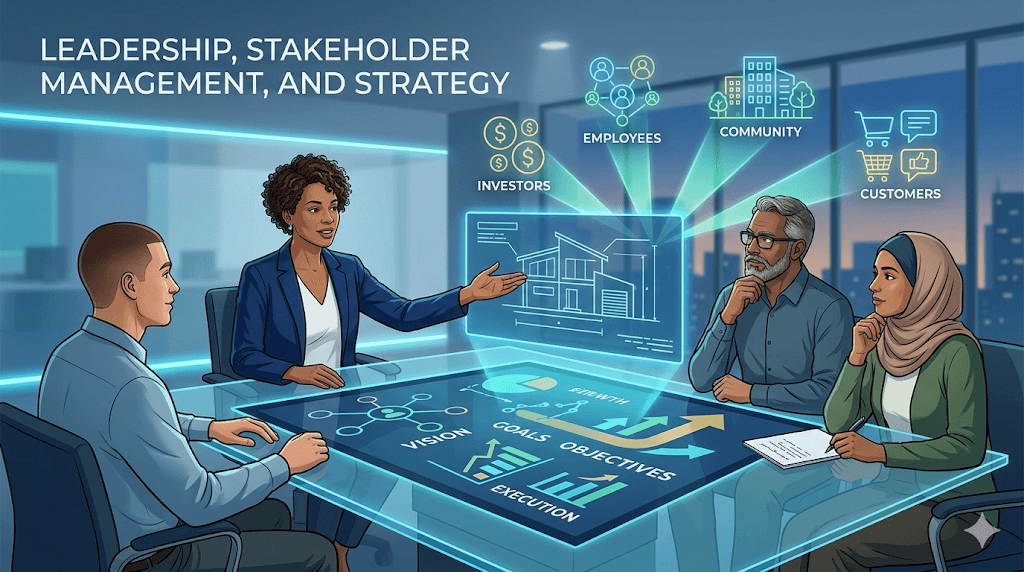
These three concepts—Leadership, Stakeholder Management, and Strategy—are deeply interconnected. In a successful organization, strategy defines where you’re going, leadership drives how you get there, and stakeholder management ensures you bring the right people along.
Here’s a concise breakdown of each and how they integrate.
1. Strategy (The “What” and “Why”)
Strategy is the long-term direction and scope of an organization. It involves making deliberate choices to achieve competitive advantage and deliver value.
Key elements:
- Vision & Mission: Where are we going, and why do we exist?
- Goals & Objectives: Specific, measurable targets (e.g., revenue growth, market share).
- Resource Allocation: Where to invest capital, talent, and time.
- Competitive Positioning: Differentiation, cost leadership, or niche focus.
Common frameworks: SWOT, PESTLE, Porter’s Five Forces, Blue Ocean Strategy, Balanced Scorecard.
Without strategy, leadership and stakeholder management lack direction.
2. Leadership (The “Who” and “How”)
Leadership is the ability to influence, motivate, and enable others to contribute toward organizational success. It’s not just about authority—it’s about behavior and culture.
Key aspects:
- Setting direction: Translating strategy into actionable plans.
- Aligning people: Ensuring teams and individuals understand their role.
- Motivating & inspiring: Building commitment, not just compliance.
- Decision-making under uncertainty: Balancing risk, opportunity, and ethics.
Leadership styles relevant to strategy & stakeholders:
- Transformational: Inspires change and innovation (good for new strategies).
- Servant leadership: Prioritizes stakeholder needs (builds trust).
- Situational: Adapts style based on the audience (crucial for diverse stakeholders).
Without leadership, strategy remains a document, and stakeholders remain unengaged.
3. Stakeholder Management (The “With Whom”)
Stakeholder management is the process of identifying, understanding, and engaging individuals or groups who have an interest in or influence over the organization’s strategy and outcomes.
Key steps:
- Identify: Who are the stakeholders? (internal: employees, board; external: customers, investors, regulators, suppliers, community)
- Analyze: Map by power vs. interest (Mendelow Matrix), or by attitude (supportive, neutral, resistant).
- Prioritize: Not all stakeholders are equal—focus on high power, high interest.
- Engage: Tailor communication, involve in decisions, manage expectations.
- Monitor & adapt: Stakeholder positions change over time.
Without stakeholder management, even the best strategy can be derailed by resistance or lack of buy-in.
How They Integrate
| Strategy → | Leadership → | Stakeholder Management |
|---|---|---|
| Defines direction | Inspires and aligns | Identifies who must support it |
| Sets priorities | Makes trade-offs | Balances competing stakeholder needs |
| Requires resources | Builds coalitions | Secures buy-in from powerful groups |
| Faces risks | Manages uncertainty | Mitigates opposition or misunderstandings |
Practical Example: Launching a new digital product
- Strategy: Expand into a new customer segment via a subscription model.
- Leadership: CEO and product head articulate the vision, model new behaviors, and reward cross-functional collaboration.
- Stakeholder Management:
- Investors want ROI projections.
- Sales team needs training and incentives.
- IT requires realistic timelines.
- Customers need clear value and support.
- Regulators require compliance checks.
A good leader engages each stakeholder group early, addresses concerns, and adjusts the strategy based on feasible feedback—while keeping the core direction intact.
Key Takeaway
You cannot execute strategy without leadership, and you cannot lead effectively without managing stakeholders.
- Poor strategy + good leadership + good stakeholder management = you’ll go somewhere, but maybe the wrong place.
- Good strategy + poor leadership + good stakeholder management = low execution, no buy-in.
- Good strategy + good leadership + poor stakeholder management = resistance, delays, or failure.
Mastering all three is the hallmark of senior executives and successful change agents. If you’d like practical tools (e.g., a stakeholder matrix template, leadership reflection questions, or a strategy one-pager), let me know.