Most AI tools answer a question and stop. Enterprise-grade AI agents go further: they plan multi-step work, use tools and data, remember context, and coordinate with other agents to finish a job. This article explains what makes an agent enterprise-grade, the six-layer modular architecture behind reliable systems, and how those layers work together in practice.
In the age of artificial intelligence, the conversation is rapidly shifting from what AI can generate to how AI can act, learn, and collaborate as a system rather than a simple model. Today’s most impactful AI systems aren’t just powerful language models — they are orchestrated networks of intelligent components designed to solve complex, real-world enterprise problems.
The Limitation of Simple Models
At its core, traditional Generative AI — big language models trained on vast corpora of data — excels at producing text, answering questions, and mimicking human-like responses. But this is a surface-level capability. Without structured planning, tools, memory, or a way to reason beyond immediate prompts, generative models remain reactive rather than proactive.
Today’s business challenges demand more:
- Execution: systems must act on information, not just interpret it,
- Coordination: multiple steps and sub-tasks need orchestration,
- Adaptability: solutions must evolve based on results and feedback.
This brings us to the next phase of AI evolution: AI Agents and Agentic AI systems.
What Makes an AI Agent “Enterprise-Grade”?
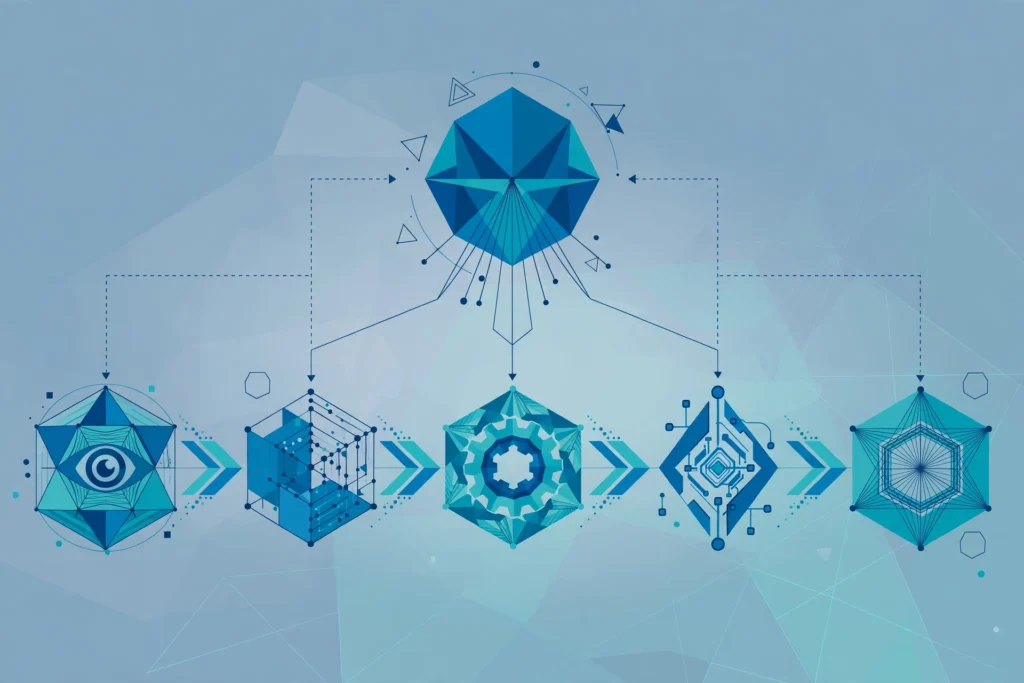
An enterprise-ready AI agent is far more than a single model responding to a prompt. It is a multi-agent architecture — a system where specialized components work together in a structured workflow. Here’s how the key layers stack up:
1. User Interaction Layer
This layer handles how users interact with the system — whether through chat, voice, or API calls. It is the gateway that translates human intent into machine-actionable requests.
2. Orchestration Layer
At the heart of an agentic system lies the orchestrator — the decision engine that:
- Detects intent,
- Breaks goals into tasks,
- Chooses which specialized agent to invoke.
This layer is the brain of the system that ensures tasks flow smoothly across components.
3. Knowledge Layer
Here, data is organized and retrieved: vector databases, semantic search tools, and RAG (Retrieval-Augmented Generation) techniques connect raw enterprise knowledge to the system’s reasoning processes.
4. Storage Layer
This is where conversation history, agent states, and operational logs live — typically in fast storage systems like Redis or cloud archives — enabling continuity and context across sessions.
5. Agent Layer
Specialization matters. A supervisor agent coordinates sub-agents, while local agents handle specific tasks such as analytics, data lookup, or tool invocation. This modularity supports scaling, auditability, and robustness.
6. Integration & Observability
No agent works in isolation. Integration with external tools — databases, analytics engines, internal APIs — ensures the system can interact with existing business services. Observability tools track performance, errors, cost, and success metrics, preventing trust degradation over time.
From Chatbot to Autonomous Systems
This architectural evolution marks a fundamental shift: AI is no longer about responses but about actions. Instead of a single model producing text, we now build composite systems capable of logic, planning, and autonomous decision-making.
In an enterprise support scenario, for example:
- A user requests insights into shipment delays.
- A classifier interprets the logistics query.
- A data agent fetches historical data and detects anomalies.
- A supervisor agent synthesizes results and delivers an executive summary.
Such workflows are modular, fault-tolerant, and designed for real-world operational use.
Why This Matters
As organizations scale AI adoption from experiments to production systems, simple chat-style models won’t suffice. Enterprises need systems that:
- Maintain state and continuity across interactions,
- Delegate tasks to specialized agents,
- Integrate seamlessly with existing infrastructure,
- Monitor behavior with robust observability and evaluation pipelines.
IIn essence, we’re moving from AI as a conversational tool to AI as an orchestrated decision-making layer deeply embedded within business processes.
The evolution from generative models to agentic architectures points to a future where AI doesn’t just assist but autonomously executes on complex goals. Building enterprise-grade AI agents requires deliberate system design, modular intelligence, and careful orchestration — the kind of multi-agent architecture that transforms AI from isolated responses into scalable enterprise workflows.
From Generative AI to Multi-Agent Systems
🔹 1️⃣ The Evolution of AI
Phase 1: Generative AI
- Text generation
- Q&A responses
- Prompt-based interaction
- Reactive systems
Limitation: No planning, memory depth, or task orchestration.
⬇️ Evolution
Phase 2: Agentic AI
- Goal-driven execution
- Task decomposition
- Tool usage
- Multi-step reasoning
- Autonomous workflows
🔄 How It Works (Workflow Snapshot)
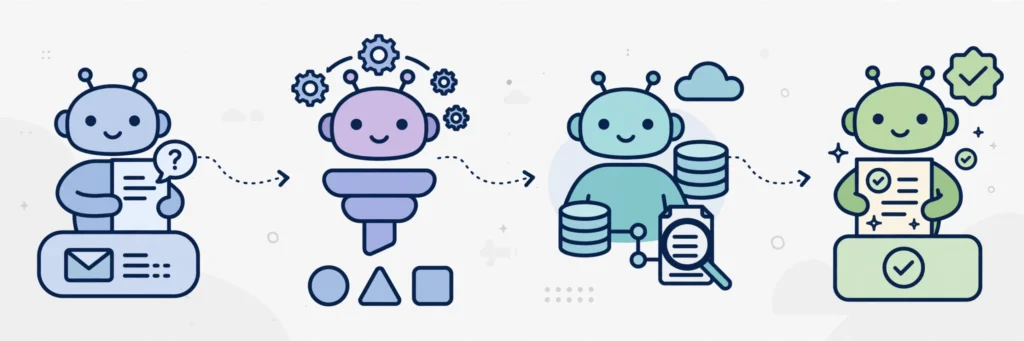
User Request
⬇
Intent Classification
⬇
Task Decomposition
⬇
Specialized Agents Execute
⬇
Supervisor Aggregates
⬇
Final Structured Output
📈 Why Enterprises Need This
✅ Multi-step automation
✅ Cross-system intelligence
✅ Real-time decision support
✅ Scalable AI infrastructure
✅ Production-grade reliability
🔮 The Big Shift
From: AI that responds
To: AI that plans, acts, and collaborates
Enterprise AI is no longer just about powerful models —
it’s about orchestrated intelligence systems.
Further reading: start with a practical guide to AI agents, see how Anthropic’s AI agents are changing work, and review how artificial intelligence works. For implementation patterns, see Anthropic’s guide to building effective agents and Google Cloud’s overview of what AI agents are.
The shift is clear: value now comes less from a single clever model and more from a well-orchestrated system. Organisations that get the layers right — interaction, orchestration, knowledge, storage, specialised agents, and observability — can deploy agents that are reliable, governable, and genuinely useful. Start small, measure outcomes, and expand the agents that prove themselves.