
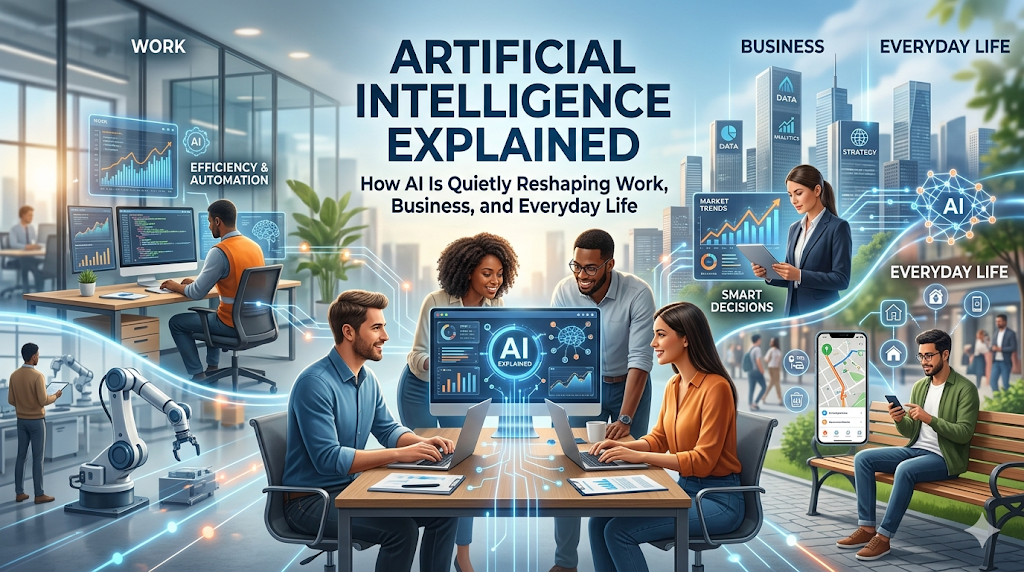
Introduction: The Assistant You Didn’t Know You Hired
A few years ago, “artificial intelligence” sounded like something reserved for science-fiction films and elite research labs. Today, it quietly drafts your emails, recommends what you watch on Friday night, flags suspicious charges on your bank statement, and helps your doctor read a scan more accurately.
Here’s a statistic that captures how fast this shift happened: by the end of 2025, around 56% of U.S. employees were already using generative AI tools for work, and roughly 76% of companies reported using AI in at least one business function. In other words, AI stopped being a future promise and became part of the present-day toolkit — often without much fanfare.
So what is artificial intelligence, really? How does it work beneath the buzzwords? And, more importantly, how can professionals and everyday users benefit from it without getting lost in the hype?
This guide breaks it all down in plain language. Whether you’re a business leader evaluating your next investment or simply someone curious about the technology shaping your daily life, you’ll walk away with a clear understanding — and a few practical steps you can act on today.
What Is Artificial Intelligence?
At its core, artificial intelligence (AI) is the ability of a computer system to perform tasks that normally require human intelligence — things like understanding language, recognizing images, making decisions, and learning from experience.
The key word is learning. Traditional software follows fixed rules written by a programmer: “If X happens, do Y.” Modern AI is different. Instead of being told exactly what to do, it studies large amounts of data, identifies patterns, and improves its performance over time.
A simple way to picture it:
- Traditional software is like a calculator — it does precisely what it’s told.
- Artificial intelligence is more like an apprentice — it learns from examples and gets better with practice.
A Quick History (Without the Jargon)
AI isn’t new. The idea dates back to the 1950s, but the technology stalled for decades because computers weren’t powerful enough and data was scarce. Three forces changed everything in recent years:
- Massive data — the internet, smartphones, and sensors generate enormous volumes of information to learn from.
- Cheaper computing power — specialized chips can now process that data at incredible speed.
- Better algorithms — breakthroughs in “deep learning” allowed machines to handle language and images with surprising fluency.
Together, these unlocked the wave of AI tools we use today.
How AI Actually Works: The Three Building Blocks
You don’t need a computer science degree to understand the essentials. Most modern AI rests on three connected concepts.
1. Machine Learning
Machine learning is the engine of modern AI. Rather than being explicitly programmed, a system is “trained” on data and learns to make predictions. Show it thousands of labeled photos of cats and dogs, and it eventually learns to tell them apart on its own — even with images it has never seen before.
2. Deep Learning and Neural Networks
Deep learning is a more advanced form of machine learning inspired loosely by the human brain. It uses layered structures called neural networks to recognize complex patterns. This is the technology behind voice assistants, facial recognition, and self-driving features in cars.
3. Generative AI
This is the category that brought AI into the mainstream conversation. Generative AI doesn’t just analyze information — it creates new content: text, images, code, audio, and video. When you ask a chatbot to write a summary or generate an illustration, you’re using generative AI. It learns the patterns of human language and produces responses that feel remarkably natural.
Why AI Matters Right Now: The Numbers Behind the Trend
For professionals, the business case is no longer theoretical. AI has crossed from experimental to essential, and the data shows it.
- The global AI market is growing at roughly 35% per year and is projected by industry analysts to reach well over a trillion dollars by the end of the decade.
- Studies report that organizations adopting AI are seeing productivity gains between 26% and 55% in specific functions.
- In financial services alone, global AI spending exceeded $20 billion in 2025, with fraud detection as the leading use case.
But there’s an important counterbalance, and honest professionals should keep it in view: a large share of AI projects still fail to reach full production, and concerns about accuracy (“hallucinations”) remain real. The lesson isn’t to avoid AI — it’s to adopt it thoughtfully, with human oversight built in.
Real-World Use Cases: AI in Action
The clearest way to understand AI is to see where it already delivers value.
In Business and the Workplace
- Customer service: AI chatbots handle routine questions instantly, freeing human agents for complex issues.
- Marketing: AI analyzes customer behavior to personalize recommendations and predict what buyers want next.
- Operations: Predictive maintenance uses AI to flag equipment failures before they happen, saving costly downtime.
- Knowledge work: Professionals use AI to draft documents, summarize meetings, analyze data, and brainstorm ideas.
In Everyday Life
- Healthcare: AI helps detect diseases in medical images, sometimes spotting patterns human eyes miss.
- Navigation: Map apps predict traffic and reroute you in real time.
- Entertainment: Streaming and music platforms curate recommendations tailored to your taste.
- Finance: Banks use AI to process millions of transactions per second and detect fraud as it happens.
A Personal Insight
When I first started using an AI writing assistant, I expected a gimmick. What I got instead was a thinking partner. It didn’t replace my judgment — it accelerated it. Drafts that took two hours now take thirty minutes, leaving more time for the part only I can do: deciding what’s actually worth saying. That, in my experience, is the real promise of AI today. It’s less about replacement and more about amplification.
Common Myths About AI (And the Truth)
Misconceptions slow people down. Let’s clear up a few.
- Myth: “AI is going to take everyone’s job.”
Reality: AI is more likely to change jobs than eliminate them outright. Roles that adapt — using AI as a tool — tend to become more valuable, not less. - Myth: “AI is always right.”
Reality: AI can produce confident-sounding errors. It’s a powerful assistant, not an infallible oracle. Always verify important outputs. - Myth: “You need to be technical to use AI.”
Reality: Most modern AI tools are designed for everyday users. If you can type a question, you can use them.
How to Start Using AI: A Practical Step-by-Step Guide
Ready to move from reading about AI to actually benefiting from it? Here’s a simple roadmap.
- Identify a repetitive task. Look for something you do often that’s time-consuming — writing emails, summarizing reports, planning schedules.
- Choose one tool and learn it well. Resist the urge to try everything. Pick a single, reputable AI assistant and get comfortable with it first.
- Write clear instructions. The quality of your output depends on the quality of your input. Be specific about what you want, the tone, and the format.
- Always review the output. Treat AI as a first draft, not a final answer. Your expertise turns a good draft into a great result.
- Protect sensitive information. Avoid sharing confidential data unless you’re using approved, secure tools that meet your organization’s policies.
- Iterate and refine. If the first result isn’t right, adjust your instructions. Working with AI is a conversation, not a one-shot command.
Key Takeaways
- Artificial intelligence is software that learns from data rather than following fixed rules — it improves with experience.
- The three building blocks to know are machine learning, deep learning, and generative AI.
- AI adoption has gone mainstream: a majority of companies and employees now use it in some form.
- The biggest wins today come from amplifying human work, not replacing it.
- Smart adoption means pairing AI’s speed with human oversight to manage errors and risk.
- You don’t need to be technical — start small, stay specific, and always review the output.
Frequently Asked Questions (FAQs)
1. Is artificial intelligence the same as machine learning?
Not quite. Machine learning is a subset of AI. AI is the broad goal of building intelligent systems, while machine learning is one of the main methods used to achieve it.
2. Will AI replace human jobs?
AI will automate certain tasks, but it’s also creating new roles and making existing ones more productive. The people most at risk are those who refuse to adapt; those who learn to work alongside AI tend to gain an advantage.
3. Is it safe to use AI tools?
Reputable AI tools are generally safe for everyday use, but you should avoid sharing sensitive or confidential information and always verify important outputs, since AI can occasionally make mistakes.
4. Do I need coding skills to use AI?
No. Most popular AI tools are built for general users and require nothing more than typing a clear request in plain language.
5. How is generative AI different from regular AI?
Traditional AI typically analyzes data and makes predictions or classifications. Generative AI goes a step further by creating new content, such as text, images, or code.
Conclusion: Don’t Just Watch the Revolution — Join It
Artificial intelligence is no longer a distant concept reserved for tech giants. It’s here, woven into the apps you use, the businesses you buy from, and increasingly, the work you do. The professionals and curious learners who thrive in the years ahead won’t be the ones who fear AI — they’ll be the ones who understand it and use it intentionally.
You don’t need to master everything overnight. You just need to start. Pick one task, try one tool, and see what becomes possible when you add a tireless assistant to your workflow.