A few years ago, a former schoolteacher I know decided she was done with the classroom. She had no computer science degree, no tech background, and a healthy fear of the word “coding.” Eighteen months later, she was working remotely as a UX researcher for a company three time zones away, earning more than she ever had, and logging on from a sunlit kitchen table instead of a fluorescent-lit staff room.
Her story is not a fluke. It’s a preview of where work is heading.
We’re living through the largest reshaping of the global labor market in generations, and digital careers are at the very center of it. Whether you’re a student mapping out your first move, a professional eyeing a pivot, or simply curious about what “working online” actually means, this guide will walk you through what digital careers are, which ones are thriving, and exactly how to build one of your own.
What Is a Digital Career, Really?
A digital career is any profession where your core work is created, delivered, or managed primarily through digital tools and the internet. That definition is deliberately broad, because the category has exploded far beyond “people who work in tech.”
A digital career might mean:
- Writing code for a software product
- Designing the interface of a mobile app
- Running paid advertising campaigns for global brands
- Analyzing data to guide a company’s decisions
- Producing videos, podcasts, or written content for an online audience
- Managing cybersecurity for a hospital network
What unites these roles isn’t the industry. It’s that the work is location-flexible, skills-driven, and built on digital infrastructure. You’re rarely tied to a single building, and your value comes from what you can do rather than where you sit.
Digital Career vs. Traditional Career
The line is blurring, but a few differences still stand out:
- Flexibility: Many digital roles can be done remotely or on a freelance basis.
- Pace of change: Skills evolve quickly, so continuous learning is part of the job.
- Entry paths: Degrees matter less; portfolios, certifications, and demonstrable skills matter more.
- Earning models: Beyond a salary, you can layer in freelancing, consulting, or building your own digital products.
Why Digital Careers Matter More Than Ever
This isn’t hype. The data tells a striking story.
According to the World Economic Forum’s Future of Jobs Report 2025, structural shifts in the labor market are expected to create 170 million new jobs and displace 92 million by 2030 — a net gain of 78 million jobs. The biggest single driver of that change? Broadening digital access. Employers cited it as the most transformative trend affecting their businesses.
A few more numbers worth sitting with:
- The fastest-growing roles in percentage terms are big data specialists, fintech engineers, and AI and machine learning specialists, per the WEF.
- Employers expect 39% of the core skills workers need to change by 2030.
- Demand for digital skills — AI, big data, cybersecurity, and technological literacy — is accelerating faster than the global supply of people who have them.
Meanwhile, the way we structure digital work is shifting too. The freelance and gig economy has grown into a force of its own. Estimates put the U.S. independent workforce at over 70 million people in 2025, roughly 36–38% of the total workforce, and surveys suggest a large majority of hiring managers plan to lean more heavily on freelance talent in the coming years.
The takeaway is simple: digital skills are no longer a “nice to have.” They’re becoming the baseline currency of the modern economy — and the gap between supply and demand is exactly where opportunity lives.
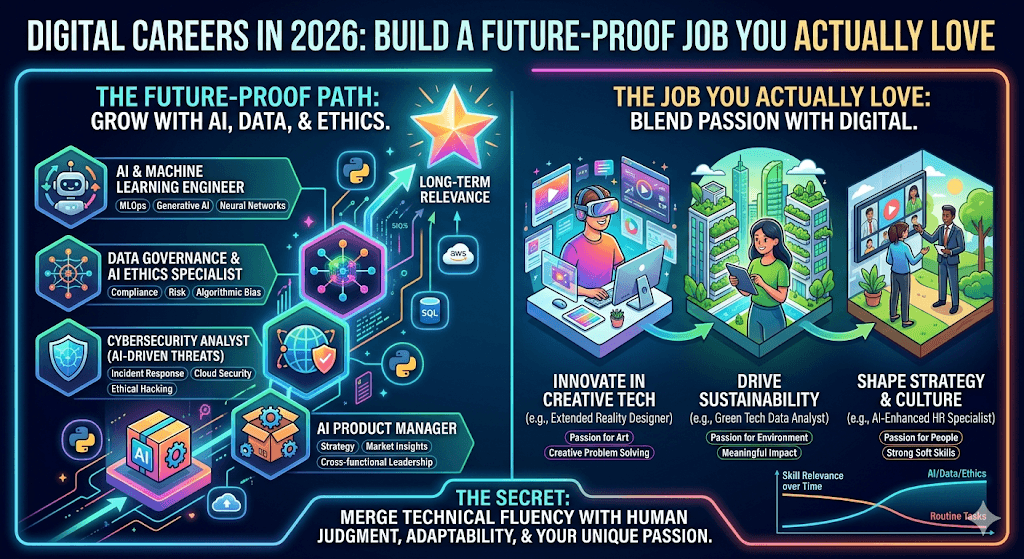
The Most In-Demand Digital Careers in 2026
Here’s a practical map of where the strongest demand sits right now. You don’t need to master all of these — pick the lane that fits your strengths and interests.
1. Software Development and Engineering
Still the backbone of the digital economy. Developers build the apps, platforms, and systems everything else runs on.
- Roles: Front-end developer, back-end developer, full-stack engineer, mobile developer
- Core skills: A programming language (JavaScript, Python), version control (Git), problem-solving
- Why it’s hot: Nearly every company is now a software company in some form.
2. Data and AI
As organizations drown in information, the people who can interpret it have become indispensable.
- Roles: Data analyst, data scientist, machine learning engineer, AI specialist
- Core skills: SQL, Python or R, statistics, data visualization, and increasingly, working alongside generative AI tools
- Why it’s hot: The WEF ranks AI and big data among the very fastest-growing skills across nearly every industry.
3. Digital Marketing
The art and science of reaching audiences online. Accessible to non-technical people, with a clear path to senior roles.
- Roles: SEO specialist, content strategist, social media manager, paid ads (PPC) manager, email marketer
- Core skills: Analytics, copywriting, audience research, campaign management
- Why it’s hot: Marketing budgets have decisively shifted online, and results are measurable.
4. UX/UI and Product Design
Making digital products that are usable, beautiful, and intuitive.
- Roles: UX designer, UI designer, product designer, UX researcher
- Core skills: Design tools (Figma), user research, prototyping, empathy for the end user
- Why it’s hot: Companies have learned that good design directly drives revenue and retention.
5. Cybersecurity
As more of life moves online, protecting it has become urgent.
- Roles: Security analyst, penetration tester, security engineer
- Core skills: Networking, threat analysis, risk management, relevant certifications
- Why it’s hot: Rising geopolitical tension and digital expansion have driven a surge in demand for network and cybersecurity skills.
6. Content Creation and Digital Media
The creator economy has matured into a legitimate career path.
- Roles: Video producer, podcaster, technical writer, online educator
- Core skills: Storytelling, editing, audience building, consistency
- Why it’s hot: Brands and individuals alike need content, and platforms have lowered the barrier to entry.
How to Start a Digital Career: A Step-by-Step Plan
Knowing the options is one thing. Building momentum is another. Here’s a realistic roadmap that works whether you’re starting fresh or pivoting from another field.
Step 1: Choose Your Lane (Don’t Try to Learn Everything)
The most common mistake is trying to study a little of everything. Pick one primary path based on your natural strengths:
- Love logic and building things? → Development or data
- Enjoy persuasion and creativity? → Marketing or content
- Drawn to people and problem-solving? → UX or product
You can always expand later. Depth beats breadth at the start.
Step 2: Build Foundational Skills
You don’t need a four-year degree. Reputable online platforms — think Coursera, Google Career Certificates, freeCodeCamp, or industry-specific bootcamps — can take you from zero to job-ready in months. Aim for one solid, well-respected credential rather than a pile of half-finished courses.
Step 3: Create a Portfolio (Proof Beats Promises)
This is the single highest-leverage move you can make. Employers and clients want to see what you can do, not just what you’ve studied.
- Build 2–3 real projects, even if they’re for fictional or volunteer clients
- Publish them somewhere public (GitHub, a personal site, Behance, a blog)
- Document your thinking, not just the final result
Step 4: Build a Digital Presence
Optimize your LinkedIn profile, share what you’re learning, and engage with people already working in your target field. Visibility compounds. Many first opportunities come from someone simply seeing your work online.
Step 5: Get Your First Experience — However You Can
The hardest gap to cross is from “learner” to “professional.” Bridge it with:
- Freelance gigs on platforms like Upwork or Fiverr
- Internships or apprenticeships
- Volunteering your skills for a nonprofit or small business
- Contributing to open-source projects
Step 6: Never Stop Learning
Digital fields evolve fast. The professionals who thrive treat learning as a permanent habit, not a one-time event. Set aside a few hours each week to stay current — especially with AI tools, which are now woven into nearly every digital role.
The Skills That Actually Future-Proof You
Tools change. Mindsets last. Beyond technical know-how, the WEF and major employers consistently highlight a set of human skills that remain in high demand precisely because they’re hard to automate:
- Analytical and critical thinking — making sense of complex, data-heavy situations
- Resilience, flexibility, and agility — adapting when the ground shifts
- Creative thinking — solving problems no template covers
- Collaboration and communication — working well across remote, global teams
- AI literacy — knowing how to work with intelligent tools, not against them
The sweet spot is combining a marketable technical skill with these durable human ones. That blend is what makes a career genuinely future-proof.
Key Takeaways
- A digital career is any role delivered primarily through digital tools — and the category now spans far more than just “tech jobs.”
- The labor market is projected to add a net 78 million jobs by 2030, with digital access as the leading driver of change.
- The hottest fields include software development, data and AI, digital marketing, UX/UI design, cybersecurity, and content creation.
- You don’t need a traditional degree. A focused skill, a real portfolio, and a visible online presence matter far more.
- Pair technical skills with human skills — critical thinking, adaptability, and AI literacy — to stay valuable for the long haul.
- Continuous learning isn’t optional; it’s the job.
Frequently Asked Questions
1. Do I need a degree to start a digital career?
In most cases, no. Many of the highest-demand digital roles prioritize demonstrable skills and portfolios over formal degrees. Certifications and real projects often carry more weight with employers and clients than a diploma.
2. Which digital career is best for beginners?
Digital marketing, content creation, and UX research tend to have lower technical barriers to entry, making them friendly starting points. If you enjoy logic and structure, data analysis is also surprisingly accessible with the right courses.
3. How long does it take to become job-ready?
With consistent effort, many people reach an entry-level standard in 6 to 12 months. The variable isn’t talent so much as steady practice and building a portfolio that proves your skills.
4. Will AI replace digital careers?
AI is reshaping digital work, not erasing it. It’s automating routine tasks while creating new roles and raising the value of people who can use AI tools skillfully. The safest position is to become someone who works with AI rather than competing against it.
5. Can I build a digital career while keeping my current job?
Absolutely — and many people do. Freelancing on the side, building a portfolio in your evenings, and taking on small projects lets you transition gradually and de-risk the leap before going all in.
Conclusion: Your Move
The teacher I mentioned at the start didn’t have a secret advantage. She had a willingness to learn one new skill, the patience to build proof of it, and the courage to put herself online. The economy did the rest.
That same door is open to you. Digital careers reward initiative more than pedigree, and the gap between the demand for digital skills and the supply of people who have them is, frankly, your opportunity.
You don’t have to overhaul your life this week. You just have to take the first step: pick one lane, start one course, build one project.
So here’s my challenge to you. Choose the digital field that lit you up most as you read this, and commit to spending the next seven days learning its fundamentals. Then come back and tell me which one you picked — I’d genuinely love to hear where you’re headed.