
Enterprise AI has a data problem, and Dell thinks it has the fix. At Supercomputing 2026 (SC26) in Chicago on November 16, Dell Technologies announced a major round of advancements to the Dell AI Factory with NVIDIA — the full-stack platform that now spans more than 420 offerings and serves over 6,500 customers. The pitch is simple: help companies prepare data at scale, manage the infrastructure with confidence, and deploy validated systems that work together from day one.
This is not a single product launch. It is a stack-wide update covering data orchestration, storage, infrastructure management and networking — the unglamorous plumbing that decides whether an AI pilot ever becomes a production system. Here is what changed, and when each piece actually arrives.
What Dell Announced at SC26
The SC26 announcement touches every layer of the AI Factory. On the data side, the Dell AI Data Platform gains new orchestration and storage-engine capabilities. On the hardware side, the Exascale storage portfolio gets liquid-cooled and higher-density options. And on the operations side, Dell is rolling out agentic management tools that can run infrastructure at a scale of up to 100,000 devices.
The timing is no accident. AI agents are moving from demos into production, and production agents are only as useful as the data they can reach. Dell’s bet is that the companies that win the next phase of enterprise AI will be the ones that can feed their agents trusted, governed data — on infrastructure they own and control — without rebuilding their stack for every new model. That is the thread running through the whole announcement.
The AI Data Platform Turns Enterprise Data Into Agent-Ready Context

The centrepiece is the Dell AI Data Platform, the data foundation of the AI Factory. Dell is expanding it from an unstructured-data pipeline engine into an open, agent-ready platform, and the headline addition is the Agentic Data Gateway: a single governed path that gives every agent access to enterprise data and context, with OpenAI-compatible and Model Context Protocol endpoints, so teams build once instead of rewiring every connection.
Hybrid data pipeline orchestration is the other half of the story. Pipelines now run where the data lives — across on-premises private clouds, Dell AI Factory infrastructure including NVIDIA and AMD environments, non-Dell infrastructure and public cloud endpoints — so organisations avoid moving massive unstructured datasets just to make them usable. A Data Intelligence layer adds lineage, quality monitoring and metadata search, so teams can see where data came from and whether it is fit to feed an agent.
Under the hood, the storage engines are built for AI throughput, with NVIDIA GPUDirect Storage, NFS over RDMA and pNFS delivering parallel multi-stream access at scale. One number stands out: KV cache offload through NVIDIA CMX, which moves key-value cache to shared Dell AI storage, delivers up to 19 times faster time-to-first-token than standard vLLM — and lets teams serve more concurrent sessions on the same GPU hardware. For anyone running inference at scale, that is the kind of gain that shows up directly in cost per request.
Exascale Storage Goes Liquid-Cooled and Denser
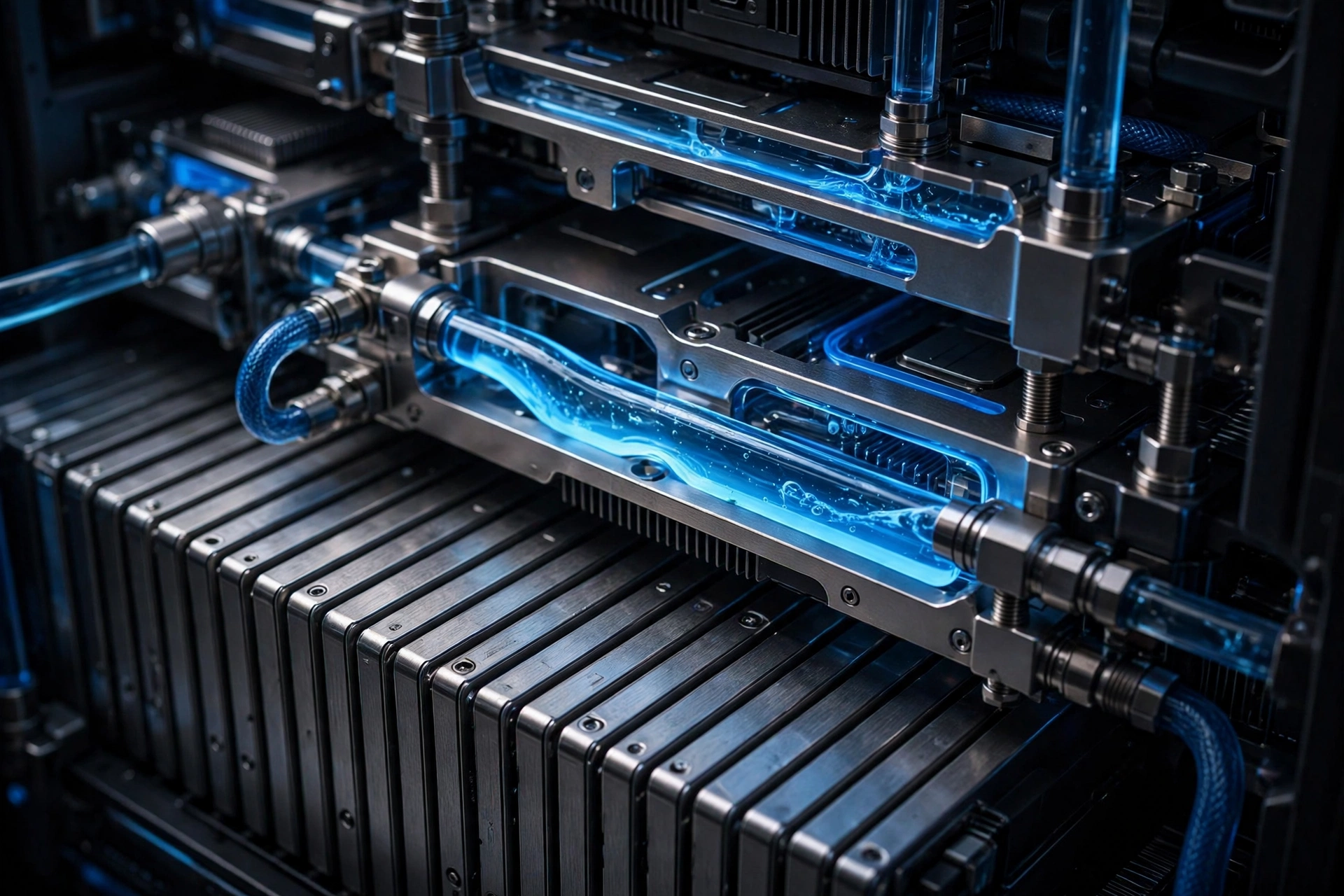
Storage is where the announcement gets most concrete. Dell is expanding the Exascale portfolio with what it calls the world’s first direct-liquid-cooled (DLC) storage for rack-scale AI. The 2OU, fully liquid-cooled platform will support up to 32 NVMe drives and is designed around open rack AI infrastructure standards, simplifying rack design, deployment and expansion as AI environments scale.
Alongside it comes a high-density 1U Exascale platform for rack-constrained environments, delivering 67% higher drive density per rack unit than the current option — a meaningful saving in floor space, power and cooling for dense AI clusters. Both are software-defined, supporting file, block, object and parallel file storage on one 4-in-1 platform.
There is also a validation win: software-defined PowerScale running on Dell Exascale has achieved NVIDIA-Certified Storage validation at the Foundation level, giving organisations a proven platform for AI-accelerated data access in large GPU environments. For cloud service providers weighing new storage foundations, that certification matters more than any spec sheet.
Managing 100,000 Devices With Agentic Infrastructure Tools
The operations side of the announcement may matter most to the people who actually run AI infrastructure. Dell OpenManage Rack Scale is the next evolution of Dell OpenManage: an agentic infrastructure management platform that deploys, manages, observes and automates physical infrastructure from individual servers to complete racks, at a scale of up to 100,000 devices — up to 12 times more than the previous generation.
Dell Fabric Manager adds centralised, intent-based automation, lifecycle management and observability across multi-vendor, multi-silicon network fabrics spanning data centre, AI, HPC and edge environments. And the Enterprise SONiC Distribution by Dell adds support for new platforms including the Z9964F-ON and the NVIDIA Spectrum SN4700 switches, with Dell SONiC support on Broadcom and NVIDIA Spectrum-X, plus Cumulus on Spectrum-X.
The pattern is familiar from the rest of the industry: as AI clusters grow from hundreds of GPUs to tens of thousands, manual operations stop working, and the vendors that automate the boring parts win the deployment. Microsoft Ignite 2026 pushed the same idea from the software side with agentic Azure operations — Dell is now pushing it from the hardware side.
Validated Systems You Can Deploy on Day One
Dell also refreshed the validated-system side of the AI Factory. The PowerEdge XE9785 configuration with NVIDIA HGX B300 GPUs — an AMD-based, air-cooled system with eight HGX B300 GPUs — was available on announcement day, with Dell-supported NVIDIA AI Enterprise, and Dell added support for Microsoft Azure Local on HGX B300 systems.
This is the part of the AI Factory that tends to get overlooked in favour of the flashier storage and data news, but it is arguably the most practical: validated configurations mean a team can buy a system that Dell and NVIDIA have already tested together, instead of assembling and debugging one themselves. The same logic applies at the other end of the scale — Nvidia’s RTX Spark AI PCs bring local AI to the desktop, and the AI Factory brings the same validated approach to the data centre.
When Each Piece Actually Arrives
Not everything announced at SC26 is available today, and Dell was unusually clear about the timetable. The AI Data Platform advancements start rolling out from December 2026. The PowerStore validated modular configuration lands in Q4 calendar 2026. The Enterprise SONiC Distribution update arrives in January 2027. And the two new Exascale hardware options — the liquid-cooled 2OU platform and the high-density 1U platform — are planned for the first half of 2027.
That staggered schedule is worth keeping in mind. The data orchestration and management tools are near-term; the hardware is a 2027 story. Companies planning a 2026 deployment can use the gateway, pipelines and management tools now, and plan the storage refresh around the first-half-2027 hardware.
It is also worth noting how this fits the wider hardware race. Microsoft’s Maia 300 AI chip is chasing efficiency at the silicon level, and OpenAI’s GPT-6.2 models are pushing down the cost of frontier inference — Dell’s move is to make the infrastructure underneath all of it cheaper to run, easier to manage and ready for agents. The same week also saw Gemini’s Computer Use on Mac put an AI agent on the desktop; Dell is betting the enterprise version of that shift runs on its factory floor.
The Bottom Line
Dell’s SC26 update is not a moonshot — it is a maturity play. Agent-ready data through the Agentic Data Gateway, liquid-cooled and denser Exascale storage, and agentic management at 100,000-device scale all point in the same direction: enterprise AI is moving from “can we build a demo?” to “can we run this reliably, at scale, on infrastructure we control?”
If your organisation is already running AI agents in production, the December data-platform rollout is the piece to watch first. If you are planning a 2027 infrastructure refresh, the liquid-cooled Exascale options are the ones to put on the shortlist. And if you are still deciding whether to build on your own hardware or rent it all in the cloud, Dell’s argument — 420-plus offerings, 6,500 customers, and a full stack that works together from day one — is now a little harder to ignore.

