Most small business owners do their own marketing between everything else: answering customers, ordering stock, keeping the books. On November 12, 2026, Constant Contact announced Catalyst, an AI marketing agent built for exactly that reality. It plans campaigns, creates the content, and runs them across email, social media and text messaging — while the owner keeps final say over what goes out.
The pitch is deliberately different from the enterprise agent tools dominating AI news this week. Catalyst is not aimed at teams with marketing departments and data pipelines. It is aimed at the shop owner, the nonprofit director and the franchise operator who has no dedicated marketer at all.
What Catalyst Actually Does
Catalyst starts by scanning a business’s digital footprint — its website, social profiles and existing content — to learn its products, its customers and its tone of voice. From that understanding it builds an itemized marketing plan that the owner can review and discuss in a chat interface, refining the strategy from a single prompt.
Once the plan is approved, Catalyst creates the campaigns and distributes them across channels: emails, social posts, text messages and ads. It then tracks revenue, engagement and return across those channels, and uses the results to shape the following week’s plan. The loop is the product: plan, execute, measure, improve, repeat — every week, without the owner having to run it.
In Constant Contact’s demonstration, a small mug shop used Catalyst to run a multi-week product launch, moving from a teaser campaign to the launch itself and then a flash sale, with each week’s work building on the last.
How Catalyst Works Week to Week
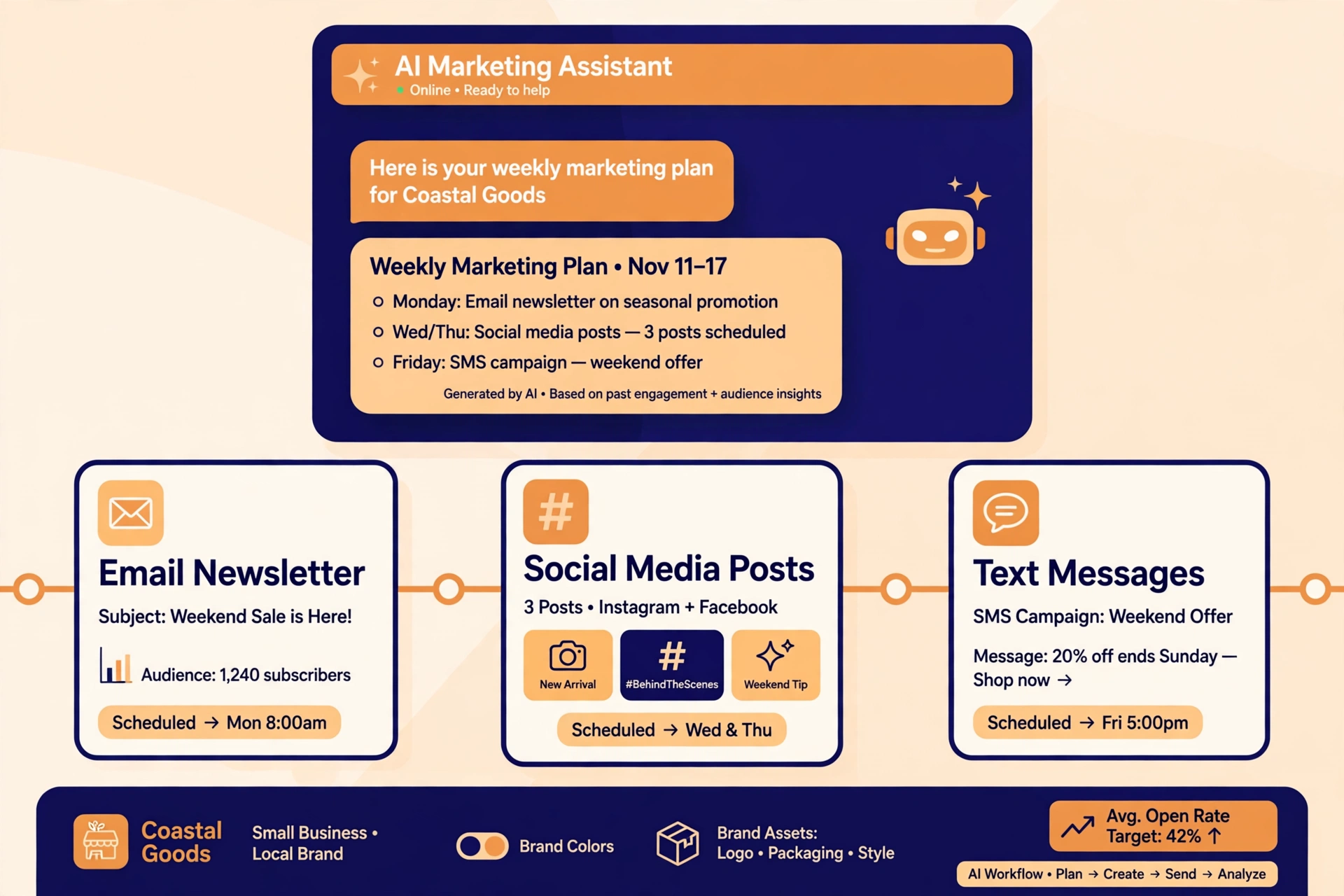
The weekly rhythm is what separates Catalyst from a one-off content generator. Each week it produces a customized marketing plan for the business, which the owner reviews and approves before anything is executed. That approval step is built into the workflow rather than bolted on: nothing is published on the business’s behalf without the owner seeing it first.
Behind the scenes, Catalyst draws on Constant Contact’s decades of small-business marketing data. The company positions the product as working “like a hire, not a tool” — an expert that owners hired rather than another dashboard they need to learn. Chief executive Frank Vella said the product grew out of customer requests for software that was easier to use, saved time, made better use of budgets and connected with audiences; few customers, he noted, asked for AI directly.
The company also cites its own track record as the foundation: a 98% inbox rate based on 2025 Validity Everest testing, up to 30x ROI seen by Constant Contact users, and more than $1 million in revenue recovered from abandoned-cart automations. Those figures describe the platform’s existing performance, not Catalyst itself, which is only now entering early access — but they explain why the company believes an agent built on that base can be trusted with a small business’s customer relationships.
You Stay in Control

The control question is the one that matters most for small businesses, and Constant Contact has made it central to the launch. Catalyst runs autonomously, but the owner tweaks or approves the work before it goes out. The brand voice it learned from the business’s own footprint is the guardrail: campaigns are supposed to sound like the business, not like generic AI output.
That human-in-the-loop design mirrors a broader pattern across this week’s agent launches. Anthropic’s Claude for Manufacturing drafts quotes and investigates quality failures for human review rather than operating equipment, and self-hosted Claude Managed Agents keep enterprise data and credentials inside the customer’s own cloud. The industry has learned that agents earn trust by keeping a person in the approval seat — and for a small business whose reputation is personal, that seat matters even more.
For owners, the practical test will be simple: does the weekly plan sound like them, and does the time saved outweigh the time spent reviewing? Early access is free, with a waitlist open now, so the cost of finding out is low.
Why This Launch Matters
Catalyst arrives in a week crowded with agent announcements aimed at large enterprises — from coding agents like Gemini 4 Hydrogen to always-on data coworkers such as Databricks Genie. Much of the coverage has focused on how AI agents are replacing entire teams at large companies. What makes this one notable is the audience. Small businesses employ roughly half the private-sector workforce in the US, yet most AI agent products are priced and designed for companies with engineering teams.
Constant Contact is betting that the same agent wave reaching the enterprise will land hardest where there is no marketing team at all. If an agent can genuinely plan, create and run a week’s marketing for a shop owner who currently does it at midnight, that is a bigger change to that business than another enterprise dashboard. It also raises the stakes on quality: a bad campaign from a big brand is embarrassing, but a bad campaign from a neighborhood shop can cost it regulars.
There are reasons for caution. Catalyst is at the early-access waitlist stage, so there is no independent evidence yet of how well it performs for real businesses. Constant Contact reports that customers using its earlier AI features sent 40% more email, posted 40% more on social media and grew their lists seven times faster — but those figures describe earlier tools focused on reducing writer’s block and automating publishing, not Catalyst itself. Owners should treat the waitlist as a trial, watch the first few weeks of output closely, and judge the agent on their own results.
The Bottom Line
Constant Contact Catalyst brings the AI agent wave to the smallest businesses: an agent that learns a business’s voice, builds a weekly marketing plan, creates the campaigns and runs them across email, social and SMS, with the owner approving every send. It is free to try through early access, and its real test starts now — in the inboxes and feeds of the small businesses that sign up.
Frequently Asked Questions
What is Constant Contact Catalyst?
Catalyst is an AI marketing agent from Constant Contact that plans, creates and runs marketing campaigns for small businesses across email, social media, SMS and ads, learning the business’s brand voice from its digital footprint.
How much does Catalyst cost?
Catalyst is available through a free early-access waitlist. Owners can join at constantcontact.com/catalyst.
Does Catalyst publish marketing without the owner’s approval?
No. The owner reviews and approves the weekly plan and the work before anything goes out. Catalyst runs autonomously, but approval is built into the workflow.
Which businesses is Catalyst for?
Small businesses, nonprofits and franchises — including organizations without a dedicated marketing department.
What channels does Catalyst cover?
Email, social media posts, text messages and ads, with results tracked across channels and used to improve the following week’s plan.
Is Catalyst available now?
It launched on November 12, 2026, during Constant Contact’s GURU Conference, with a free early-access program. General availability timing has not been announced.
Sources: Constant Contact — “Catalyst: Your AI Marketing Agent” (constantcontact.com/catalyst); Unite.AI — “Constant Contact Unveils Catalyst AI Agent for Small Businesses” (November 12, 2026); Constant Contact press release via PR Newswire — “Constant Contact Introduces Catalyst, a Leading-Edge AI Marketing Solution That Does the Work While You Stay in Control” (November 12, 2026).