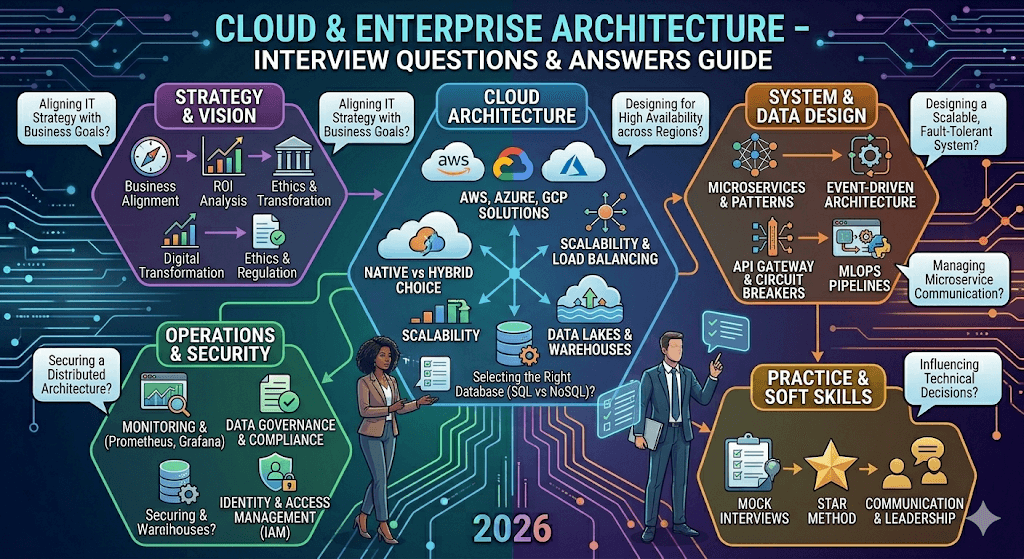
For an AI Architect, Technical Architect, Cloud Architect, Solution Architect, or Enterprise Architect role, interviewers typically focus on architecture principles, cloud platforms, scalability, security, governance, and modernization strategies.
1. What is Enterprise Architecture (EA)?
Answer:
Enterprise Architecture is a strategic framework that aligns business goals, processes, information systems, and technology infrastructure.
It helps organizations:
- Align IT with business objectives
- Reduce complexity
- Improve governance
- Enable digital transformation
- Standardize technology decisions
Popular EA Frameworks:
- TOGAF
- Zachman Framework
- FEAF
2. What are the layers of Enterprise Architecture?
Answer:
Business Architecture
Defines:
- Business capabilities
- Business processes
- Organization structure
- Strategic objectives
Data Architecture
Defines:
- Data models
- Data governance
- Data flow
- Data quality
Application Architecture
Defines:
- Applications
- Integrations
- APIs
- Services
Technology Architecture
Defines:
- Cloud
- Networks
- Servers
- Databases
- Security
3. What is Solution Architecture?
Answer:
Solution Architecture focuses on designing a specific solution for a business problem.
Responsibilities:
- Gather requirements
- Create technical design
- Define integrations
- Select technologies
- Ensure scalability
4. Enterprise Architect vs Solution Architect
| Enterprise Architect | Solution Architect |
|---|---|
| Strategic | Tactical |
| Organization-wide | Project-specific |
| Long-term vision | Immediate solution |
| Business alignment | Technical implementation |
| Governance focus | Delivery focus |
5. What is Cloud Architecture?
Answer:
Cloud Architecture defines how cloud services, networking, storage, security, and applications work together.
Core Components:
- Compute
- Storage
- Networking
- Security
- Monitoring
- Automation
6. What are the Cloud Service Models?
IaaS
Infrastructure as a Service
Examples:
- Amazon Web Services EC2
- Microsoft Azure VM
PaaS
Platform as a Service
Examples:
- AWS Elastic Beanstalk
- Azure App Service
SaaS
Software as a Service
Examples:
- Salesforce
- Microsoft 365
7. Public vs Private vs Hybrid Cloud
Public Cloud
Shared infrastructure.
Examples:
- Amazon Web Services
- Google Cloud
- Microsoft Azure
Private Cloud
Dedicated environment.
Examples:
- VMware
- OpenStack
Hybrid Cloud
Combination of public and private cloud.
8. What is Multi-Cloud?
Answer:
Using multiple cloud providers simultaneously.
Benefits:
- Avoid vendor lock-in
- Disaster recovery
- Best-of-breed services
- Compliance
Example:
- AWS for analytics
- Azure for Active Directory
- Google Cloud for AI workloads
9. What are the AWS Well-Architected Pillars?
Answer:
- Operational Excellence
- Security
- Reliability
- Performance Efficiency
- Cost Optimization
- Sustainability
10. What is the AWS Shared Responsibility Model?
AWS Responsible For:
- Hardware
- Networking
- Data centers
- Physical security
Customer Responsible For:
- Data
- IAM
- Applications
- OS configuration
- Encryption
11. What is High Availability?
Answer:
High Availability ensures systems remain operational even if a component fails.
Techniques:
- Load balancing
- Auto scaling
- Multi-AZ deployment
- Database replication
Target:
99.9%, 99.99%, or 99.999% uptime
12. What is Disaster Recovery?
Answer:
Disaster Recovery (DR) is the ability to restore services after catastrophic failures.
Key Metrics:
RTO
Recovery Time Objective
Maximum acceptable downtime.
RPO
Recovery Point Objective
Maximum acceptable data loss.
13. What are Common DR Strategies?
Backup & Restore
Lowest cost
Pilot Light
Minimal resources running
Warm Standby
Partially active environment
Active-Active
Fully redundant environments
14. What is Scalability?
Vertical Scaling
Increase CPU/RAM.
Example:
Server from 8GB → 64GB RAM.
Horizontal Scaling
Add more servers.
Example:
10 servers → 100 servers.
Preferred in cloud environments.
15. What is a Microservices Architecture?
Answer:
Application is split into small independently deployable services.
Benefits:
- Independent deployment
- Faster releases
- Better scalability
- Technology flexibility
Challenges:
- Complexity
- Monitoring
- Distributed transactions
16. Monolithic vs Microservices
| Monolith | Microservices |
|---|---|
| Single deployment | Multiple deployments |
| Easier initially | More scalable |
| Tightly coupled | Loosely coupled |
| Slower releases | Faster releases |
17. What is Event-Driven Architecture?
Answer:
Components communicate through events rather than direct calls.
Examples:
- Order placed
- Payment completed
- Shipment dispatched
Technologies:
- Apache Kafka
- RabbitMQ
- AWS EventBridge
18. What is API Gateway?
Answer:
Single entry point for APIs.
Functions:
- Authentication
- Rate limiting
- Routing
- Logging
- Monitoring
Examples:
- AWS API Gateway
- Kong
- Apigee
19. What is Infrastructure as Code (IaC)?
Answer:
Managing infrastructure using code.
Benefits:
- Automation
- Repeatability
- Version control
- Faster deployments
Tools:
- Terraform
- AWS CloudFormation
- Ansible
20. What is Zero Trust Security?
Answer:
Security model based on:
“Never trust, always verify.”
Principles:
- Least privilege access
- Continuous validation
- MFA
- Network segmentation
21. What is Cloud Governance?
Answer:
Policies and controls ensuring cloud resources are managed properly.
Includes:
- Cost management
- Security controls
- Compliance
- Resource tagging
- Monitoring
22. What is a Landing Zone?
Answer:
A preconfigured cloud environment that includes:
- Security baseline
- Networking
- IAM
- Monitoring
- Governance controls
Used as the foundation for cloud adoption.
23. What is FinOps?
Answer:
Financial Operations (FinOps) helps organizations optimize cloud spending.
Focus Areas:
- Cost visibility
- Cost optimization
- Resource rightsizing
- Budget governance
24. What is Data Mesh?
Answer:
A decentralized data architecture where domain teams own their data products.
Principles:
- Domain ownership
- Data as a product
- Self-service platform
- Federated governance
25. What is a Modern Enterprise Architecture for AI?
Typical architecture:
Users
   ↓
Applications
   ↓
API Gateway
   ↓
Microservices
   ↓
Event Streaming (Kafka)
   ↓
Data Lake
   ↓
AI/ML Platform
   ↓
LLMs & GenAI
   ↓
Monitoring & Governance
Advanced Architect Interview Questions
Q1: How would you migrate a monolithic application to cloud-native architecture?
Answer:
- Assess application dependencies
- Containerize workloads
- Break into microservices
- Implement CI/CD
- Deploy on Kubernetes
- Introduce observability
- Optimize performance and cost
Q2: How would you design a highly available global application?
Answer:
- Multi-region deployment
- Global load balancer
- CDN
- Database replication
- Auto scaling
- Disaster recovery strategy
- Continuous monitoring
Q3: How would you architect an Enterprise GenAI platform?
Answer:
Components:
- LLM Layer
- Vector Database
- RAG Framework
- API Gateway
- AI Agents
- Prompt Management
- Security Controls
- Monitoring
- Governance
Top Architecture Frameworks to Know
- TOGAF
- Zachman Framework
- SABSA
- ITIL
- COBIT
Must-Know Skills for 2026 Architect Interviews
- Enterprise Architecture
- Cloud Architecture (AWS/Azure/GCP)
- Solution Architecture
- Microservices
- Kubernetes
- DevOps
- Data Engineering
- AI/GenAI Architecture
- Security Architecture
- FinOps
- Governance & Compliance
- Data Lake & Data Mesh
- RAG Architecture
- AI Agents
- Multi-Cloud Strategy
- Event-Driven Architecture
These topics cover the majority of Cloud Architect, Enterprise Architect, Solution Architect, Technical Architect, and AI Architect interview discussions.
Cloud & Enterprise Architecture is a critical discipline that aligns technology strategy with business objectives, enabling scalable, secure, and efficient IT operations.
1. What is Enterprise Architecture (EA)?
Enterprise Architecture provides a holistic blueprint for an organization’s structure, processes, information systems, and technology. It ensures that IT investments support business goals.
Key Frameworks:
- TOGAF (The Open Group Architecture Framework): Most widely used. Includes ADM (Architecture Development Method) with phases like Preliminary, Architecture Vision, Business Architecture, etc.
- Zachman Framework: Focuses on 6 perspectives (What, How, Where, Who, When, Why) across different levels.
- FEAF (Federal Enterprise Architecture Framework) – common in government.
- ArchiMate: Modeling language for EA visualization.
Core Domains of EA:
- Business Architecture: Strategy, processes, capabilities, organizational structure.
- Data Architecture: Data models, governance, master data management.
- Application Architecture: Portfolio of applications, integration patterns (microservices, SOA).
- Technology Architecture: Infrastructure, platforms, standards.
2. Cloud Architecture
Cloud architecture designs systems that leverage cloud computing (IaaS, PaaS, SaaS) for elasticity, resilience, and cost optimization.
Cloud Service Models:
- IaaS (e.g., AWS EC2, Azure VMs)
- PaaS (e.g., AWS Elastic Beanstalk, Azure App Service)
- SaaS (e.g., Salesforce, Microsoft 365)
Deployment Models:
- Public Cloud
- Private Cloud
- Hybrid Cloud
- Multi-Cloud
Key Design Principles (Well-Architected Frameworks):
- AWS Well-Architected Framework: Operational Excellence, Security, Reliability, Performance Efficiency, Cost Optimization, Sustainability.
- Similar pillars exist in Azure, Google Cloud, etc.
Modern Cloud Patterns:
- Microservices & Serverless (Lambda, Azure Functions)
- Containers & Kubernetes (EKS, AKS, GKE)
- Event-driven architecture
- Infrastructure as Code (Terraform, CloudFormation, Bicep)
- Zero Trust Security
- Observability (Prometheus, ELK, OpenTelemetry)
- Data Mesh / Lakehouse architectures
3. Integrating Cloud into Enterprise Architecture
This is where the real value lies — Cloud-enabled Enterprise Architecture.
Key Considerations:
- Business Capability Mapping: Identify which capabilities benefit most from cloud (e.g., customer-facing vs. core systems).
- Cloud Adoption Framework (CAF): AWS, Azure, and Google have their own versions.
- Migration Strategies (the “6 Rs”):
- Rehost (lift & shift)
- Replatform
- Refactor/Re-architect
- Repurchase
- Retire
- Retain
- Hybrid Integration: Using tools like Azure Arc, AWS Outposts, Anthos for consistent management.
- Governance & Compliance: Cloud Center of Excellence (CCoE), FinOps, policy-as-code (OPA/Gatekeeper), landing zones.
- Security Architecture: Shared Responsibility Model, encryption, IAM, network security (VPCs, PrivateLink), compliance (SOC2, ISO27001, GDPR, HIPAA).
4. Current Trends (2025-2026)
- AI/ML Integration: Cloud-native AI platforms (SageMaker, Vertex AI, Azure AI)
- Edge Computing & IoT
- Sustainable/Green Architecture
- Platform Engineering & Internal Developer Platforms (IDPs)
- Composable Enterprise (using MACH architecture: Microservices, API-first, Cloud-native, Headless)
- Quantum-ready architectures (exploratory)
- RAG & Agentic AI systems in enterprise
Tools & Technologies
- Modeling: Archi, Enterprise Architect (Sparx), Lucidchart
- IaC: Terraform, Pulumi, Crossplane
- Orchestration: Kubernetes, OpenShift
- Observability: Datadog, New Relic, Grafana
- API Management: Apigee, Azure API Management, Kong
Would you like me to go deeper into any specific area?
- Designing a reference architecture for your industry?
- Migration roadmap?
- Cost optimization strategies?
- Comparison of AWS vs Azure vs GCP?
- TOGAF implementation steps?
- Security & compliance patterns?
This is a broad but critical topic at the intersection of IT strategy, business transformation, and technical design. Here is a concise, structured overview of Cloud & Enterprise Architecture.
1. Core Definitions
- Enterprise Architecture (EA) : A strategic planning framework that aligns business goals, processes, information, and technology. It answers “How does the entire organization operate and change?”
- Cloud Architecture: The design of systems, applications, and infrastructure that run on cloud platforms (IaaS, PaaS, SaaS). It answers “How do we build scalable, resilient systems in the cloud?”
When combined, Cloud & Enterprise Architecture means designing an organization’s overall IT landscape to leverage cloud models for agility, cost, and innovation, while maintaining governance, security, and integration.
2. Key Frameworks & Standards
| Framework | Purpose |
|---|---|
| TOGAF (The Open Group) | Most widely used EA framework; includes Architecture Development Method (ADM). |
| Zachman | Taxonomy for classifying architectural artifacts; focuses on “what, how, where, who, when, why.” |
| ArchiMate | Modeling notation for EA (often used with TOGAF). |
| AWS Well-Architected / Azure Well-Architected | Cloud-specific pillars: operational excellence, security, reliability, performance efficiency, cost optimization, sustainability. |
| Cloud Adoption Framework (CAF) | Guidance from cloud providers on people, process, and technology for cloud transformation. |
3. The Four Domains of EA (adapted for cloud)
- Business Architecture
- Value streams, capabilities, org structure.
- Cloud impact: new business models (e.g., usage-based pricing, global reach).
- Data Architecture
- Data governance, master data, integration (e.g., data mesh, data fabric).
- Cloud enablers: data lakes (S3, ADLS), databases (Aurora, Cosmos DB), ETL tools.
- Application Architecture
- Microservices, APIs, event-driven designs, legacy modernization.
- Cloud patterns: containers (K8s), serverless (Lambda, Functions), app services.
- Technology (Infrastructure) Architecture
- Compute, storage, network, edge, security.
- Cloud brings virtualization, elasticity, IaC, multi/hybrid cloud.
4. Key Cloud Architecture Patterns in an Enterprise Context
- Lift & Shift (Rehost) : Fast migration but minimal cloud benefit.
- Re-platform (e.g., managed DB instead of self-managed).
- Refactor / Re-architect (to microservices, serverless).
- Hybrid Cloud (on-prem + cloud) – common for regulated industries.
- Multi-cloud (use two+ providers) – avoid lock-in, use best-of-breed.
- Distributed Cloud (cloud services at edge or on-prem).
- Strangler Fig Pattern – gradually replace legacy with cloud-native components.
5. Critical Considerations & Challenges
| Area | Key Questions |
|---|---|
| Security & Compliance | How do we unify IAM, network security, and compliance (PCI, HIPAA, GDPR) across cloud and on-prem? |
| Cost Management | How to avoid runaway spend? Use FinOps, tagging, budgets, rightsizing. |
| Integration | Legacy systems + SaaS + cloud apps – need API gateways, ESB, or event mesh. |
| Operational Governance | Policy as code (e.g., Azure Policy, AWS SCPs), tagging standards, guardrails. |
| Skill Gaps | Cloud-native requires new skills (infra as code, container orchestration, DevOps). |
| Vendor Lock-in | Use abstractions (K8s, Terraform) but accept some provider-specific value. |
| Organizational Change | Shift from project-based to product-based; from ops to DevOps/SRE. |
6. Cloud Adoption Lifecycle (from EA perspective)
- Strategy – Define business drivers, KPIs, target cloud operating model.
- Assessment – Portfolio rationalization (retire, retain, replatform, replace).
- Landing Zone – Design shared services (networking, identity, security) as foundation.
- Migration – Use proven methods (e.g., 6 R’s of migration).
- Operations & Optimization – FinOps, SecOps, Cloud Center of Excellence (CCoE).
- Innovation – Leverage AI/ML, IoT, data analytics in the cloud.
7. Example: Enterprise Architecture Artifacts for Cloud
- Cloud Capability Map – What business capabilities the cloud enables.
- Cloud Value Streams – e.g., “Provision new environment from <2 days to <5 minutes.”
- Architecture Principles – “Cloud by default,” “Data classification drives placement.”
- Reference Architectures – Approved patterns for microservices, data ingestion, etc.
- Landing Zone Blueprint – Network topology, IAM hierarchy, policy enforcement.
- Migration Heatmap – Application vs. cloud readiness.
8. Trends Influencing Cloud & EA
- Platform Engineering – Internal developer platforms (IDPs) on top of cloud.
- AI-Enabled Architecture – Generative AI for design recommendations, anomaly detection, auto-remediation.
- FinOps – Becoming a core EA discipline, not just finance.
- Sustainability – Green cloud architecture (carbon-aware scheduling, efficient code).
- Zero Trust – Never trust, always verify; cloud networking (e.g., micro-segmentation).
- Edge & 5G – Extending cloud architecture to distributed locations.
9. Getting Started / Recommended Actions
If you are an architect or leader:
- Align EA with Cloud Strategy – Don’t treat cloud as just infrastructure. Update your business architecture.
- Build a Cloud Center of Excellence (CCoE) – Cross-functional team (security, finance, ops, dev, EA).
- Create a Cloud Operating Model – Who can provision what? How are costs tracked? How is compliance enforced?
- Implement IaC and CI/CD – Treat infrastructure like software (Terraform, Bicex, CloudFormation, Pulumi).
- Start with a Well-Architected Review – Use provider frameworks to assess existing workloads.
- Develop a Migration Factory – For repeatable, low-risk moves to cloud.