
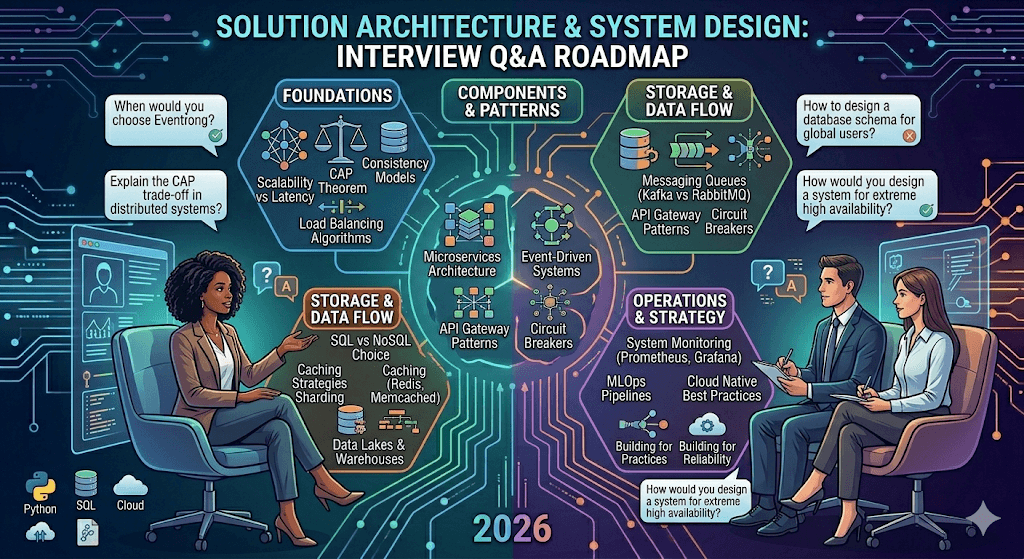
If you’re preparing for a Solution Architect or Technical Architect interview, you should be ready for both conceptual architecture questions and real-world system design scenarios.
1. What is Solution Architecture?
Answer:
Solution Architecture is the process of designing and describing how different technology components work together to meet business requirements.
A Solution Architect bridges the gap between:
- Business Requirements
- Technical Implementation
- Infrastructure
- Security
- Scalability
- Cost Optimization
Responsibilities
- Design end-to-end solutions
- Select technologies
- Define integrations
- Ensure scalability and security
- Align IT strategy with business goals
2. Difference Between Solution Architect and Technical Architect
| Solution Architect | Technical Architect |
|---|---|
| Focuses on business and technical alignment | Focuses on technical implementation |
| Designs complete solution | Designs technical components |
| Works with stakeholders | Works with development teams |
| High-level architecture | Low-level architecture |
3. What are the key pillars of a good architecture?
Answer
A good architecture should be:
- Scalable
- Secure
- Reliable
- Maintainable
- Cost Effective
- High Performance
- Flexible
- Observable
4. Explain Scalability
Answer
Scalability is the ability of a system to handle increasing workloads without performance degradation.
Types
Vertical Scaling
Increase server resources.
Example:
- 8GB RAM → 64GB RAM
Horizontal Scaling
Add more servers.
Example:
- 1 Server → 10 Servers
Interview Tip
Most cloud-native applications use horizontal scaling.
5. What is High Availability (HA)?
Answer
High Availability ensures applications remain operational even if a component fails.
Methods
- Load Balancer
- Multiple Application Servers
- Database Replication
- Multi-AZ Deployment
Example:
Users
   |
Load Balancer
   |
----------------
|              |
App1         App2
6. What is Fault Tolerance?
Answer
Fault tolerance means the system continues working even when one or more components fail.
Example:
- Multiple application servers
- Database replicas
- Multi-region deployments
7. Difference Between Scalability and Availability
| Scalability | Availability |
|---|---|
| Handles increased load | Handles failures |
| Focus on growth | Focus on uptime |
| More users | Less downtime |
8. What is Load Balancing?
Answer
Load balancing distributes incoming requests across multiple servers.
Benefits:
- High availability
- Better performance
- Fault tolerance
Algorithms
- Round Robin
- Least Connections
- Weighted Round Robin
- IP Hash
9. What is CAP Theorem?
Answer
CAP states a distributed system can provide only two of:
C – Consistency
All users see same data.
A – Availability
System always responds.
P – Partition Tolerance
System continues during network failures.
Examples
| Database | CAP |
|---|---|
| MongoDB | CP |
| Cassandra | AP |
| Traditional SQL | CA |
10. What is Event-Driven Architecture?
Answer
Applications communicate using events.
Example:
Order Created
     |
Event Bus
     |
------------------
|                |
Inventory      Billing
Benefits:
- Loose coupling
- Scalability
- Real-time processing
11. What are Microservices?
Answer
Microservices are independently deployable services that focus on specific business functions.
Example:
User Service
Order Service
Payment Service
Inventory Service
Benefits:
- Independent deployment
- Scalability
- Fault isolation
12. Monolith vs Microservices
| Monolith | Microservices |
|---|---|
| Single application | Multiple services |
| Easier initially | More complex |
| Difficult scaling | Easy scaling |
| Single deployment | Independent deployment |
13. What is API Gateway?
Answer
An API Gateway acts as a single entry point for APIs.
Responsibilities:
- Authentication
- Routing
- Rate Limiting
- Monitoring
Example:
Client
  |
API Gateway
  |
--------------------
|        |         |
User   Order   Payment
14. What is Circuit Breaker Pattern?
Answer
Prevents cascading failures.
States:
- Closed
- Open
- Half Open
Example:
If Payment Service fails repeatedly:
Order Service
      |
Circuit Breaker
      |
Payment Service
Requests stop temporarily.
15. What is CQRS?
Answer
Command Query Responsibility Segregation.
Separate:
- Read operations
- Write operations
Benefits:
- Better performance
- Independent scaling
16. What is Caching?
Answer
Caching stores frequently used data for faster access.
Tools:
- Redis
- Memcached
Benefits:
- Reduced latency
- Lower database load
17. What is CDN?
Answer
Content Delivery Network delivers content from the nearest location.
Examples:
- Cloudflare
- Akamai Technologies
- Amazon Web Services CloudFront
Benefits:
- Faster delivery
- Reduced latency
18. What is Message Queue?
Answer
Message queues enable asynchronous communication.
Examples:
- Apache Kafka
- RabbitMQ
- Amazon SQS
Example:
Producer
   |
 Queue
   |
Consumer
19. Explain Database Sharding
Answer
Splitting a database into smaller partitions.
Example:
Shard1: A-F
Shard2: G-M
Shard3: N-Z
Benefits:
- Scalability
- Performance
20. What is Database Replication?
Answer
Copying data from primary database to replicas.
Primary DB
     |
-------------
|           |
Replica1  Replica2
Benefits:
- High availability
- Read scaling
21. What is Observability?
Answer
Ability to understand system health through:
Metrics
CPU, Memory, Latency
Logs
Application events
Traces
Request journey across services
Tools:
- Prometheus
- Grafana
- OpenTelemetry
22. Design a URL Shortener
Requirements
- Generate short URLs
- Redirect quickly
- Analytics
Architecture:
Users
  |
Load Balancer
  |
Application Layer
  |
Redis Cache
  |
Database
Key Design:
- Base62 Encoding
- Cache Popular Links
- CDN for Analytics
23. Design Netflix-like Streaming Platform
Components:
Client
  |
API Gateway
  |
Microservices
  |
Metadata DB
  |
CDN
  |
Video Storage
Key Considerations:
- Global CDN
- Adaptive Bitrate Streaming
- Multi-region Deployment
24. Design Uber-like System
Services:
- Rider Service
- Driver Service
- Location Service
- Payment Service
- Notification Service
Technologies:
- GPS Tracking
- Event Streaming
- Real-time Matching
25. Design an AI-Powered Enterprise Platform
Architecture:
Users
  |
API Gateway
  |
AI Orchestration Layer
  |
LLM Services
  |
Vector Database
  |
Knowledge Base
  |
Data Lake
Components:
- RAG (Retrieval-Augmented Generation)
- Vector Search
- AI Agents
- Prompt Management
- Guardrails
- Monitoring
Tools:
- LangChain
- LlamaIndex
- Pinecone
- Weaviate
Top 10 Architecture Interview Questions Frequently Asked
- Design a scalable e-commerce platform.
- Design a URL shortener.
- Design a social media application.
- Design a chat application.
- Design a ride-sharing platform.
- Design a video streaming platform.
- Design a payment processing system.
- Design a notification service.
- Design an AI chatbot platform using RAG.
- Design a multi-tenant SaaS application.
Architect Interview Formula
For every system design question, structure your answer as:
Requirements → Capacity Estimation → High-Level Design → Database Design → API Design → Scalability → Security → Monitoring → Cost Optimization → Trade-offs
This framework works well for Solution Architect, Technical Architect, Cloud Architect, AI Architect, and Enterprise Architect interviews.
Solution Architecture and System Design are closely related but distinct disciplines in software engineering and IT. They focus on turning business or technical requirements into practical, scalable solutions.
Key Differences
| Aspect | Solution Architecture | System Design |
|---|---|---|
| Focus | High-level, business-aligned solution that fits into the broader enterprise. | Detailed “how” of building a specific system/component, often technical and implementation-focused. |
| Scope | End-to-end solution (people, processes, tech) meeting business needs. | Components, data flows, scalability, trade-offs for a product/feature. |
| Level | Strategic / Enterprise-oriented. | Tactical / Delivery-oriented. |
| Time Horizon | Longer-term structure and evolution. | Weeks to months for a working system. |
| Artifacts | Diagrams (context, container), roadmaps, cost estimates. | HLD (High-Level Design), LLD (Low-Level Design), APIs, DB schemas, etc. |
- Solution Architecture bridges business strategy and technical execution (e.g., selecting AWS services for a new CRM).
- System Design dives into building it (e.g., designing the recommendation engine inside that CRM).
All architecture is design, but not all design rises to the level of architecture (per Grady Booch).
Core Principles of Solution Architecture
- Business-Centric — Align everything to business goals and processes.
- Reuse & Prioritize Existing — Leverage current systems before building new.
- Scalability & Future-Proofing — Design for growth and change.
- Security & Compliance — Build in from day one.
- Modularity & Layering — Separate concerns (presentation, business logic, data).
- Cost Efficiency — Balance performance with operational expenses.
- Resilience — Handle failures gracefully.
- Communication — Clear diagrams and stakeholder alignment.
Frameworks like TOGAF, Azure Well-Architected, or SABSA (security-focused) provide structured guidance.
System Design Approach (RESHADED Framework or similar)
A common structured way to tackle system design problems (especially in interviews):
- Requirements — Functional + Non-functional (scale, latency, availability).
- Estimation — QPS, storage, bandwidth.
- Service Breakdown — High-level components (API Gateway, Load Balancers, Microservices).
- Data Model — SQL vs NoSQL, schemas.
- High-Level Design — Diagrams, data flow.
- Detailed Design — APIs, caching, queues, CDNs.
- Scalability & Trade-offs — CAP theorem, consistency vs availability.
- Evaluation — Bottlenecks, monitoring, edge cases.
Key Concepts to Master:
- Load balancing, Caching (Redis), CDNs, Message Queues (Kafka/RabbitMQ).
- Databases (sharding, replication, eventual consistency).
- Microservices vs Monolith.
- Rate limiting, Circuit breakers.
- Observability (logs, metrics, tracing).
Common System Design Examples
Popular interview questions include:
- Design Twitter / Instagram / TikTok (news feed, timelines).
- Design Uber / DoorDash (location tracking, matching).
- Design WhatsApp / Messenger (real-time chat).
- Design Dropbox / URL shortener.
- Design Netflix recommendation system.
Best Practices
- Start broad, then drill down — Clarify requirements first (always ask questions).
- Discuss trade-offs — “It depends” is valid — justify choices (e.g., SQL vs NoSQL).
- Diagrams — Use C4 model (Context, Containers, Components, Code) for clarity.
- Iterate — Designs evolve; show how you’d handle scale from 1K to 10M users.
- Collaboration — Architects rarely work in isolation.
If you’re preparing for interviews, focus on 8–10 common problems and practice verbalizing your thought process. For real projects, emphasize alignment with business value and total cost of ownership.
What specifically are you looking for?
- A deep dive into a particular system (e.g., design TikTok)?
- Interview preparation tips?
- Solution architecture for a specific domain (cloud migration, fintech, etc.)?
- Templates, diagrams, or resources?
let’s focus on Solution Architecture & System Design for AI workloads on AWS.
I’ll outline a structured approach, covering common AI/ML patterns, relevant AWS services, and design trade-offs.
1. Key AI/ML Architecture Patterns on AWS
| Pattern | Description | Typical AWS Services |
|---|---|---|
| Predictive inference | Real-time or batch predictions from a trained model | SageMaker Endpoints, Lambda + API Gateway, ECS/EKS |
| Training at scale | Distributed model training on large datasets | SageMaker Training, ParallelCluster, FSx for Lustre |
| Generative AI / LLMs | Prompt-based or fine-tuned foundation models | Bedrock, SageMaker JumpStart, EKS with vLLM/TGI |
| ML pipelines / MLOps | Automated data prep, training, evaluation, deployment | SageMaker Pipelines, Step Functions, CodePipeline |
| Real-time feature serving | Low-latency feature retrieval for online models | DynamoDB (as feature store), MemoryDB, SageMaker Feature Store |
| Data processing for ML | Transform, label, and validate training data | Glue, EMR, SageMaker Ground Truth, Lambda |
2. Example System: Real-time Document Q&A with LLM on AWS
Requirements:
- Upload PDF/Word documents → ask natural language questions → get accurate answers with citations.
- Low latency (<2 seconds per query).
- Documents are private (no external API calls to public models).
High-level architecture
text
User → API Gateway → Lambda (auth, routing) →
  [Option A: Bedrock (Claude / Titan)]
  OR
  [Option B: SageMaker endpoint for fine-tuned Llama 3]

Knowledge base:
  Document → S3 → (trigger) Lambda → Chunking → Embeddings (Titan Embeddings) → OpenSearch/Vector DB

Query path:
  User question → Embedding → Vector search (top-k chunks) → LLM prompt (context + question) → Answer
AWS Services Used
- API Gateway – HTTP/REST endpoint
- Lambda – orchestration, authentication, chunking
- Bedrock – Claude or Titan models (managed, no GPU ops) or SageMaker for fine-tuned models
- OpenSearch Serverless – vector database for RAG
- S3 – raw document storage
- Secrets Manager / IAM – security & permissions
Key Design Decisions
| Decision | Option | Why |
|---|---|---|
| Managed LLM vs self-hosted | Bedrock | Reduced ops, no GPU cluster management |
| Vector DB | OpenSearch | Native AWS, good performance, full-text + vector hybrid search |
| Chunking strategy | Overlapping 500-token chunks | Balances context length vs. granularity |
| Caching | Elasticache for Redis | Cache repeated question-answer pairs |
3. Best Practices for AI Architecture on AWS
Performance & Cost
- Use inference accelerators (Inferentia, GPU instances) only when needed – Bedrock or SageMaker Serverless for spiky traffic.
- Set up auto-scaling on SageMaker endpoints with
TargetTrackingScaling(invocations per minute). - For LLMs, use prompt caching and response streaming to improve perceived latency.
Security
- Keep models and data in your VPC.
- Use AWS PrivateLink for Bedrock/SageMaker API calls.
- Encrypt data at rest (S3, EBS) with KMS.
- For RAG, ensure source documents are never leaked outside the prompt context.
Resilience
- Deploy inference endpoints across two AZs.
- Use SageMaker Multi-Model Endpoints to reduce cold starts for rarely used models.
- For batch inference, use SageMaker Batch Transform with automatic retries.
Data & Governance
- SageMaker Feature Store – online (low-latency) + offline (batch) feature store.
- Lake Formation + Glue for data lineage and access control on training data.
- Model Registry – version models, track approval status, and automate deployment.
4. Example Architecture Diagram (text representation)
text
[Client] → (HTTPS) → [API Gateway] → [Lambda Authorizer] → [AWS WAF]
                           ↓
                    [Lambda Orchestrator]
                     /        |        \
                    ↓         ↓         ↓
            [Bedrock]   [OpenSearch]  [S3]
            (LLM call)   (vector DB)  (raw docs)
                     \        |        /
                      → [Lambda RAG] ←
                            ↓
                    [Response: Answer + Citations]
5. Common Pitfalls (and Solutions)
| Pitfall | Solution |
|---|---|
| LLM context window too small | Use RAG with chunking instead of stuffing entire doc |
| High vector search latency | Partition by tenant/customer; use approximate nearest neighbor (ANN) index |
| Model endpoint cold starts | Keep one warm instance, or use SageMaker Serverless |
| Overpaying for GPU instances | Use spot instances for training; batch inference during off-peak |
| Data poisoning during training | Validate data schema & ranges; use SageMaker Clarify for bias detection |
Next Steps – What Would You Like to Dive Into?
I can go deeper on any of these:
- Full MLOps pipeline (training → validation → deployment → monitoring)
- Cost optimization for LLM inference on AWS
- Fine-tuning vs. RAG trade-offs
- Vector database deep dive (pgvector, OpenSearch, Pinecone on AWS)
- Multi-tenant AI architecture (model isolation, data per tenant)
- Disaster recovery for AI systems (cross-region model replication)