
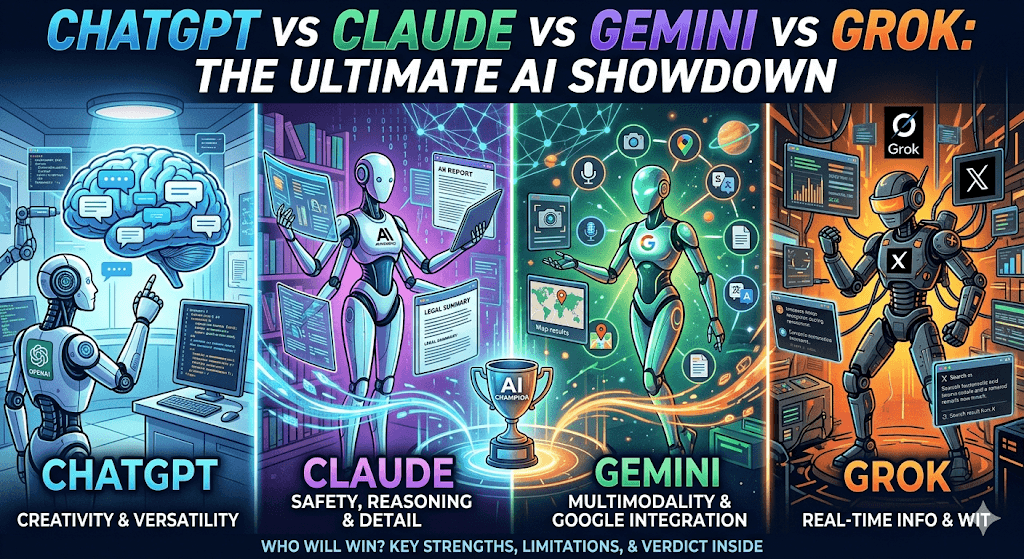
We spent weeks testing all four AI assistants on real tasks — coding, writing, research, creativity, and everything in between. Here’s what we actually found.
The AI landscape in 2026 doesn’t look anything like it did two years ago. The chatbot era is over. These are full-blown work platforms now — with agents, real-time data, video generation, and the ability to write entire codebases overnight. So which one deserves your time and money? Let’s break it down.
The State of AI in April 2026
If you haven’t checked in on AI since 2024, buckle up. The “which chatbot gives better answers” debate is almost quaint at this point. In 2026, the conversation has shifted to something far more interesting: which AI platform can actually do work for you?
OpenAI is running GPT-5.4 across multiple tiers — Instant for quick tasks, Thinking for complex reasoning, and Pro for the heavy lifting. Google’s Gemini has leapfrogged to version 3.1 Pro and woven itself into practically every Google product you already use. Anthropic just released Claude Opus 4.7 (with Opus 4.6 still widely deployed), bringing agent teams and a million-token context window to the table. And Elon Musk’s xAI — now under the SpaceX umbrella — is shipping Grok 4.20 with video generation while training the monster that will be Grok 5.
Each of these platforms has a distinct personality, philosophy, and set of tradeoffs. There’s no single “best” anymore. There’s only “best for you.” Let me show you what I mean.
ChatGPT — The Platform Powerhouse
ChatGPT in 2026 barely resembles the chatbot that went viral in late 2022. OpenAI has transformed it into a full workspace — with a File Library for managing your uploads, deep research that lets you steer multi-step investigations, shopping tools for product comparison, an agentic coding environment called Codex, and even Apple CarPlay integration.
The model lineup has been simplified. You pick between Instant (fast, everyday tasks), Thinking (deeper reasoning), and Pro (maximum capability). The system smartly routes between them, so you don’t always have to choose manually. GPT-5.4 Thinking can show you its plan before generating an answer, which lets you course-correct mid-response — a genuinely useful feature for complex work.
Here’s what I appreciate about ChatGPT in 2026: it meets you where you are. If you’re a casual user who wants quick answers, the free tier works. If you’re a developer living in Codex, the Pro plan at $100/month is packed with value. OpenAI has clearly studied how real people actually use AI and built the product around those patterns.
But here’s the thing — ChatGPT’s breadth sometimes comes at the cost of depth. When I pushed it on genuinely hard reasoning tasks or asked it to sustain focus across a massive codebase, I could feel the edges. It’s spectacularly good at being good enough for almost everything. Whether “good enough” is good enough for you depends on what you’re doing.
Claude — The Thoughtful Workhorse
Claude has carved out a fascinating niche. Where ChatGPT is the platform that does everything, Claude is the colleague that does the hard stuff really well. Opus 4.6 introduced agent teams — multiple AI agents working on different parts of a problem simultaneously, each with up to a million tokens of context. Opus 4.7, released just this week, adds sharper vision, better coding, and the ability to double-check its own work.
The model’s reputation for software engineering is well-earned. In a notable experiment, 16 Claude Opus 4.6 agents wrote a working C compiler in Rust from scratch — one capable of compiling the Linux kernel. Claude Code, the command-line tool, has become a genuine phenomenon among developers, including non-programmers who use it for what people are calling “vibe coding.”
What sets Claude apart, honestly, is how it thinks. There’s a deliberateness to its reasoning that you can feel in the output. When you ask Claude to analyze a legal document, review a complex codebase, or write a nuanced research summary, it doesn’t just pattern-match its way to an answer. It plans, it qualifies, it catches its own mistakes. Anthropic describes this as “sustained reasoning,” and it shows.
The tradeoff? Claude’s ecosystem is narrower. It doesn’t have ChatGPT’s sixty-plus integrations or Gemini’s native connection to your entire Google life. And its safety-first philosophy means you’ll occasionally bump into guardrails that feel unnecessary. But for pure intellectual heavy lifting — especially anything involving code, long documents, or professional analysis — Claude is hard to beat right now.
Worth noting: Anthropic has also built a model called Claude Mythos that outperforms Opus 4.7 on benchmarks but hasn’t been released publicly due to safety concerns. The fact that they’re choosing not to release their most powerful model says a lot about their approach — and it’s an approach I respect, even if it means the publicly available product isn’t always the absolute frontier.
Gemini — The Ecosystem Play
Gemini’s secret weapon isn’t any single model — it’s Google. When you use Gemini in 2026, you’re not just chatting with an AI. You’re plugging into Gmail, Google Drive, Photos, Calendar, YouTube, Maps, and Search all at once. The “Personal Intelligence” feature, which rolled out to free-tier US users in March, lets Gemini draw on your actual Google life to give context-aware answers. That’s powerful in a way the other three can’t easily replicate.
On pure benchmarks, Gemini 3.1 Pro ties with GPT-5.4 for the top spot across 339 models evaluated on the Artificial Analysis Intelligence Index. Deep Think mode tackles frontier-level science and research problems. Flash-Lite handles high-volume tasks at the lowest price point in the industry. And Gemini’s multimodal roots mean it handles images, video, and audio as naturally as text.
Gemini is the AI you choose when you live inside Google’s world. And let’s be honest — most of us do. The ability to say “find that PDF my boss sent last week about Q1 projections and summarize the key changes” and have Gemini actually dig through your Gmail and Drive to find it? That’s not a parlor trick. That’s a genuinely different experience from any other AI assistant.
Where Gemini stumbles is in personality and prose. Its answers can feel clinical — technically correct but somehow flat. For creative writing, nuanced analysis, or anything where you want the AI to show real judgment rather than just retrieve information, I find myself reaching for Claude or ChatGPT instead. Gemini is a spectacular information engine. It’s a less compelling conversation partner.
Grok — The Wild Card
Grok is the AI that doesn’t want to be like the others — and it shows. Built on real-time data from X (formerly Twitter) and the open web, Grok’s answers arrive with a personality that ranges from witty to irreverent. The current Grok 4.20 model operates on a multi-agent architecture, and xAI has been iterating fast — Beta 2 shipped in early March with targeted improvements in instruction following and reduced hallucinations.
The Grok Imagine API is genuinely impressive, generating 10-second 720p videos from text prompts. With SpaceX’s acquisition of xAI in February 2026, the company now has resources that rival any tech giant. And Grok 5 — with its rumored 6 trillion parameters — is expected to arrive in mid-2026.
Using Grok feels like consulting someone who’s simultaneously brilliant, provocative, and occasionally reckless. Its real-time data access is genuinely useful — if you need to understand what’s happening on social media right now, or you want sentiment analysis of trending topics, Grok has an edge nobody else can match.
But the platform carries baggage. Documented issues with biased or offensive outputs, a political leaning baked into the product’s DNA, and content moderation challenges that have drawn criticism from lawmakers worldwide. If you can navigate around those rough edges, there’s real capability here. But “navigate around the rough edges” is doing a lot of work in that sentence.
Head-to-Head Comparison
Here’s how all four stack up across the categories that matter most for daily use:
| Category | ChatGPT | Claude | Gemini | Grok |
|---|---|---|---|---|
| Coding | ||||
| Creative Writing | ||||
| Research & Analysis | ||||
| Real-time Info | ||||
| App Integrations | ||||
| Image/Video Gen | ||||
| Long Documents | ||||
| Safety & Trust | ||||
| Free Tier Value | ||||
| Voice / Audio |
The Honest Verdict: Which One Should You Use?
I know you want me to crown a winner. I’m not going to, because doing so would be dishonest. What I can do is tell you exactly which AI fits which person. And I’ve been specific enough that you should be able to find yourself in this list.
Pick Your AI Match
You’re a software developer. Start with Claude. The combination of Claude Code, agent teams, and a million-token context window makes it the most capable coding partner available. Use ChatGPT’s Codex as your secondary when you need broader tool integrations.
You do knowledge work — finance, legal, research. Claude Opus is your primary. Its professional domain expertise and sustained reasoning on long documents are a clear step above the others. Gemini is a strong backup when you need to pull data from across your Google Workspace.
You’re a creative — writer, designer, content creator. ChatGPT’s polish and DALL·E integration make it hard to beat for creative workflows. Grok’s Imagine API is worth trying for video content. Claude writes the most nuanced long-form prose if you need depth over flash.
You live in Google’s ecosystem. Gemini. It’s not even close. Personal Intelligence, deep integration with Gmail, Drive, Maps, Calendar — no other AI can touch this if Google is your digital home.
You’re a casual user who wants one AI app. ChatGPT remains the safest, most well-rounded choice. Its model routing means you don’t need to understand the difference between Instant and Thinking — it just figures it out for you.
You need real-time data and social pulse. Grok’s direct pipeline from X and the open web gives it the freshest answers. If your work involves media monitoring, trending analysis, or cultural commentary, Grok has a real edge here.
You want the best free option. Gemini’s free tier is the most generous, especially with Personal Intelligence now available to all US users. ChatGPT’s free tier at 10 messages per 5 hours is frustratingly limited by comparison.
The Bottom Line
The real story of AI in 2026 isn’t about which model is “smartest.” On benchmarks, the top four are within striking distance of each other — Gemini 3.1 Pro and GPT-5.4 literally tie on several major evaluations. The real story is about differentiation.
OpenAI is building the most accessible, feature-rich platform. Anthropic is building the most capable and trustworthy reasoning engine. Google is building the AI layer for your existing digital life. And xAI is building the most aggressive, personality-driven, real-time alternative.
My honest advice? Don’t pick just one. The power users I know keep two or three subscriptions and route different tasks to different tools. They use Claude for coding and deep analysis, ChatGPT for creative work and general productivity, and Gemini when they need something from their Google data. That might sound expensive, but the productivity gains are real — and most of these have capable free tiers to start with.
The best AI isn’t the one that wins the most benchmarks. It’s the one that fits the way you work. Now you know enough to make that call.
This article will be updated as new models and features ship. Grok 5 is expected mid-2026, and all four platforms are iterating faster than ever. Bookmark this page and check back — the landscape will look different again in three months.