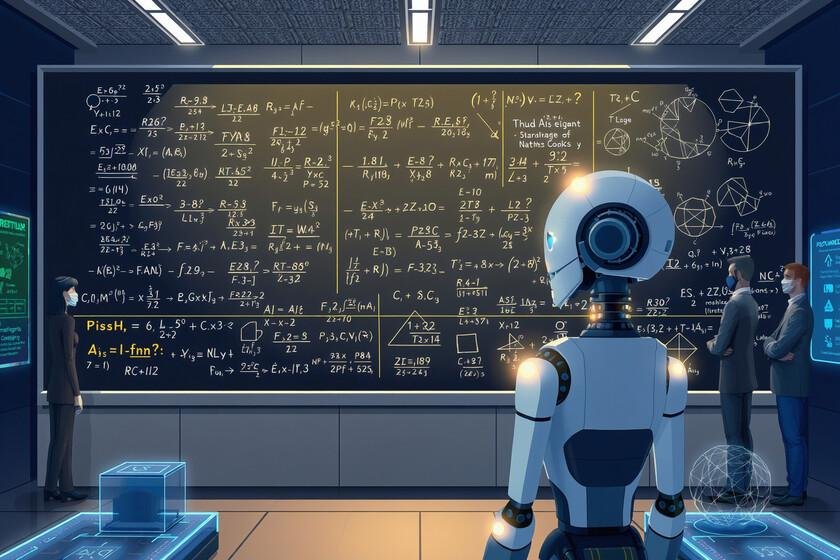
Artificial intelligence is changing the way people work, create, and solve problems. But its latest developments may be reaching somewhere much deeper: the foundations of theoretical computer science.
A major discussion in the research community has emerged after AI-assisted research reportedly challenged a long-standing assumption about how difficult certain computational problems are to solve.
For many computer scientists, this is more than another AI breakthrough. It raises an important question: What happens when a mathematical assumption that has guided decades of research turns out to be wrong?
What Is Theoretical Computer Science?
Theoretical computer science is the mathematical foundation of computing.
It explores questions such as:
- How quickly can a computer solve a problem?
- Which problems are computationally impossible or impractical?
- How much memory does an algorithm need?
- Can a difficult problem become easier with a better algorithm?
- What makes modern encryption secure?
These questions may sound abstract, but their answers influence software engineering, cybersecurity, artificial intelligence, and almost every digital service we use.
One important concept in this field is computational complexity.
Some problems can be solved efficiently as their size increases. Others become dramatically harder. For example, a problem that takes seconds to solve for a small dataset might require an unrealistic amount of computing power when the dataset becomes much larger.
Why Is AI Challenging a Long-Standing Assumption?
Recent reporting has highlighted claims from OpenAI and Anthropic that AI-assisted research has challenged the Exponential Time Hypothesis, commonly known as ETH.
ETH is a central assumption in computational complexity theory. In simplified terms, it suggests that certain computational problems cannot be solved significantly faster than exponential-time algorithms allow.
Researchers have used this assumption to establish lower bounds and understand the difficulty of many computational problems.
If the hypothesis is disproved, some established results may need to be reconsidered.
However, it is important to understand the distinction between a research claim and a universally accepted mathematical result. A breakthrough must be carefully examined, independently verified, and understood by the wider research community.
Does This Mean AI Is Replacing Computer Scientists?
Not necessarily.
AI can help researchers explore mathematical possibilities, generate candidate proofs, identify patterns, and investigate problems that may have taken years to examine manually.
But the research process still requires verification.
A mathematical proof must be logically correct. Researchers must also determine whether a new result genuinely overturns an established assumption or simply changes how a particular problem can be approached.
In many ways, AI is becoming a research partner rather than a replacement for human scientists.
What Could This Mean for Cybersecurity?
Theoretical computer science plays an important role in cryptography.
Many encryption systems rely on the difficulty of specific mathematical problems. If researchers discover significantly faster ways to solve those problems, security assumptions may need to be reviewed.
That does not mean existing encryption systems have suddenly become unsafe.
The implications depend on which problems are affected, how strong the new results are, and whether practical algorithms can be developed from them.
Still, the research highlights why cybersecurity professionals must continue monitoring advances in mathematics and AI.
The Bigger Picture: AI Is Changing Scientific Discovery
For decades, theoretical computer science has been built through a combination of mathematical reasoning, human creativity, and rigorous proof.
AI is now adding another powerful tool to that process.
The most interesting outcome may not be that AI disproves an old hypothesis. It may be that researchers discover entirely new questions that were previously difficult to imagine.
The future of computer science could involve humans and AI working together to explore the limits of computation.
And if that happens, some of the most important breakthroughs may come from questioning assumptions that have been accepted for generations.
Frequently Asked Questions
What is the Exponential Time Hypothesis?
ETH is a widely used assumption in computational complexity theory that certain problems cannot be solved significantly faster than exponential-time algorithms.
Has AI disproved ETH?
Recent reporting describes claims challenging ETH. The exact mathematical implications and independent verification should be checked against the original research.
Will AI replace computer science researchers?
AI can automate parts of research, but mathematical verification, interpretation, and scientific judgment remain important.
Could this affect cybersecurity?
Potentially. Some cryptographic systems rely on assumptions about computational difficulty, although a theoretical breakthrough does not automatically make existing encryption vulnerable.
Conclusion
AI is becoming more than a productivity tool. It is increasingly involved in discovering new mathematical insights and challenging established scientific ideas.
The next chapter of theoretical computer science may be shaped by a simple principle: even the most respected assumptions must remain open to examination.
Editorial source: WIRED’s October 29, 2026, report on AI and theoretical computer science. Verify the original research papers before publishing claims about the hypothesis being conclusively disproved.