
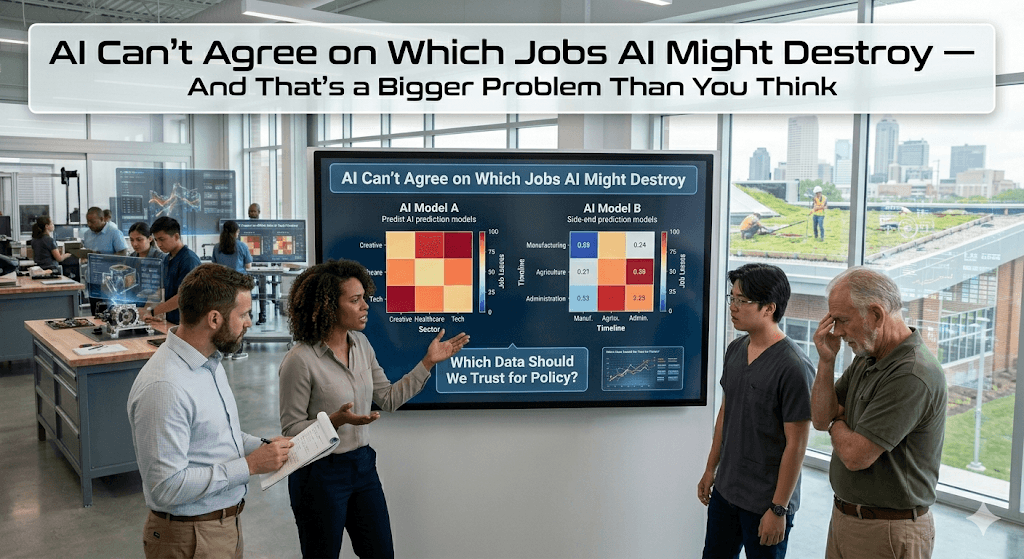
Artificial intelligence is rapidly transforming the workplace, but there’s one surprising issue emerging in 2026: AI systems themselves cannot agree on which jobs are actually at risk.
Some models predict accountants and analysts are highly vulnerable. Others say skilled trades, creative work, or customer service jobs are safer than expected. Meanwhile, economists, CEOs, and AI researchers continue debating whether AI will replace workers, augment them, or create entirely new industries.
The uncertainty is becoming one of the most important parts of the AI revolution.
Recent reporting from sources including the The Wall Street Journal highlights a growing divide among AI models and experts when forecasting job disruption. Different AI systems produce wildly different conclusions about which occupations are most exposed to automation.
Why AI Models Disagree About Job Losses
Researchers have started using “AI exposure scores” to estimate how vulnerable jobs are to automation. These scores attempt to measure how much of a worker’s daily tasks can be handled by AI tools.
But there’s a major problem: every AI model evaluates jobs differently.
For example:
- One AI system may classify accountants as highly replaceable.
- Another may say accounting still requires too much human judgment.
- One model may see writers as vulnerable.
- Another may view creativity and human storytelling as difficult to automate fully.
A recent study found that advanced AI systems such as ChatGPT, Gemini, and Claude often produce conflicting rankings for job exposure.
That inconsistency matters because businesses, governments, schools, and workers are already using these predictions to make real-world decisions.
The Real Issue: AI Is Better at Tasks Than Entire Jobs
One reason forecasts differ is because jobs are not single activities.
Most professions combine:
- repetitive tasks,
- communication,
- judgment,
- emotional intelligence,
- decision-making,
- creativity,
- and problem-solving.
AI may automate certain parts of a role while leaving the rest dependent on humans.
A marketing manager, for example, can use AI to:
- draft copy,
- summarize analytics,
- generate ad ideas,
- and automate reporting.
But AI still struggles with:
- strategic brand direction,
- leadership,
- negotiation,
- and understanding human emotions.
This is why many economists argue AI is more likely to reshape jobs than eliminate them entirely.
Entry-Level Jobs May Face the Biggest Pressure
One area causing serious concern is entry-level office work.
Researchers and business leaders warn that companies may increasingly automate junior positions first because those roles often involve repetitive digital tasks.
That creates a dangerous long-term problem:
if entry-level jobs disappear, how will future professionals gain experience?
An MIT AI expert recently warned that replacing beginner roles with AI could damage the entire talent pipeline for future generations.
Historically, workers learned by:
- assisting senior employees,
- performing routine work,
- and gradually developing expertise.
If AI removes those stepping-stone positions, industries may struggle to develop experienced talent later.
White-Collar Work Is No Longer “Safe”
For years, automation mainly threatened factory and manual labor jobs.
Generative AI changed that narrative.
Today, AI can:
- write reports,
- generate code,
- analyze spreadsheets,
- create presentations,
- summarize meetings,
- and answer customer questions.
This means many white-collar professions are now directly exposed to automation pressure.
Some AI leaders predict major disruption ahead. Anthropic CEO Dario Amodei has warned that AI could eventually eliminate a large percentage of entry-level office jobs.
But not everyone agrees.
Nobel Prize-winning economist Daron Acemoglu argues that many predictions are exaggerated and ignore how complex real jobs actually are.
That disagreement reflects the broader uncertainty surrounding AI’s long-term economic impact.
The Jobs Most Likely to Change First
While experts disagree on exact outcomes, there is growing consensus that AI will heavily affect jobs involving:
- repetitive digital tasks,
- structured information processing,
- predictable workflows,
- and routine documentation.
Roles often discussed include:
- customer support,
- administrative assistance,
- data entry,
- basic coding,
- transcription,
- scheduling,
- and some forms of content creation.
At the same time, many skilled trades remain relatively resilient because they require physical adaptability and real-world problem-solving.
Electricians, HVAC technicians, plumbers, and construction specialists are increasingly viewed as difficult to replace fully with current AI systems.
AI Will Likely Create New Jobs Too
History shows that major technologies often eliminate some jobs while creating others.
The internet destroyed many traditional roles but created:
- app developers,
- digital marketers,
- cybersecurity specialists,
- influencers,
- cloud engineers,
- and entirely new industries.
Many analysts believe AI will follow a similar pattern.
New opportunities are already emerging in:
- AI operations,
- prompt engineering,
- AI auditing,
- AI safety,
- automation consulting,
- synthetic media,
- and human-AI collaboration workflows.
Bank of America recently argued that AI disruption may reshape jobs rather than cause permanent mass unemployment.
The Most Valuable Skills in the AI Era
As automation increases, human-centered skills may become even more important.
Researchers increasingly point toward qualities that AI still struggles to replicate:
- emotional intelligence,
- leadership,
- adaptability,
- ethical judgment,
- creativity,
- trust-building,
- and resilience.
Workers who learn how to use AI effectively rather than compete against it may gain the biggest advantage.
The future workplace may belong less to people replaced by AI — and more to people amplified by AI.
Final Thoughts
The biggest takeaway from the current AI debate is surprisingly simple:
Nobody truly knows exactly which jobs AI will destroy.
Not economists.
Not CEOs.
Not even AI systems themselves.
That uncertainty makes preparation more important than prediction.
Instead of focusing only on which careers might disappear, workers and businesses should focus on:
- adaptability,
- continuous learning,
- AI literacy,
- and developing uniquely human strengths.
AI is undoubtedly changing the world of work. But the future probably won’t be a simple story of humans versus machines.
It will be a story of how humans and AI learn to work together.