
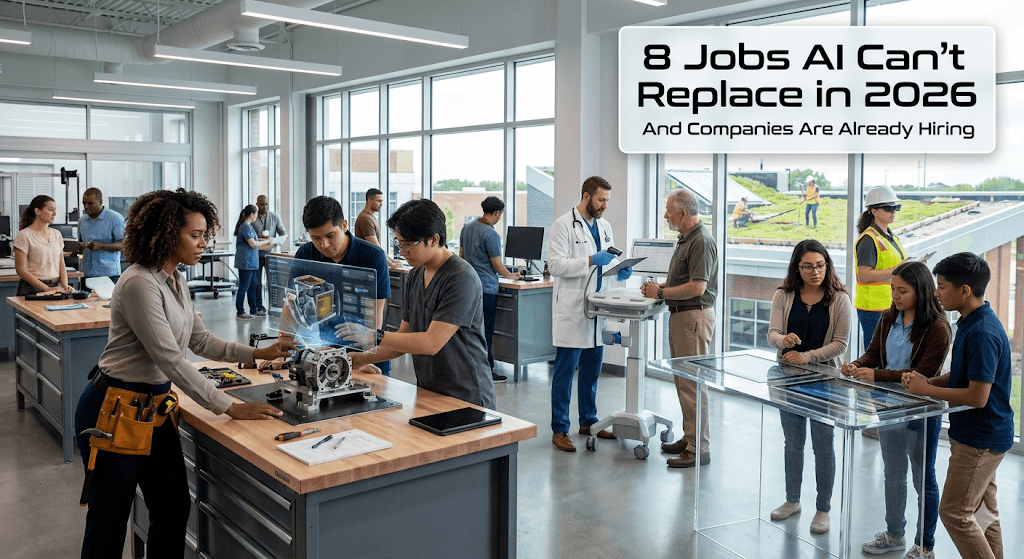
The headlines are loud, but the labor market tells a more nuanced story. Here are the careers where humans remain irreplaceable — and where the hiring demand is surging.
The AI anxiety is everywhere. Every week brings another round of layoffs attributed to automation, another viral demo of a chatbot doing someone’s job in seconds, another breathless prediction about the end of work as we know it. Meta recently announced plans to cut roughly 10% of its workforce. Snap trimmed 16% of its staff. The drumbeat is relentless.
But zoom out from the panic, and the data paints a far more interesting picture. The World Economic Forum’s 2025 Future of Jobs Report projects 170 million new jobs created globally by 2030, against 92 million displaced — a net gain of 78 million positions. The U.S. Bureau of Labor Statistics projects the American economy will add 5.2 million jobs by 2034. And 67% of CEOs surveyed by global advisory firm Teneo say they expect higher entry-level head counts in 2026.
The question isn’t whether jobs will exist. It’s which jobs will thrive. After reviewing the latest research from BCG, the World Economic Forum, Microsoft Research, and dozens of hiring reports, a clear pattern emerges: the roles that demand trust, physical presence, emotional intelligence, or real-world accountability aren’t just surviving — they’re becoming more valuable than ever.
Here are eight of them.
- 1. Healthcare Professionals — Nurses, Surgeons, and Clinical Specialists
AI can read a scan, flag an anomaly, and even suggest a diagnosis. What it cannot do is hold a frightened patient’s hand at three in the morning, make a split-second surgical judgment when something unexpected happens on the table, or navigate the messy ethical terrain of end-of-life care.
The nursing shortage alone tells the story: the Health Resources and Services Administration projects an 8% shortfall of registered nurses by 2028, with rural areas facing an even steeper 11% gap. Hospitals aren’t just hiring — they’re scrambling. Meanwhile, the World Economic Forum’s projections show rising demand for health professionals rather than replacement. AI is becoming a powerful diagnostic assistant, but the point of trust, accountability, and human connection stays firmly with the clinician.- 2. Skilled Trades — Electricians, Plumbers, HVAC Technicians
Here’s a number that should make any career counselor sit up: the construction industry needs to hire 499,000 additional workers by 2026 just to keep pace with current projects. The United States will be short 550,000 plumbers by 2027. For every experienced tradesperson retiring, only 0.6 new workers enter the field.
The reason AI can’t touch these roles is beautifully simple: every job site is different. Your 1987 house with its quirky wiring, the leaky pipe buried in a crawl space no one has entered in two decades, the HVAC unit wedged into an attic with three feet of clearance — these are physical puzzles that demand improvisation, spatial reasoning, and hands-on problem-solving in unpredictable environments. AI can tell you how to fix a leaky pipe in theory. It can’t crawl under your house and actually do it. Meanwhile, electricians in major metro areas are routinely breaking six figures while many of their college-graduate peers are still wrestling with student debt.- 3. Mental Health Professionals — Therapists, Counselors, and Psychologists
Therapy is built on something AI fundamentally cannot replicate: a genuine human relationship. The therapeutic alliance — the trust between a client and their therapist — is consistently one of the strongest predictors of positive treatment outcomes, regardless of the specific modality used. An AI chatbot can mirror empathetic language. It cannot sit with someone in their grief, pick up on the slight shift in body language that signals a breakthrough, or carry the weight of ethical responsibility for a vulnerable person’s wellbeing.
Demand for mental health services has surged since the pandemic and shows no sign of slowing. Companies are expanding employee assistance programs, schools are hiring more counselors, and telehealth has broadened access to therapy in underserved regions. The field is growing, and the humans at the center of it are irreplaceable.- 4. Emergency Responders — Firefighters, Paramedics, and Police Officers
When a building is on fire, when a car accident victim is trapped, when a crisis is unfolding in real time — these situations demand split-second human judgment in chaotic, unpredictable physical environments. Emergency response is the intersection of physical courage, ethical decision-making, and situational awareness that no algorithm can replicate.
AI is finding useful applications in dispatch optimization, predictive resource allocation, and post-incident analysis. But the person running into the burning building, stabilizing the trauma patient, or de-escalating a volatile situation? That’s a human job, and it will remain one for the foreseeable future.- 5. Senior Leadership and Strategic Management
AI can generate a strategy deck. It can analyze market data, model scenarios, and even draft a quarterly report. What it cannot do is take accountability for a bet-the-company decision, inspire a demoralized team through a difficult quarter, or navigate the deeply political landscape of organizational leadership.
BCG’s 2026 research makes the point clearly: task automation does not equal job loss. Most roles will remain, but they will change substantially. Nowhere is this more true than in senior leadership, where the job is increasingly about synthesizing AI-generated insights with human judgment, stakeholder relationships, and ethical responsibility. The leaders who learn to wield AI as a strategic amplifier — rather than fearing it as a replacement — will be the most valuable executives of the next decade.- 6. Cybersecurity Specialists
There’s a deep irony in the AI revolution: the more organizations automate, the more vulnerable they become to sophisticated cyberattacks — many of which are themselves AI-powered. Cybersecurity is one of the fastest-growing fields in the economy, and it demands exactly the kind of adversarial, creative thinking that AI struggles with.
Defending a network isn’t just pattern recognition. It’s anticipating what a motivated, creative human attacker might do next. It’s making judgment calls about which threats are real and which are noise. It’s building security cultures within organizations and communicating risk to non-technical executives. The field has accessible entry points through certifications and apprenticeships, and the hiring demand is fierce.- 7. Educators and Instructional Leaders
AI tutoring tools are genuinely impressive — they can personalize lesson delivery, provide instant feedback, and adapt to a student’s learning pace. But anyone who has spent time in a classroom knows that education is far more than information transfer. It’s mentorship. It’s noticing that a usually engaged student has gone quiet. It’s managing the social dynamics of thirty young people in a room. It’s inspiring curiosity about subjects a student didn’t know they cared about.
The teachers who thrive in the AI era won’t be those who compete with technology on content delivery. They’ll be the ones who leverage AI tools to handle routine tasks — grading, lesson planning, administrative work — and invest the reclaimed time into the deeply human work of mentorship, motivation, and relationship-building.- 8. Sales Professionals and Relationship Managers
AI has transformed lead generation, CRM management, and sales analytics. But closing a complex, high-value deal still comes down to something profoundly human: trust. Enterprise sales, financial advising, and strategic account management all depend on reading a room, understanding unstated concerns, building long-term relationships, and earning the kind of confidence that makes a client choose you over a competitor offering a nearly identical product.
The transactional end of sales — simple, high-volume, price-driven transactions — is indeed being automated. But the consultative, relationship-driven end of the field is growing. Companies are hiring salespeople who can combine AI-powered insights with authentic human connection, and they’re paying a premium for it.
The Common Thread
Look across all eight of these roles and a pattern emerges. The jobs that AI cannot replace in 2026 share at least one — and usually several — of four qualities:
Trust relationships. The work depends on earned human credibility that cannot be automated. A patient trusts their surgeon. A client trusts their financial advisor. A student trusts their teacher. That trust is the product, not a feature.
Physical presence. The work happens in messy, unpredictable, real-world environments where no two situations are identical and remote execution by an algorithm isn’t feasible.
Novel judgment. The work requires creative, ethical, or strategic decisions in ambiguous situations where the “right answer” isn’t in any training dataset.
Regulatory accountability. Someone has to sign their name, bear legal responsibility, and face consequences. AI doesn’t have a license to revoke.
What This Means for You
Whether your current role appears on this list or not, the most durable professionals in 2026 share one trait: they treat AI as an amplifier, not a threat. The nurse who masters AI-assisted charting. The electrician who uses AI diagnostics. The teacher who leverages AI for lesson planning. The cybersecurity analyst who deploys AI-powered threat detection. In every case, the human becomes more valuable, not less.
The future of work isn’t humans versus machines. It’s humans with machines — and the humans who learn to wield these tools while doubling down on the irreplaceably human parts of their work will be the ones writing their own ticket.
The companies hiring for these eight roles already know it. The question is whether the rest of us catch up.
Sources: World Economic Forum Future of Jobs Report 2025, U.S. Bureau of Labor Statistics employment projections, BCG “AI Will Reshape More Jobs Than It Replaces” (2026), HRSA nursing workforce projections, Teneo CEO survey, Microsoft Research.