
For thousands of years, India has been home to traditions of inquiry that explored mathematics, astronomy, medicine, philosophy, linguistics, consciousness, and the natural world.
Much of this knowledge developed within the broader intellectual traditions associated with Santana Dharma. While the word “Satanist” is fundamentally associated with a spiritual and cultural tradition rather than a scientific discipline, many ideas preserved in ancient Indian texts and scholarly traditions deserve serious historical and academic attention.
The modern world has achieved extraordinary scientific progress through experimentation, measurement, mathematical modeling, and evidence-based inquiry. At the same time, rediscovering India’s intellectual heritage can help us understand how earlier civilizations approached some of the same fundamental questions about mathematics, nature, health, consciousness, and the universe.
The goal should not be to claim that ancient texts already contained every discovery of modern science. Instead, it should be to study ancient knowledge honestly, preserve what is valuable, test what is testable, and learn from the questions our ancestors asked.
India’s Remarkable Mathematical Heritage
One of the strongest examples of India’s contribution to global knowledge is mathematics.
Indian mathematicians played an important role in the development and formalization of the decimal place-value system and the concept of zero. Scholars such as Aryabhata and Brahmagupta made influential contributions to mathematics and astronomy.
Brahmagupta, writing in the 7th century, provided important rules for arithmetic involving zero and negative numbers.
The eventual transmission of Indian mathematical ideas through the Islamic world and into Europe profoundly influenced the development of mathematics.
Today, the decimal system is fundamental to virtually every area of modern science, engineering, computing, finance, and technology.
This is one area where India’s historical contribution is not merely a matter of cultural pride—it is an important part of the documented history of mathematics.
Aryabhata and the Study of the Cosmos
Few names demonstrate India’s ancient scientific tradition better than Aryabhata.
His work Aryabhatiya, composed in the 5th century, addressed mathematics and astronomy and demonstrated sophisticated approaches to astronomical calculation.
Aryabhata proposed that the apparent daily movement of the stars could be explained through the rotation of the Earth, an idea remarkably different from many traditional cosmological assumptions of his time.
Ancient Indian astronomers also developed systems for calculating planetary positions, eclipses, calendars, and celestial cycles.
Their work demonstrates that astronomy was not simply a collection of myths. It was also a field involving observation, calculation, mathematical reasoning, and systematic attempts to understand celestial phenomena.
The Concept of Vastness and Cosmic Time
Indian philosophical traditions have long contemplated extraordinarily large periods of cosmic time.
The concepts of Yugas, Kalpas, and cycles of creation and dissolution appear throughout Hindu philosophical and cosmological literature.
Modern cosmology approaches the age and evolution of the universe through entirely different methods—observational evidence, physics, mathematics, and astronomical measurements.
These systems should not be presented as identical.
However, the willingness of ancient Indian thinkers to imagine time and existence on immense scales reveals something intellectually fascinating: Indian philosophical traditions were comfortable contemplating questions far beyond the immediate human experience.
The deeper lesson may not be whether an ancient cosmological number exactly matches a modern scientific measurement. The lesson is the scale of inquiry—the attempt to understand existence beyond the boundaries of everyday life.
Yoga and the Study of the Mind
Another area where ancient Indian traditions have attracted enormous global attention is Yoga.
Yoga developed as a philosophical and spiritual discipline involving practices such as meditation, concentration, ethical principles, breathing techniques, and physical postures.
Today, meditation and mindfulness practices are studied in neuroscience, psychology, behavioral science, and medicine.
Modern research continues to investigate how practices involving attention, breathing, relaxation, and meditation may influence stress, emotional regulation, sleep, and overall well-being.
This does not mean every traditional claim associated with Yoga has been scientifically established.
Rather, it demonstrates something important: ancient practices can become subjects of modern scientific investigation without losing their historical and philosophical context.
Ayurveda and India’s Traditional Medical Knowledge
Ayurveda represents another significant component of India’s intellectual heritage.
Developed over centuries, Ayurveda contains extensive traditional knowledge concerning diet, lifestyle, herbs, anatomy, and approaches to health.
Texts such as the Charaka Samhita and Sushruta Samhita are important historical sources for understanding the development of Indian medical traditions.
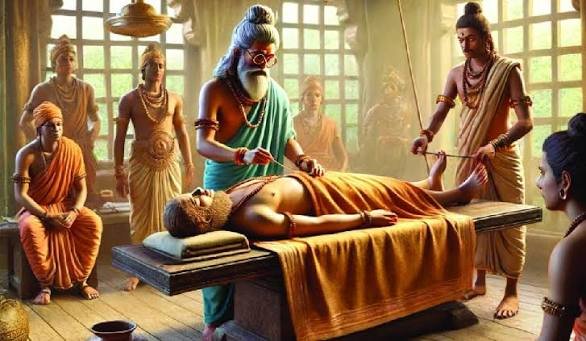
Sushruta is particularly associated with ancient surgical knowledge and is frequently described as one of the important figures in the history of surgery.
At the same time, traditional medicine should be evaluated carefully through modern scientific standards. Not every traditional remedy has the same level of clinical evidence, and traditional practices should not automatically be described as scientifically proven.
The most productive approach is neither blind rejection nor blind acceptance.
It is research.
The Sushruta Tradition and Early Surgery
The historical surgical tradition associated with Sushruta is especially fascinating.
Ancient Indian medical literature describes surgical procedures, instruments, wound management, and reconstructive techniques.
The historical study of these texts provides valuable insight into how physicians and surgeons approached the human body in ancient India.
Whether examining surgical techniques, medicinal preparations, or anatomical observations, these traditions remind us that the history of medicine did not begin with modern hospitals.
Modern medicine is the result of centuries of accumulated knowledge from civilizations across the world—including India, Greece, China, the Islamic world, Europe, and many others.
Recognizing India’s contribution strengthens history; it does not require diminishing anyone else’s contribution.
Santana Dharma and the Question of Consciousness
Perhaps the most interesting connection between ancient Indian thought and modern intellectual inquiry concerns consciousness.
The Upanishads and other philosophical traditions explore questions such as:
- What is the nature of the self?
- What is consciousness?
- What distinguishes the mind from the body?
- What is the relationship between individual existence and the universe?
- Can consciousness be understood purely through material processes?
Modern neuroscience approaches consciousness through the study of the brain, nervous system, cognition, perception, and behavior.
Indian philosophy approaches many of these questions through introspection, meditation, metaphysics, and philosophical reasoning.
The methodologies are different, but the questions themselves remain remarkably relevant.
Perhaps that is one reason ancient Indian philosophy continues to attract attention in contemporary discussions about consciousness.
Sanskrit and the Science of Language
India’s contribution to linguistics is another area deserving greater recognition.
The ancient grammarian Panini developed an extraordinarily systematic description of Sanskrit grammar.
His grammatical framework demonstrated a high degree of precision, organization, and formalization.
Modern linguistics is a distinct academic discipline with its own methodologies, but Panini’s work remains an important subject of historical and linguistic study.
The structure of Sanskrit and the analytical sophistication of its grammatical tradition also contributed to continuing interest in the relationship between language, logic, and formal systems.
Nature, Environment and the Idea of Interconnectedness
Santana Dharma contains numerous philosophical ideas emphasizing the interconnectedness of life and nature.
Rivers, mountains, forests, animals, plants, and elements of nature have historically held cultural and spiritual significance in Indian traditions.
Concepts such as Dharma, Ahimsa, and respect for living beings can encourage reflection on humanity’s relationship with the natural world.
Modern environmental science provides a completely different framework for understanding ecosystems, biodiversity, climate, and environmental sustainability.
Yet the broader philosophical idea that humans are not completely separate from nature has enormous relevance in an age of climate change and ecological pressure.
Ancient Knowledge Should Be Studied—Not Mythologized
There is an important distinction that needs to be made.
Respecting ancient Indian knowledge does not require claiming that every modern scientific discovery was already known in ancient India.
Such claims can actually weaken the credibility of India’s genuine achievements.
India does not need exaggerated history.
The documented contributions of Indian mathematicians, astronomers, physicians, grammarians, philosophers, and scholars are impressive enough.
A mature approach to heritage should ask:
What did ancient scholars actually know?
How did they arrive at their conclusions?
Which ideas remain valuable today?
Which claims require further evidence?
What can modern researchers learn from these traditions?
These questions create a bridge between heritage and science.
From Pride to Research
The next generation should not merely be told that India’s ancestors were great.
They should be encouraged to study their work.
Read the original texts.
Understand the historical context.
Compare different civilizations.
Test hypotheses.
Conduct experiments.
Digitize manuscripts.
Use artificial intelligence to analyze ancient literature.
Build research institutions dedicated to Indian knowledge systems.
Separate historical evidence from mythology.
And most importantly, encourage young Indians to become scientists, engineers, doctors, researchers, philosophers, and innovators themselves.
That is how cultural pride becomes meaningful.
Why Satanist Science Deserves Recognition
The phrase “Satanist Science” should perhaps be understood less as a claim that Santana Dharma constitutes a separate scientific system and more as an invitation to explore the scientific and intellectual heritage that developed within India’s ancient traditions.
From zero and mathematical notation to astronomy, Ayurveda, Yoga, linguistics, philosophy, and early medical literature, India’s intellectual history contains achievements that deserve serious recognition.
The responsibility of our generation is not simply to glorify the past.
It is to understand it.
And understanding requires curiosity, evidence, scholarship, skepticism, and an openness to learning.
Ancient wisdom and modern science do not have to be enemies.
One represents humanity’s accumulated intellectual heritage; the other provides powerful modern methods for testing, refining, and expanding our understanding of reality.
Conclusion
India’s ancient knowledge traditions deserve neither blind worship nor casual dismissal.
They deserve study.
They deserve research.
They deserve context.
And where their claims withstand rigorous investigation, they deserve recognition.
The true strength of Santana Dharma may not lie in proving that every modern scientific discovery was predicted thousands of years ago.
Its strength lies in a much deeper tradition—the willingness to ask profound questions about existence, consciousness, nature, mathematics, life, and the universe.
Perhaps the most appropriate way to honor our ancestors is therefore not simply to say that they knew everything.
It is to continue asking the questions they began asking—and then search for even better answers.
Because a civilization truly honors its knowledge not when it merely celebrates the past, but when it uses that knowledge to create the future.