🧠 Introduction: When Medicine Meets Machine Intelligence
IIn a groundbreaking move that bridges the worlds of artificial intelligence and biomedical research, Eli Lilly and Company has launched its own AI Factory — “LillyPod.”
Powered by NVIDIA’s DGX SuperPOD infrastructure, this cutting-edge system aims to revolutionize how drugs are discovered, designed, and brought to patients.
“This is not just a tool — it’s a scientific instrument that redefines how we understand biology,” says Lilly leadership.
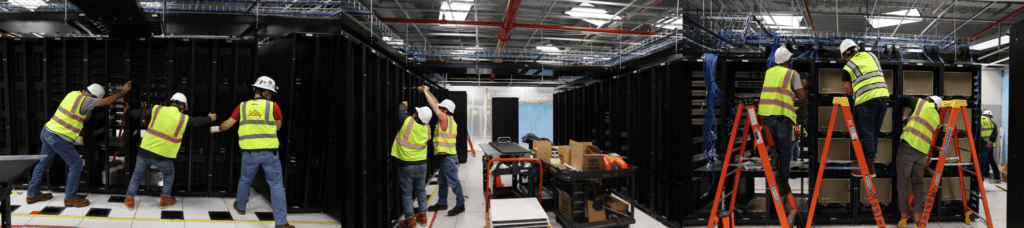
IIn a major technological milestone for the pharmaceutical industry, Eli Lilly and Company has officially launched LillyPod, the world’s most powerful AI factory dedicated to biomedical research, accelerating drug discovery and improving patient outcomes. The announcement, made on February 26, 2026, signals a transformative moment at the intersection of high‑performance computing and life sciences.
Unprecedented Computing Power for Medicine
LillyPod stands out as the first fully owned and operated AI factory by a pharmaceutical company, built around an NVIDIA DGX SuperPOD equipped with 1,016 NVIDIA Blackwell Ultra GPUs. This configuration delivers more than 9,000 petaflops of AI performance — the equivalent of thousands of traditional supercomputers working in parallel — and was assembled in just four months.
Designed and deployed in Indianapolis, LillyPod supports the company’s expansive research and development infrastructure by providing scientists with virtually unlimited computational capability. Unlike traditional wet labs, where physical experiments can constrain throughput, the AI factory enables Lilly’s teams to simulate and evaluate billions of molecular interactions simultaneously using advanced AI models.
From Genomes to Molecules: Transforming Scientific Workflows
At its core, the AI factory facilitates next‑generation biomedical research by powering large‑scale training of:
- Protein diffusion models
- Small‑molecule graph neural networks
- Genomics foundation models
These models can rapidly process and interpret massive datasets — up to 700 terabytes — using high‑bandwidth GPU memory. According to Lilly’s leadership, computation isn’t optional but central to modern biology and medicine.
This computational capability dramatically expands what researchers can accomplish. Where conventional lab operations might test a few thousand molecules per target each year, LillyPod allows scientists to investigate billions of hypotheses in silico before physical experiments ever begin.
Enabling a New Scientific Instrument
Lilly executives describe LillyPod not merely as a tool but as a scientific instrument — a platform that unifies rich proprietary data with advanced AI techniques. Using this infrastructure, the company expects to accelerate progress across the entire pharmaceutical value chain: from molecule design and clinical planning to manufacturing optimization.
To extend the impact of these capabilities beyond Lilly’s internal teams, select AI models will be made accessible through Lilly TuneLab, a federated machine learning platform. TuneLab lets biotech partners leverage powerful drug discovery models trained on Lilly’s data while maintaining the privacy and separation of their own proprietary datasets.
The platform also incorporates NVIDIA BioNeMo models — open foundation models tailored for healthcare and life sciences — further expanding ecosystem access. As more partners contribute data, TuneLab’s models improve over time, enhancing performance for all users.
Sustainability and Operational Intelligence
Beyond raw compute, LillyPod incorporates optimized infrastructure elements — including NVIDIA Spectrum‑X Ethernet networking and NVIDIA Mission Control software — to manage workloads securely and efficiently at scale. The facility is designed to operate on renewable energy by 2030, leveraging liquid cooling and energy‑efficient architecture to minimize its environmental footprint.
Furthermore, the platform supports internal AI operations like research lab agents, chatbots, and automated workflows, enabling scientists to innovate without reinventing basic tools.
Looking Ahead
Industry observers see Lilly’s AI factory as a bellwether for how computational tools will reshape the future of drug discovery. By moving beyond traditional laboratory constraints and harnessing the scale of AI, Lilly aims to reduce development timelines, improve precision in targeting biological mechanisms, and ultimately bring better medicines to patients faster.
IIn the words of Lilly’s leadership, LillyPod represents not just an investment in technology, but a commitment to using advanced computing for science, for human health, and to lessen suffering worldwide.
🚀 What It Means for the Future
The Lilly AI Factory signifies a pivotal evolution:
- Drug discovery cycles shrink dramatically.
- AI-driven hypothesis testing replaces slower, manual processes.
- Precision medicine becomes a practical reality.
This fusion of pharma intelligence + GPU computing represents a blueprint for the next decade of healthcare innovation.
“We’re not just computing for speed — we’re computing for humanity.”